
Gastro-Vision: In the Land of Plenty
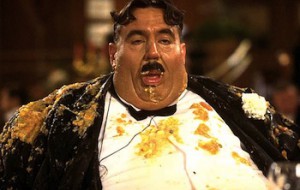
Mr. Creosote, the morbidly obese character of the 1983 comedy Monty Python’s The Meaning of Life, is a picture of gluttony never to be forgotten. Upon taking his seat in a fancy French restaurant, he begins to vomit, showing no concern for the people around him and the dreadfulness of his action. Throughout the skit he continues to project ridiculously large streams of matter onto the floor, into buckets, on the maître d’, cleaning woman, and himself. Between upchucks, he heedlessly orders and consumes copious amounts of food. In a darkly humorous ending, the character explodes, showering the restaurant and its patrons with human viscera. The camera pans back to Mr. Creosote, who is now a hollow carcass with a still-beating heart. The maître d’ presents him with the check.
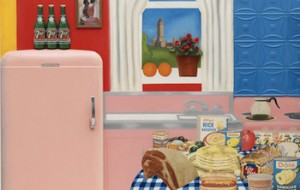
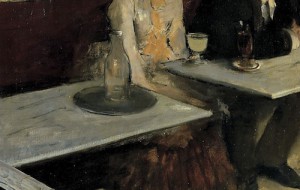
The same year that audiences were introduced to Mr. Creosote, the art world was entering a period of phenomenal excess. The wealth enjoyed by upper and middle class Americans in the early 1980s brought about rapid growth in the art market. The resulting bubble would, like Mr. Creosote, eventually burst. At the present moment, we are acutely aware of this bulimic pattern: after the buying binge of recent years, the market (along with the larger economy) again purged, and given the latest art fair reports, is back on the rise. Might Mr. Creosote be the perfect metaphor for the contemporary art world that is always hungry for more?
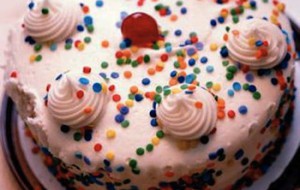
Gluttony in art consumption and our craving for new things was at the center of a provocative panel discussion held earlier this month at The Independent art fair. As one of the seven deadly sins of Christianity, gluttony is of course loaded with notions of repulsive and immoral behavior. It suggests hedonism in food and drink while denying it to those less fortunate and in need. Of course, this idea is not universal. Gluttony can also be a sign of status, wealth, or desire unburdened by beliefs and moral principles. Panelists of “On Gluttony” expressed the full gamut of interpretations. Organized by Kreemart Salon (the group responsible for Haunch of Venison’s New York Cake Party), the program featured painter Will Cotton, food artist Jennifer Rubell, Rachel Lehmann of Lehmann Maupin Gallery, art advisor Raphael Castoriano, and art journalists Anthony Haden-Guest and Linda Yablonsky.
Gastro-Vision: Stomachache

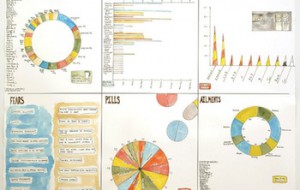
Christina Mazzalupo, "Countdown: Week 1," 2009. Ink and watercolor on paper, 22 1/2 x 30 in. Courtesy Mixed Greens.
Food diaries — daily records of everything one eats and drinks — are strange and fascinating objects. For nutritionists and dietitians, they are useful tools in determining a person’s eating habits and caloric intake. Taken out of a medical context, however, a blow-by-blow report of one’s ingestion seems trivial and neurotic. I’ll admit that I’ve kept my own food diary off and on over the years, repeatedly tucking it away once it became too tedious a task. When I stumbled upon one of my old journals a few years ago, I made a startling discovery: in logging teaspoons, cups, ounces and calories I had sketched a picture of my subconscious self. Bits and pieces of my life that were before unclear were laid out in my diet and notes. I was reminded of this epiphanic moment when I saw a new body of work by artist Christina Mazzalupo that takes her food diary as its starting point.
Since 2004, alternative healthcare practitioners have suggested Mazzalupo keep daily journals listing her food intake and bodily symptoms. For her exhibition Stomachache, now on view at Mixed Greens Gallery in New York, she has translated that documentation into eight drawings, one for every week leading up to her milestone 40th birthday.
If I was doubtful about the visual interestingness of this monotonous premise, I quickly forgot and was totally enthralled by Mazzalupo’s delicate ink and watercolor works on paper. Never has a food diary possessed the charm of a children’s coloring book and the density of a Mark Lombardi diagram. In addition to food and nutritional supplements, Mazzalupo has charted her medications, ailments, feelings, and journeys to reveal an extremely and sometimes uncomfortably personal memoir. Continue reading »
The Fruit of Experience
Fallen Fruit Collective formed six years ago through a project by artists David Burns, Matias Viegener, and Austin Young for the Journal of Aesthetics and Protest. The trio created a street-by-street diagram of fruit trees growing on or over public property in their Silver Lake neighborhood of Los Angeles. While the city boasts bananas, peaches, avocados, lemons, oranges, kumquats, plums, pomegranates, and other fruits growing year-round, this bounty is not always shared. Mapping “public fruit” was a way to approach food resource and accessibility concerns in urban space. From the beginning, Fallen Fruit urged city officials, urban planning groups, and property owners to plant with the goal of yielding edible goods for the local populace. You might call Burns, Viegener, and Young the locavores of contemporary art.
Next month, Fallen Fruit will launch EATLACMA, a year-long investigation into food, art, culture, and politics at the Los Angeles County Museum of Art. Their ambitious plan consists of an exhibition culled from the museum’s collection; a newly commissioned work; seven curated artist gardens on the museum campus; two fruit tree giveaways; a participatory YouTube project; and Let Them Eat LACMA, a day of public performance and engagement involving over fifty artists and collectives. EATLACMA grew out of Fallen Fruit’s participation in a program at the museum in 2008 (organized by Machine Project), for which they mapped fruit in the permanent collection and designed thematic tours. In a recent interview, Burns explained this way of looking at the history of art:
“When you start organizing painting or history by looking at the subject/object/symbol of fruit, it’s really fascinating the way it collapses art. People put so much importance on the stroke, which is valid, and in what Impressionism [for instance] means, but forget that the reason [an artist] is painting oranges is because they’re colorful. Or you go back a hundred years and Dutch painters are painting them because they’re exotic, expensive, and oranges do not grow in Northern Europe. It’s a luxury item that is only possible because of shipping industries and world trade.”
In EATLACMA, depictions of fruit serve to connect the museum’s holdings in a whole new way and shed light on food in the history of human contact. (Burns informed me that fruit exists in the history of art more than any other food.) But it is living fruit that Burns, Viegener, and Young use to connect people today.
Gastro-Vision: The Year in Meat

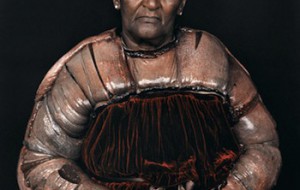
Pinar Yolacan, "Untitled (PYM4.22)," 2007, C-print, 40" x 30", edition of 6. Courtesy the Artist (via Rivington Arms).
Last year’s group exhibition Meat After Meat Joy at Daneyal Mahmood Gallery left a lasting impression on me — I still can’t shake the suffocating, putrid smell of rotting meat. As a vegetarian, I suppose my preexisting sensitivity to the content played a role in that. Be that as it may, the exhibition (a truly good show) has made me especially cognizant of all things meat this year, and there were quite a few of them. Here’s a look back at some meaty moments in 2009:
Dressed with Kill
Whereas Pinar Yolacan’s work could easily have gone unnoticed in the aforementioned exhibition, her presence was felt this year in Dress Codes, the third triennial of the International Center of Photography. Her portraits of Afro-Brazilian women were highlights of an all around impressive installation of photographs and video. Stitching together sumptuous velvets and silks with slimy gizzards and chunks of animal protein, her costumes appeared to drip from and restrain her sitters. Vile and picturesque, slaughtered and oddly seamless, her compositions give new meaning to “raw beauty.”

"Spiral Jetty Burger," The Laundromat Gallery, 2009. Caption: "Sadly, the Robert Smithson, by Jonathan Allmaier was less Spiral Jetty and more Paul McCarthy meets Andres Serrano. It was, nonetheless, very good.” Courtesy C-Monster.net.
Burgers en Masse
Epicurious predicts that burgers will be on the back burner in 2010, though they were haute (in art) in 2009. In August, C-Monster (once a guest blogger of Art21) captured The ‘Burger’ Group Show at The Laundromat Gallery. For this conceptual cookout artists grilled homages to Roberts Smithson and Motherwell; a high-rising whopper for Rachel Harrison; and a couple of Spanish masterpieces (with blue cheese) among other beefy works. I can’t say I would have partaken in this eat-zibit, but after scrolling through these masterful creations, seitan looked awfully boring.

Bruce High Quality Foundation, "Die Burger" (detail), 2009. Courtesy Eat Me Daily. Photo: Elizabeth Jones/Eat Me Daily.
At Art Basel Miami Beach, Eat Me Daily caught wind of the Bruce High Quality Foundation installation Die Burger: a modified video of Warhol eating sliders, and a display of Beuysian mac multiples with meat patties made of felt, cheese slices of lard, and real Burger King buns. On that note:
Antidiets of the Avant-Garde

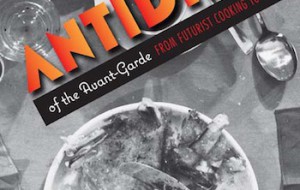
"Antidiets of the Avant-Garde: From Futurist Cooking to Eat Art" cover art. University of Minnesota Press, 2010.
Some 30 years after the Italian poet and founder of the Futurist movement Filippo Tommaso Marinetti wrote The Futurist Cookbook (1932) and proposed a revolution in food, the European avant-garde artist Daniel Spoerri, who is closely associated with the Fluxus art movement, opened Restaurant de la Galerie J in Paris, a fully functional business with waiters from the art world. Four years later, in 1967, he opened Restaurant Spoerri in Dusseldorf, featuring guest chefs such as artist Joseph Beuys; and in 1970, established his now famous Eat Art Gallery upstairs.
Two recent events have brought attention to these landmark moments in food-art history: the Futurist theme of the 18-day performance biennial Performa 09, which, among other events, kicked off with a gala dinner based on Marinetti’s writings; and Eating the Universe, the Kunsthalle Dusseldorf’s latest exhibition, which traces the character of Spoerri’s Eat Art projects from its origins through to today. It seems the perfect moment, then, for Cecilia Novero’s new book, Antidiets of the Avant-garde: From Futurist Cooking to Eat Art, due out in January.
Novero, a professor in the Department of Languages and Cultures at the University of Otago in New Zealand, has written extensively on the cultural history of food, German and European film, Dada, Viennese Actionism, and most recently contemporary “animal art.” Below, she gives a glimpse into her forthcoming book, in which she focuses on the connections between avant-garde studies and the culinary field in 20th- and 21st-century artistic production.
The following excerpts are taken from an interview conducted via email.

Marinetti eating pasta at Milan's Biffi restaurant, 1930. Courtesy Estorick Collection, via Cabinet Magazine.
Nicole J. Caruth: How do you define “antidiet”? Is it synonymous with the rejection of “taste” in art (i.e. anti-taste) or related to the French idea of dégoût/disgust?
Cecilia Novero: Antidiet is not always dégoût–that would work with Dada but not with Futurism. Antidiet is meant in the sense of anti-art, without being a synonym of it. If diet is a set of regulations that orders ways of eating, table manners, etc., the anti-diet counters these “bourgeois” and “Western” rules. For example, the ways in which we take pleasure, appreciate what is considered/constructed as the beautiful, and especially the ways we “taste” art and thus stop thinking about inherited concepts of beauty. In the avant-garde and neo-avant-garde, anti-diet also refers to acquired notions of “progress,” hence traditional historicist approaches to art and civilization.
NJC: What are some of the topics and sub-topics covered in your book?
CN: Antidiets deals with Futurist cooking, Dada poetry and manifestos, the culture critic Walter Benjamin’s writing on food, travel and art, and the European artist Daniel Spoerri and his Eat Art Project, which involved many others (mostly those artists known as Nouveaux Realists in France, but also others such as Robert Filliou, Dieter Roth, Andre Thomkins and, marginally, Piero Manzoni). The epilogue briefly traces the differences in aesthetics between this anti-art of food and more contemporary examples of food in/through art, including Janine Antoni, Ben Kinmont, Rikrit Tiravanija, and Jana Sterbak.
The first chapter, like the last, is devoted to the more direct employment of food in art, namely to the Manifesto of Futurist Cooking (1930), The Futurist Cookbook, and the Futurist restaurant, The Holy Palate (both 1931). In contrast, in Chapter Two on Dada (particularly the Dadaist artists in Zurich), and Three on Benjamin’s short texts on eating, the reader finds a rhetorical and performative use of incorporation [a term used by the author interchangeably with "devouring"]. One of the major suggestions of this study is that the antidiets, not just Spoerri’s, but also those of Futurism, Dada, and Benjamin, transformed some of the gastronomic principles of pleasure, taste, assimilation, and digestibility, as well as history, and mobilized those principles for a redefinition of art and the subject. Continue reading »
Gastro-Vision: Breaking Bread

John Baldessari, "Yours in Food" book jacket image. Princeton Architectural Press, 2004.
Gastro-Vision is a new monthly column dedicated to all things food in contemporary art and visual culture. This month’s post also falls under the Flash Points topic, Systems.
Yours in Food — by Season 5 artist John Baldessari — had, like many other books, been on my Amazon wish list for a couple of years. When I stumbled upon a used copy at Biography Bookshop in Manhattan (note: across the street from Magnolia Bakery) this summer, what had before appeared fun and frivolous seemed a requisite purchase.
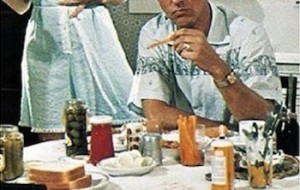
Flipping through, I found provocative images of food, dinner tables and eaters, appropriated from film and video as is characteristic of Baldessari’s work. A group of young men wearing overalls and plaid shirts seated for a meal of mashed potatoes, milk and other ostensibly hearty foods suggests a rural working class family. The face at the head of the table is covered by one of Baldessari’s signature colored dots. In other images, a banquet table procession of porcelain dishware and brass candelabras, flanked by women in sequin dresses and pearls, speaks to high society. A picture of stainless steel cafeteria trays and husky men in denim blue shirts hints at a prison scene. Baldessari inserts his hand again in a candid black-and-white shot of a lodge-like dining scene; a series of white circles obscure the faces of white males, suggesting homogeny and self-segregation. On the book jacket (above), jarred pickles and olives, ketchup, a stack of white bread, and what resembles a can of Cheez Whiz, call to mind the all-American pantry. Between these vignettes, Paul Auster, Peter Schjeldahl, David Bryne, Lynne Tilman, Tim Griffin and other notable writers share tales of love, loss and toast; poverty and onion pie; Thanksgiving gluttony; and other reflections on “taste.” Yours in Food is, on the whole, a study of the shared meal, or “breaking bread.”

"Don't Perish" Dinner #3. Courtesy Joseph Montgomery and Jesse Willenbring.

"Don't Perish" Dinner #3. Courtesy Joseph Montgomery and Jesse Willenbring.
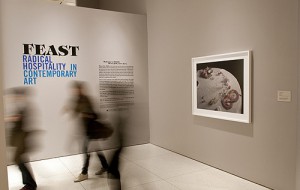
“The act of sharing food and drink with others is…an enduring source of aesthetic inspiration,” writes Stephanie Smith, curator of the forthcoming exhibition Feast: Radical Hospitality and Contemporary Art, “Today, the shared meal has become a compelling artistic medium.” Every so often it also inspires a whole curatorial thesis. For the exhibition Don’t Perish, recently at Leo Koenig Inc. Projekte in Manhattan, curators (and practicing artists) Joseph Montgomery and Jesse Willenbring invited friends and strangers to look at work with them “over a meal.” This group show, dinner series, and food-drive in one–an alternative to passive viewing–involved nine potlucks at the gallery spread out over four weeks. Similar to Baldessari, Montgomery and Willenbring demonstrate how the shared meal is itself a system, or paradigm by which to engage viewers in a concept and body of work. Montgomery says:
We had anywhere from 15 to 30 people per night. Tuesday nights were very crowded. Saturday nights on the smaller side. Conversations changed the work…Everything was not original; conversations were repeated [and] similar dishes cooked, but the act of being there again and again brought strength and endurance to the show…All the smoke, smells, looking, colors, breath, and words were absorbed, polished into the art, tables and shelves.
Gastro-Vision: Art of the Pub

Yara El-Sherbini, "A Pub Quiz," 2009. Live art, duration: 60 minutes. Performance at Fiddlesticks Pub, NY. Courtesy the Artist and Lombard-Freid Projects
Gastro-Vision is a new monthly column dedicated to all things food in contemporary art and visual culture.
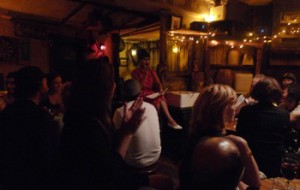
Yara El-Sherbini has used pubs as a site for her work for the past three years. In the U.K., where the artist is based, pub quizzes, or trivia nights are enormously popular. (According to Wikipedia, it has been estimated that more than 22,000 regular quizzes take place across the country every week.) In short, the game requires groups of roughly six to ten people to form teams. The evening quizmaster poses a series of questions, which are broken into rounds, and teams respond using a provided answer sheet. The results are scored, and the team with the highest count is usually awarded a prize. El-Sherbini has adopted this interactive entertainment format for her performance, A Pub Quiz, which she staged in the United States for the first time earlier this month.
Finger food spread at Fiddlesticks Pub, NY. Photo: N. Caruth
Gastro-Vision: Aesthetics of Urban Farming, Part II

Atom Cianfarani, Sketch for "Welcomed Guests," 2009. Courtesy of the artist.
I closed Part 1 of this post with an e-mail from Truck Farmers Curt Ellis and Ian Cheney in which they encouraged others to reclaim unused open spaces in New York City.
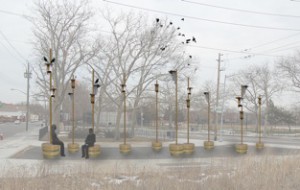
Reclamation is central to the work of Brooklyn-based green artist/designer Atom Cianfarani who says, to paraphrase, that sustainable, recyclable designs can be beautiful, but few artists push it that far. (If you’re familiar with Brooklyn, Cianfarani helped to design the popular eco-eatery Habana Outpost in Fort Greene.) Later this week, DOT Urban Art Commission will host a ribbon-cutting ceremony for Cianfarani’s new public sculpture, Welcomed Guests, located across the street from Brooklyn’s Added Value/Red Hook Farm. (The 2.75 acre urban farm has provided space to stage and produce the sculpture). Sponsored by DOT and the Lower East Side Ecology Center, the piece consists of ten poles set in place by retired wine barrels from local vineyard & winery, Castello di Borghese. The poles will support functional bird homes made of salvaged materials; the roofs will be covered with patches of wild strawberries. These stylized habitats not only provide food to support birds, but also help native plants to flower and bees to pollinate. As illustrated in Cianfarani’s sketch, the space is also designed for humans to congregate, engage with urban wildlife, and, perhaps, have a snack of their own. Continue reading »
Gastro-Vision: Aesthetics of Urban Farming, Part I

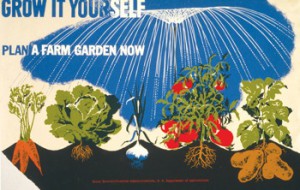
Herbert Bayer, "Grow It Yourself: Plant a Farm Garden Now," ca. 1941-43, New York NY. Silkscreen on board, WPA War Services. Courtesy of Library of Congress, Prints and Photographs Division, WPA Poster Collection.
Gastro-Vision is a new monthly column dedicated to all things food.
It probably goes without saying that depictions of food in art are as old as art itself. Since the prehistoric cave paintings of bison, deer and other fodder, food has permeated all forms of cultural production and continues to be subject and/or material for countless artists and artisans today. Over the past year, a few of our guest bloggers have (unknowingly) given you a taste of what Gastro-Vision is about. Taking food and drink as a jumping off point, Sarah Silwa wrote about the Body Bakery of Thai artist Kittiwat Unarrom, and listed a few other artists known for their use of sugars and starch, such as Felix Gonzalez-Torres and Joseph Beuys; Paul Schmelzer profiled artist Chakkrit Chimnok in his post, “Banana-Leaf Utopia“; and, most recently, Tracy Candido outlined economic models for arts funding and fundraising, citing new ventures like her own bake sale artist residency, Sweet Tooth of the Tiger. Gastro-Vision seeks to continue and expand on such contributions while making connections to broader topics in contemporary visual art and culture.
Readers who follow my personal blog know that I have become increasingly interested in what goes into my food and where it comes from. (I probably owe this to food writer Michael Pollan, whose books The Omnivore’s Dilemma and In Defense of Food, and soothing voice in the “civilized horror movie” Food, Inc., have helped open America’s eyes to problems with our food system and subsequent eating habits). The more I learn, the more motivated I am to eat as close to the bottom of the food chain as possible (i.e. increasing my consumption of locally grown plants). But New York City certainly has its challenges when it comes to finding (and affording) good local food. Hence, the rise of urban farming. Three new visual and edible projects—Truck Farm, Welcomed Guests, and Window Farms—reflect this trend, presenting resourceful methods for growing your own food in the metropolis and, what’s more, sharing it with others. Continue reading »