Gimme Shelter | APAP 2012: Time Is Empty and Everything Is Real
In January, New York played host to the Association of Performing Arts Presenters Conference. A number of festivals and venues showcased dance, theater and performance at venues throughout the city, the idea being that international presenters would swoop down on the shiny things they saw and bring them to their own institutions. Risky business in the midst of this economy, but riskier still for artists and for pieces that lie in between forms. Highlights from P.S. 122′s COIL Festival and the American Realness Festival at Abrons Art Center exemplify the kinds of events that reside between these interstices.

Daniel Linehan spinning in "Not About Everything Dance," photo by Ian Douglas.
The most stunning performances I attended were those where the repetition of speech and/or movement were the key forces catalyzing the experience, as in Daniel Linehan’s Not About Everything Dance at the American Realness Festival and Heather Kravas’ The Green Surround at the COIL Festival. I have tried to theorize this tendency in performance to understand why repetition yields such a strong reaction in me and others.
Gimme Shelter | Smash Your Idols: Clifford Owens at MoMA PS1
Am I living in the 21st Century? Perambulating the art world, there are times when my senses tell me I am, but my overall experience feels stuck in the conceptual mire of minimalism, emptied of the latter’s social gravitas, while at the same time standing in the wake of relational dystopia. All this, even before I consider those in this world who have the power to shape my experience of art. If there is one artist who has the ability to shake me out of this Gen X-Y, zombie trance of ironic equanimity and break this century open, it is Clifford Owens.

Clifford Owens. Anthology (Jennie C. Jones). C-print. 30x40 inches. Image courtesy On Stellar Rays.
“Breaking open” is the operative phrase in describing Owen’s solo exhibition Anthology at MoMA PS1.* The phrase functions on the level of history and on our present experience of race, class and gender, both in the art world and beyond it. The exhibition is comprised of “performance scores” given to Owens by over twenty inter-generational Black artists, all of which he performed and documented during his five month residency at PS1.
By acting as the vessel through which Black art is anthologized, Owens puts himself in a space that is fraught with struggle and contradiction. He sustains his own image as a Black artist by obliterating the notion that there is a unified definition of Black art, and as such, he also problematizes the way an anthology is supposed to function. Different scores seem to scrape against each other, creating a conceptual friction between identity and its meaning. Through his labor, Owens reveals a broken narrative of Black history, and Black art history, with himself at the vortex, channeling the ideas of his fellow artists while serving as the site and subject of his audience’s projections.

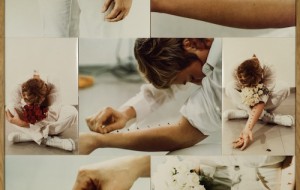
Clifford Owens. Anthology (Glenn Ligon), detail. 3 c-prints. 20x24 inches. Courtesy On Stellar Rays.
This is a hard place to be. Where, exactly? In Clifford Owens’s body, within the institutional structure of PS1, in the 21st century–where post-race discourse has subsumed post-colonial discourse–and even in my small, white woman’s body. For me, walking through Anthology feels like walking among the shards of a cultural suicide bomb. The texts, photos and video works appear to fit together to form a smart, visually stunning installation in which the combined works reflect multiple histories, from Fluxus to Minimalism to Body Art. Owens’s own project–to reflect a heretofore invisible history of Performance Art by Black artists–is embodied by his interpretation of the scores. On close inspection, the scores’ contents are rife with conflicts about what it means to be Black, to be a man, to be inventing a history, to be re-staging a history, and ultimately, to be staging oneself.

Clifford Owens. Anthology (Kara Walker), detail. C-print. 16x24 inches. Image courtesy On Stellar Rays.
As part of the exhibition, Owens is performing various scores on a monthly basis, through March 2012. I had the opportunity to participate in his performance of Kara Walker’s score during the exhibition’s opening. The following is my account of the experience.
We are all lining the hallway of the 3rd floor in front of the Anthology exhibition at PS1. Owens hands Walker’s score to curator Christopher Lew, and asks him to read it aloud. “Score: French kiss an audience member. Force them against a wall and demand Sex. The audience/viewer should be an adult. If they are willing to participate in the forced sex act abruptly turn the tables and you assume the role of victim. Accuse your attacker. Seek help from others, describe your ordeal. Repeat.”
Set Me Free! Performa 2011 Part II: Beyond the Biennial

Performa 11: "You don't really love me, you just keep me hanging on"
If moribund is defined as an adjective for that which is approaching death or obsolescence, then perhaps it is the best word to describe my experience of Performa’s last week. This is not to say that the biennial ended without a bang, indeed it seemed that the best was saved for last. However, my patience for big names that delivered less than quality performance did not hold out through the week. My attention veered toward performance that was not lassoed into that calendar of events, but was nonetheless invigorating and contemporary.
Liz Magic Laser’s I feel Your Pain, an intervention-cum-reenactment of political folly, utilized the audience as the stage at the SVA Theater. Actors coming out of their seats performed caricatures of politicians debating, negotiating, or seeking sympathy in the form of romantic comedy.

Scene from Liz Magic Laser's "I Feel Your Pain." Photo credit: Yola Monakhov, via Artfagcity.com.
The performances, projected on a large screen on stage, suggested the spectacle of newsmedia as the whole theater was implicated in the events, making this take on the “living newspaper” a living, breathing beast of the political underbelly. As actors playing Glenn Beck and Sarah Palin sweet-talked one another until converging in a make out session, it felt like the audience was witnessing what everyone was thinking while watching Beck interview Palin on Fox News, but couldn’t say. Many of the parodies felt this way, indulging self-evident posturing while peeling off the veneer of political sincerity or redemption.

An audience member sampling cocaine offered by a docent in Tania Bruguera's 2009 piece. Image via www.animalnewyork.com
While there was an adrenaline rush of sorts that comes from everyone in the audience realizing that actors could pop up from anywhere, I couldn’t help but sense a formulaic-air on the side of entertainment. I Feel Your Pain was promising on the side of Tania Bruguera’s 2009 staged intervention at the Hemispheric Institute of Performance and Politics. At the Universidad Nacional of Bogota, Colombia, Bruguera created a fake panel that included a right-wing paramilitary fighter, a left-wing guerilla, and a refugee displaced by the fighting, as a docent walked through the aisles offering cocaine to the audience.
Gimme Shelter | Performa 2011: Performance Art Is Dead. Long Live Performance Art!

Performa 11 logo.
November brings with it the sweeping Performa 2011 Biennial, filling theaters, galleries, churches and plazas across New York City. This is the fourth Biennial to date, and the most far-reaching, ambitious and populated. Roselee Goldberg, founder of Performa, is the famed art historian who is known for authoring a history of performance art in her books, Performance Art: From Futurism to the Present and Performance: Live Art Since 1960. Goldberg also was curator of The Kitchen in the 1970’s, putting it on the map as a leading venue for experimental forms.
Goldberg’s books, taught widely in universities and art schools, place performance alongside painting and sculpture as part of the art historical canon. They make the case for performance art as a form that can be traced through multiple disciplines and which continues to play a significant part in the art world. Of course, I jumped at the chance to cover Performa and was more than eager to absorb the energy, experimentation, absurdity, profundity and dialogue this Biennial has to offer. On November 1, I jumped into the loosely themed “Constructivism and Fluxus” rabbit-hole and bid my quotidian comforts adieu, to be taken up again after the upcoming three weeks had passed. Oh, promises of exhilaration.

Running nowhere fast, Joseph Feines as Ingar Dragset in "Happy Days in the Art World," 2011. Image from whitewallmag.com.
Am I having an experience yet? Maybe. Nope, not yet. Now? And so the weeks progressed…what was a rabbit-hole became a black hole of amateur theater made by blue chip visual artists. With many tickets at steep rates for commissioned works, the hype outweighed the reality. Paradoxically, giving visual artists time, space and funding to create performance has resulted in an experience that is not even half as good as going to 42nd street. If you’re going to the theater, why not just pay those prices to see a real show?

"Chicago," the Broadway musical. Image from broadwayworld.com
Goldberg claims that performance art is stuck in the 1980’s and needs to be brought into the 21st century; however, my experience of much of Performa’s “visionary” performances is that they were actually quite conventional. Were I to see Performa from the standpoint of the average art viewer, I might perceive performance art as plays, or worse yet–as mime. Yes, miming art historical movements through the artifice of spectacle. For all intents and purposes, it might be more accurate to describe it as “Performa: Theater Camp for the 21st Century.” Yet now that I have given voice to my dashed expectations, I am also prepared to say that there have been some redeeming moments to Performa. These moments have mainly occurred because some actual performance artists were invited to participate.
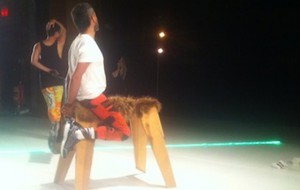
Eleanor Bauer’s solo performance Big Girls Do Big Things at New York Live Arts proved to be an outrageous adventure into the plight and privilege of the statuesque young choreographer. Slipping into a polar bear suit as she took the stage, Bauer attempted to stand up despite the suit’s bulky, misshapen folds and tucks that hindered her. She kicked two small cymbals and then searched for a way to clap them together with her paws. Not merely slapstick, the bear suit performance parodied her appearance as a “big girl” in a world of idealized dancer bodies. The difficulty with which she moved, encumbered by the suit, revealed a sad truth about the projections that audiences themselves put onto stage performers. Like a circus act, the “bear with cymbal” routine symbolizes the performers’ labor for cheap laughs and approval from audiences, but when the cymbals started to become slippery, and the roly-poly behavior of the bear broke down, the dysfunction of the performer’s role is made clear.
Bauer then transformed the suit into a kind of chic coat-dress and, now in high-heeled shoes, began to mount a ladder. As she climbed each rung, she sang Patsy Cline’s “Crazy,” at perilously higher octaves. By the time she reached the top of the ladder, Bauer was practically shrieking. It’s a dangerous moment: teetering in the heels, sweaty, and digging deep into her diaphragm for breath, it seemed like Bauer might not be able to sing a last chorus. But when she did, it provided another one of those slapstick-turned-dark moments, especially as the last echoes of the lines “I’m crazy for trying/ and I’m crazy for crying/ and I’m crazy for loving you” filled the stage with a haunting sense of desperation.

Bauer reciting a monologue based on a performance by Karen Finley. ("Nothing Happened.") Photo by Nada Zgank.
As she sat at the top of the ladder, Bauer recited a monologue based on Karen Finley’s performance Nothing Happened from 1986. Bauer’s version, “so I went on a detox diet and nothing happened/ so I became macrobiotic and nothing happened/ so I ate a protein shake with extra spirulina and wheat grass and noni juice and acai-berry and ginseng and guarana and ginko and echinacea and kumobucha and l-carnitine and chromium, and flax oil, baby, and nothing happened…” points to her body again, and to the cultish, techno-organic vocabulary of over-the-top health consciousness. Statements like, “I spent a half an hour per day signing petitions on the internets, and nothing happened. I joined moveon.org, truemajority.org, unitedforpeaceandjustice.org, I joined avaaz.org, One Million Strong, and nothing happened. I went to the rallies, I protested the war in Iraq seven times, and nothing happened!” point to the effort it takes to try and connect with others and take action within a sea of competing political and social causes and their ongoing exploitation. Big Girls Do Big Things had all the elements that were antithetical to Performa itself–a bear suit, a sentimental song, a monologue from the 1980’s–but in its fierce simplicity, Bauer’s piece managed to rank among the most contemporary and confrontational of the Biennial’s works. Continue reading »
Gimme Shelter | Exorcising the Post-Democratic Body
At St. Mark’s Church in New York City, the home of Danspace Project, Jeremy Wade performed fountain. With the house lights on, Wade stumbled along the carpeted edge of the church floor, describing in detail the interior architecture of the area where he stood. His nervous tone and dramatic gestures indicated an imminence of the holy, satirizing it with the mundane and sterile minutia of which the church is composed. Wade then invited the audience to come up to the altar and touch it with him, calling everyone “pilgrims,” after Annie Dillard’s book Pilgrim at Tinker Creek.

Jeremy Wade performing "fountain," 2011. Courtesy Danspace Project. Photo by Doro Tuch.
Wade then guided the audience to form a circle on the floor. What proceeded was a viscerally twisted exorcism consisting of choreographed writhing, groaning, torquing, guttural moans, whispered chants, and facial contortions. Wade made direct eye contact with the audience-cum-participants, suggesting that this is an exorcism for them, too, and that the dancer is channeling their demons. Having laid the space bare at the introduction of the performance, it was hard to decipher where the energy that fueled Wade’s act of channeling came from–whether it was an exorcism of his demons, those of the audience, or of historical demons in the context of the religious setting.
My experience in this circle was one of exchange, where as a witness I felt activated, as though my presence helped to fuel Wade’s evangelical endurance. The space of the church opened up for me. I became acutely aware of its structure, and how, when stripped of its symbolic codes, the church was just a place, empty and neutral.

Théodore Géricault. "The Raft of the Medusa," 1819. Oil on canvas.
Wade’s talent lies in his uncanny ability to draw attention and energy into himself, to the degree of absorbing all activity into an oscillating, chaotic world of movement and absolute terror. From a visual perspective, one might view his singular used-up, contorted figure as channeling the multitude of destitute bodies in Théodore Géricault’s 1819 painting Raft of the Medusa. For me, Wade’s performance also struck a cord with the beginning of the Occupy Wall Street protests, and the pain, desperation, anger and wailing suffered by those who desire change, as protesters congregate to perform direct actions with a strange mix of guerilla practices and what could be deemed an almost-religious hope for salvation.
Gimme Shelter | Full Frontal
I am on my way to New York, but not before finding Exercises for Rebel Artists: Radical Performance Pedagogy by Guillermo Gómez-Peña and Roberto Sifuentes delivered to my door on my last day at my Chicago address. Gómez-Peña is an original performance art activist whose work combines a very real goal of exploding race, class and gender constructs with an equally real goal of achieving a singular aesthetic. The book is an instructional how-to manual for creating workshops and performances based on the exercises developed within his collaborative group, La Pocha Nostra (of which Sifuentes is a long-standing member). I am not sure that I have ever seen a manual for performance such as this before, with illustrations, step by step breakdowns and documentation of the workshops.
What the book is establishing in 2011, the year of its publication, is that yes, performance art does involve technique. It’s not dance technique, it’s not acting technique, and it’s not directed toward the goal of becoming virtuosic. It’s taking the foundational movement exercises, warm-ups, and techniques centering the body and pairing it with social consciousness to generate radical intimacy. As participants walk through a room with their eyes closed, or hold one another’s gazes for an interminable length of time, or perform tableaux-vivants as ethnic stereotypes (all extractions of exercises that are detailed in Exercises for Rebel Artists), they are breaking down conscious and unconscious barriers to connect with one another and with future audiences. On my last night of attending exhibition openings in Chicago, I was struck by more than one showing of performance, sex, and ritual action. At Intimacies, a group show curated by Lorelei Stewart and John Neff that’s currently on view at the University of Illinois at Chicago’s Gallery 400, I spent time with a video by Elijah Burgher, whom I had met on his way to Skowhegan a few months prior [Burgher has also been a blogger-in-residence on Art21 Blog]. Burgher draws from magick and the occult to generate glyphs or sigils that he then draws, paints, and carves into his body in his studio.
Gimme Shelter | No Future
Miranda July as Sophie, who is attempting to make a YouYube dance hit. Image via Roadside Attractions.
I didn’t know I’d go to film for the second post of this performance art column, but here’s a surprise. Miranda July’s The Future. That’s right, a performance within a film within a laptop screen within a film within a performance. In the film, July plays Sophie, an aging dancer who fails to make a viral YouYube dance video. Pause. It’s not that I relish depictions of my generation as hapless dreamers full of delusion and neuroto-narcissism on the verge of a charming nervous breakdown. It’s that part of indie-stream film personae that makes me want to vomit out the Winona (Ryder)-worship of my youth. But July has captured something here about performance, the desire for visibility — albeit a very private, framed sense of it – that is real. July’s use of a laptop, YouTube, and the, “30 Dances in 30 Days,” project she sets up for Sophie situates this character in a familiar trope of contemporary persona-making where the number of online hits determines success. Sophie, however much she tries, cannot allow herself to dance for the camera on her computer screen. Suddenly, something very private, and therefore seemingly easy, becomes the voyeuristic eye that shames her out of her “star” potential.

Sophie's epic t-shirt dance, image via Sales on Film
She clings to a worn, yellow shirt that she feels between her fingers over and over again. When she attempts to leave it behind, it floats through the L.A. suburbs to the house where she is living with an older Daddy character. Alone in his bedroom, she folds the shirt over her body and begins to dance. Unlike the self-conscious moves she tries in earlier attempts to dance alone, she jerks about the bedroom to an internal sense of timing that doesn’t match up with the Beach House song playing on her laptop. There is no dialogue here, there’s no interaction, and yet it is an intensely climactic scene. I don’t remember how long the dance lasts, whether it’s the duration of the song or longer, but its cathartic and eerie imagery generates a powerful impact on the viewer, as both a dance and a symbol of time travel, blindness and a dark, shrouded mystery. The Daddy character, once noiselessly peering from the bedroom door, turns away as she rolls across the door frame. Does she see him? Either way, it doesn’t matter. The character, Sophie, is dancing for no one, but Miranda July is dancing for everyone.
It’s About Time: Gimme Shelter, A New Column on Performance Now


Mick Jagger, 1968. Photo from "The Rolling Stones Rock and Roll Circus" © 1996.
In an interview for Rolling Stone, Mick Jagger described the 1969 hit “Gimme Shelter” as a song about apocalypse, about the end of the world. He channeled the rage of an era, popularizing dissent in the face of the devastating visibility of war: “Oh, a storm is threat’ning my very life today; if I don’t get some shelter, oh yeah, I’m gonna fade away.”
In 2011, performance emerges out of the “storm” — that cultural flux set in motion by the turmoil of social order over the past ten years. As markets collapse, we are beginning to question the values and beliefs that have contributed to current states of personal and political devastation. Performance has the potential to transform the wreckage into something worth seeing, discussing, and arguing about.
With an amorphous history as a fine art threading back through visual art, theater, dance, video, and photography, performance is usually the medium artists use to rebel against definition or to critique the constraints of other art forms, politics, and socio-economic issues within both the art world and the real world.
Art21′s newest column, Gimme Shelter will feature essays, interviews, “studio” visits, documentation, creative responses, evaluations, and propositions of performance. Posts will shift between current work and historical reference points, as new connections and developments converge. What is at work in the translation of experience is an engagement of faculties beyond the normative gaze. At the core of this column is the unique voice that comes from the subjective experience of the live event. The only way to go forward, right now, is to step up with your whole body and literally, move there.