

Letter from London: Trip Advisor

March 7th, 2011

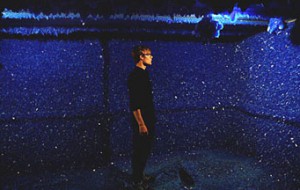
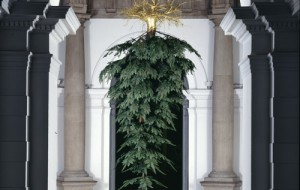
Marcus Coates, "The Trip," 2010. Documentary photograph. Courtesy the artist.

All travel is retrospective. We don’t travel for the experience – most traveling time is spent waiting, after all – but in order to have something to remember. The easy editing abilities of digital photography have transformed utterly the modern idea of travel. It’s all peaks, no troughs: the past perfect. Journeys only really exist once they’ve finished, and every story starts at the end.

The Trip is a 35-minute film by the artist Marcus Coates that consists of two long, still shots of the same thing: the interior of a room in a hospice in north west London. You see a flat-screen TV, a wall-lamp, and a window giving onto a quiet suburban road. In one of the shots, the day’s color drains, barely perceptibly, from the sky. In the other, the morning’s light is still, steady, the sky windless. Unseen between the two shots, each one lasting the duration of a dialogue heard on the soundtrack, is the event of the title: a trip to the Amazonian rainforest, which is discussed in voiceover in both parts of the film. The disparity — both comic and poignant — of what’s seen and heard is part of the point. The trip, undertaken by the artist, is plotted in the first section and recounted in the second. Nothing of the trip itself is shown: it happens in the two men’s dialogue and in the mind of the viewer. The trip was proposed by one of the men, a terminally ill man named Alex H., and was carried out and described by the artist.

Film is a proxy medium: I went here so you didn’t have to. The appetite for seamy subject matter in everything from Caravaggio to Nan Goldin to The Wire is part of what we want from art: a vicarious trawl through experiences we ourselves would never deign or dare to have. Coates’s film extends the idea further: I went here because you couldn’t. In The Trip, Coates repositions the artist as a shamanic figure, someone able to transmit information from another world for the benefit of this one. It’s a theme in much of his work: in Journey to the Lower World, he “channeled” animal spirits to the residents of a block of flats in Liverpool by dressing himself in a deer skin and imitating animal calls. The Plover’s Wing, similarly, had the artist cooing his impression of the bird to an unimpressed Israeli mayor, while wearing a dead badger on his head. Coates’s art flirts with the ridiculous – is ridiculous, at times – but it’s through his ability to exploit the liberating power of embarrassment that his art attains its uncanny beauty. His film Dawn Chorus – viewable more or less in its entirety on YouTube, and worth five minutes and forty seconds of your time – shows sped-up footage of humans imitating birdsong, while sitting in various working and domestic environments, having learned slowed-down imitations of different calls. It’s funny, and Coates’s art is genuinely funny, but the laughter it provokes is what Tom Stoppard calls “the sound of comprehension.” We recognize something.

Continue reading »

Letter from London: Gutter Rug

February 21st, 2011

Image of a boy playing a video game from Robbie Cooper's "The Immersion Project"

Whether or not computer games are actually any good for us – some argue they cause children to become withdrawn and asocial, and others suggest that they provide valuable life skills, like killing zombies with flamethrowers – there are certain life lessons all of them, whatever they are, eventually teach. Namely: spend long enough doing something and you’ll eventually do well at it, then suddenly regret all the time you spent doing it. Or: there are some things you will never be able to do, no matter how hard you try. There’s nothing like a video game – especially when the avatar is the almost exact physical opposite of the player, which is all the time – to reinforce a deeply-rooted feeling of loserishness. And that, roughly, is the subject of Cory Arcangel’s outstanding new installation at the Curve gallery in the Barbican Centre, called Beat the Champ.

Cory Arcangel, "Beat the Champ" (2011) at Curve gallery, Barbican. Photograph: Felix Clay.

Initially, Beat the Champ, which consists of 14 chronologically ordered wall-size projected clips from ten-pin bowling games, looks like a kind of history of digital aesthetics, from the juddering Atari blocks of the first clip to the slick detailing of a recent PlayStation version. One of the pleasures the work affords is the indulgence in this teleological narrative, recalling a gallery of paintings from medieval to Renaissance to mannerism: realism replaces flatness, which is then replaced by willful superfluity, like an avatar’s Durstian soul patch or the reflection of digital bowling shoes in a shiny digital floor. In line with that analogy, there’s a point at which the image’s beauty peaks and topples and everything becomes garishly ugly, Second Life-style, where muscled arms turn cubist when they move and heads and necks are the same width. Each avatar in each game has been hacked to throw a single ball, which, depending on the iteration of the game, either shoots straight into the gutter or wobbles promisingly towards the crowd of pins before slinking off-center. The evolutionary aesthetics of the images are continually undercut by their inability to play the game. No matter how good it looks, in other words, it’s just one goddamn gutterball after another.

Continue reading »

Letter from London: Being Boring

February 7th, 2011

19th century sculpture in the Musee d'Orsay: sexy but boring

“Why is sculpture so boring?” So said Charles Baudelaire in 1848. Sculpture in Baudelaire’s time was boring. In actual fact, with some notable exceptions, sculpture was, for a very long time, very boring indeed. Have a wander through the Musee d’Orsay or the second floor of the Met and you might well be struck by the disparity between painting and sculpture in the mid- to late- nineteenth century. On the one hand, there’s Gustave Courbet’s ferocious, gnarled tableaux of ugly peasants and aggressively sexual maidens; on the other, Jean-Baptiste Carpeaux’s dreary trudge through mythological subjects. With the occasional blip – all of Degas’s sculptures and some of Rodin’s – sculpture at the birth of modernism looked like something we were planning to ditch once we worked out what paintings should look like. This wasn’t new in the nineteenth century – Leonardo da Vinci had famously already slammed sculpture as retrograde and coarse, something for the horny-handed working classes/Michelangelo – and nothing had really changed by the time of Ad Reinhardt’s dinner party witticism in the 1950s: “sculpture is something you bump into when you back up to look at a painting,” after which he waggled his eyebrows and pinched an heiress on the backside.

Ad Reinhardt in action

The thing is that sculpture is only boring, in Baudelaire’s terms, as sculpture. What set aside someone like Courbet from someone like Carpeaux was that what he was painting was completely unprecedented: it might as well not have been “painting.” This is the beginning of a long line of people decrying things as “not being art”; well, maybe they aren’t. Maybe Duchamp’s readymades aren’t art. That’s fine, because it’s a semantic discussion: Duchamp’s Bottle Rack isn’t art as long as you’re quite sure what art is. (The same argument goes for Adam Sandler: I think he’s funny because he complies with my definition of what “funny” is — farts and falling over, thanks for asking — but everyone I have ever met thinks the exact opposite, which is fine. It’s a semantic discussion, I tell them, weakly, as they leave). The problem gets stickier when we take apart the statement “sculpture is boring”: sculpture in Baudelaire’s time was (mostly) boring, simply because it was certain it was sculpture, and within that narrow definition, it seemed washed-up. Reinhardt’s quip was made on the cusp of sculpture changing irreversibly in the shape of minimalism, which ditched the metaphor of traditional sculpture for good. Now every piece of contemporary sculpture has to be seen through that legacy, best summed-up in Frank Stella’s less waspish “what you see is what you see.” And because of that statement and the vast impact the art it represents has had on makers of objects, the term ‘sculpture’ feels less and less appropriate, like a childhood nickname you still cling to, even though you’re a 56-year-old divorcee living in a hotel just outside Birmingham (hi, Timmy!).

Continue reading »

Letter from London | Porn, Porn Everywhere: Analog at Riflemaker Gallery.

January 17th, 2011

In this second and last guest blog post, Kerim Aytac fills in for our hero Ben Street this month. — Ed.

Looking at Richard Nicholson’s elegiac contribution to the Analog show at Riflemaker gallery in London, I couldn’t help but apply my new knee-jerk additive term de rigeur: Porn. His nostalgic but gracious images of the now defunct space of the darkroom are gratuitous, fetishistic even, but are they actually pornographic? Analogue pornographic?  Has the term become a substitute for fantasy or escapism, instead of the darker desires the genre is traditionally associated with? Porn is demeaning. Porn is titillating and voyeuristic. Porn is seeing a lot of one thing one is not supposed to want to see, perhaps, but when applied to mainstream filmmaking, for example, it may have come to encompass the fulfillment of a need for the explicit acknowledgment of a pleasure indulged.

Richard Nicholson, "Gordon Bishop Associates, Paddington Street," 2006

Nicholson began to document London’s remaining professional darkrooms in the Summer of 2006, when there were 204 of them. By 2009, only six remained. Only the most masochistic of photographers would truly lament their passing, given the opportunities and ease of use afforded by digital post-production, but many still shoot on film. The images are big, taken with a large-format (film) camera, and pinned to the walls without frames in the manner of the work-print one might find in a darkroom. Their resolution is almost blinding. What is most striking is the aesthetic shift that seems to have occurred during this project. These professional spaces are all controlled chaos with so much stuff needing to be accessed so often, but are a far cry from the minimalist digital workspaces one encounters today. The enlargers are the focal point of most of the compositions, erect and elegant in their dominions, but each is individual in a way that computers rarely are. It has also been surprisingly easy to forget how some spaces were designed for standing before digital ubiquity. Each image represents a sense of the artisanal, a sense of the process. The notes, prints, and clippings affixed to the walls serve as biographical testimony to the many days and months spent occupying these spaces and hint at a lost allegiance to craft over technical mastery. This aspect of image-making has lost its physicality as Nicholson states:  “I do miss the aura of the red safelight and the soothing sound of running water. I miss the excited sense of performance.”

Continue reading »

Letter from London: Terry O’Neill Award Show at Hotshoe Gallery

January 6th, 2011

Teri Havens, "Richard's Camp," 2006, from the series "The Last Free Place." Toned silver gelatin print.

Guest blogger Kerim Aytac is filling in for regular columnist Ben Street this month while he makes his millions. — Ed.

It’s hard to see the work of emerging photographers hung in London. There are relatively few dedicated photography galleries and even fewer showing the work of fresh talent. To emerge as a photographer or photographic artist is indeed a complicated thing. Where does one emerge to? The art world now purports to accept photographic practice as part of its remit, but perhaps understandably, only a particular style or type makes it through. Compared to our European neighbours, France and Germany in particular, or our American cousins, the desire here is very small for those who cannot access the art market. The resulting polarization is a well-tread truism: Photography as Art or Art as Photography. Practitioners who occupy the middle ground seem to emerge elsewhere. The only other method by which to be successful, it seems, is as a genre-specific virtuoso; the best in fashion, the best in portraiture, and so on. Photojournalism, bar the work of a few genuinely inventive die-hards like Adam Broomberg and Oliver Chanarin, has lost cultural credence, falling off the tightrope it walked for so many years between form and function. As a result of all this, the main way that large sections of the British public get to access photography is when there is a Prize.

The Prize is, as curatorial concept, a comforting thing for the visitor. It is reassuring to know so many artists are baying for one’s attention. The visitor is encouraged to think: try hard, work hard, and one day, maybe, if I have the time and have nothing else even marginally more interesting to do, you might be worth an acknowledgement in the form of my attendance. The foregrounding of the gate-keeping process that cultural institutions routinely employ allows the public to feel its affections are being earned as opposed to foisted upon. In London, both the Taylor-Wessing Portrait Prize, held annually at the National Portrait Gallery, and the also-yearly World Press Photo held at the Royal Festival Hall, are always big hits. It might be cynical to suggest this is partly due to the fact that these reward the efforts of those working in genres closely aligned to what photography seems to be for: functions rather than concepts. The Turner Prize of fine art photography, the Deutsche Börse Photography Prize is consistently considered contentious and comprehensive, but only rewards those already established and blue-chip. Perhaps the Terry O’Neill Awards, a new(ish) prize in a new(ish) space showing new(ish?) work, will break the mold and provide a forum for those emerging to gain exposure.

Set up in 2008 in honour of one of the surviving photographic legends of the Swinging London of the sixties, the award invites submissions in all genres, including Fine Art as a type in itself, so long as they are “dynamic images that portray a compelling narrative.” The judging panel consists of both photographers and specialists as well as Mr O’Neill himself. Such loose criteria make for an unpredictable selection in an interesting show, held for the first time this year at the consistently brilliant Hotshoe Gallery in Farringdon, London.

Continue reading »

Letter from London: Hell Is Other People

December 20th, 2010

The Heads of the Kings of Judah and Rudolph Stingel's "Untitled" at the Palais de Tokyo, Paris

It is a truth universally acknowledged that artists make the best curators. Mark Wallinger’s exhibition, The Russian Linesman at the Hayward Gallery last March, was a proposal about what creative curatorship might actually mean – a bringing together of historically or aesthetically disparate objects which generate unexpected “sparks of poetry” (pace Max Ernst). Adam McEwen’s show, Fresh Hell at the Palais de Tokyo in Paris, is a continuation in the same spirit. Drawing on the intellectual dilettantism of the way we collate and digest information these days, and the increasing anachronism of academic specialization, McEwen’s show is a wildly disparate generator of transhistorical energy, epitomized in its display of Walter de Maria’s 1967 High Energy Bar. Set into the wall in a brightly-lit vitrine, the work – a footlong steel bar, glowering with condensed power – is the fulcrum of the whole exhibition, an object whose aesthetic and actual density lodges it in place against the onrushing stream of history.

McEwen’s theme is the weight of things, the way that art objects of particular power resist dispersal and dissolution. Like Wallinger, McEwen hops between historical periods with fluency, drawing out resonances without hammering a thesis home (as he himself says, “it’s the artworks that are in control, not the curator”). The opening room, for instance, pits a wall of silver industrial insulation panels by Rudolf Stingel (on which visitors are invited to stick notes or photos, or gouge their name in) with three huge hunks of medieval stonework: the heads of the Kings of Judah, lopped off the west façade of Notre Dame by anti-monarchists in 1793 and discovered, buried, in the 1970s. The juxtaposition invites certain readings: iconoclasms old and new, the palimpsest of history, Paris itself as a site of perennial protest. And yet the heads (which, sorry, are by far the most fascinating and beautiful works in the show) remain, despite their vandalism and interment, fully alive, blazing with authority embodied in their muscular carving and physical presence. That weight allows them to stand outside history, an idea echoed in a note pinned to the Stingel behind: “Time doesn’t exist. Clocks exist.”

Continue reading »

Letter from London: Tuition and Hopin’

December 13th, 2010

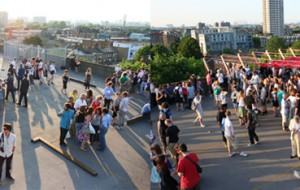
The London protests heat up (image courtesy Antony Bennison)

This week, Britain’s coalition government (narrowly) passed a proposal to dramatically hike university tuition fees, the results of which were a number of occasionally violent protests in central London. The Conservative party HQ, a modernist tower block at the edge of the Thames, was broken into and occupied by protesters, some of whom lobbed down fire extinguishers at the police below. Bottles were thrown at Prince Charles’s Rolls Royce as it sped through central London, smashing a window and leading to a proposal that he ditch the vehicle for his own safety (yes, that extreme). Protesters swung from the Union Jacks that hang from the Cenotaph, the war memorial near the Houses of Parliament. Graffitied cocks disfigured the public statues. In the frosty morning light, Parliament square looked like a cross between Helmand and Glastonbury.

The problem with protests of this sort is that it’s all too easy to take binary political positions that caricature the opposition or romanticize the nature of the thing. Plenty of the protesters weren’t, in fact, students, but it’s expedient for those who opposed the protests to describe them as such (thus, by lazy association, belittling the seriousness of their position). It’s also useful that there is a violent minority prepared to smash up police cars and spray genitalia on bus stops, so that resonant photographic images can be used as ballast for the opposition. On the other hand, many of the protesters seemed (judging by the slogans on banners ditched in bins or broken in the gutters) to see themselves as latter-day sans-culottes, for whom the issue of tuition fees was of a piece with the war in Iraq, the occupation of Palestine, and the creeping evils of capitalism, rather than being the misguided piece of legislation that it is. And yet the protests matter, and they matter for art and its future, and anyone with an interest in art ought to be taking a close interest.

Continue reading »

Letter from London: Turner Blind Eye

November 15th, 2010

Susan Philipsz. Photograph: Karen Robinson for the Observer

The Otolith Group ought to win this year’s Turner Prize, if their installation at Tate Britain is anything to go by, which it isn’t. Tate Britain’s press department must really enjoy having to explain annually that the prize is not awarded on the installation at the Tate (it’s for any show they’ve done over that year), but it’s unavoidable that the public – or, at least, those members of the public not used to the art fair/biennial Wurlitzer (i.e, the sort of people who use the word ‘public’ as though it doesn’t apply to them) – won’t follow that the thing you’re looking at isn’t the thing that wins. That’s good news for Angela de la Cruz, though, whose room was guest curated by Stevie Wonder. Works that looked ballsy, rambunctious, and endearing at her Camden Arts Centre show this year (reviewed here), hung haphazardly, look like the underdone Steven Parrino bootlegs they’re always being accused of being. Decisive or not, the duff hang does a good painter a disservice, and if she wins it’ll look like willful pretension by the judges, because it’ll look like that particular installation won it for her, which it won’t have done. But the Tate press department won’t be in a position to explain by that point, having all emigrated to Latvia and had their names changed.

The Otolith Group are definitely not at all cool

Having not seen anything by the Otolith Group before, I can only go on their room in the Turner show, so this may be fairly unrepresentative of what they do. If I say that it features thirteen TVs showing all thirteen episodes of a late-eighties French documentary series on the legacy of Greek philosophy and that it’s the most entertaining installation in the entire show, that could well be an indictment of the remainder of the show (which is, on the whole, pretty dour), but it’s the only room that seemed to contain pretty consistent public lingering. What’s most impressive about the Otolith Group’s darkened installation – which also contains the Group’s film of Satyajit Ray’s unproduced screenplay The Alien, as well as small pools of light illuminating intimidating-looking theoretical texts – is that its unabashed nerdiness doesn’t compromise its compelling beauty and sense of intellectual wonder. Throw a copy of Relational Aesthetics in the air and you’re bound to hit a pseudonymous conceptual art collective making work about unrealized artistic projects (right?). The Otolith Group do that, but they haven’t forgotten that it has to look good, too, and it does.

Continue reading »

Letter from London: The Time of Your Life

November 1st, 2010

Steve Martin and John Candy in "Planes, Trains and Automobiles," which you need to see again.

Christian Marclay’s The Clock (now on show at White Cube, Mason’s Yard) is a twenty-four hour long film which, unlike other very long art films like Douglas Gordon’s Twenty-Four Hour Psycho, or Andy Warhol’s Empire, you might actually want to watch for more than ten minutes. This is one of Marclay’s great achievements as an artist: as with his work using avant-garde music and experimental DJ-ing, he takes something often associated with arid pretension and makes it not only interesting but actually fun. His work Video Quartet – four screens playing snippets from films simultaneously, each showing musical performances, sliced together to create a piece of odd, compelling sound/visual art – was for some time one of the most visited pieces in Tate Modern until, for some unknown reason, they decided to take it down. Maybe they should buy The Clock instead, unless there’s some budget cuts occurring at the moment that I haven’t been told about.

Like Video Quartet, The Clock is a collage of found cinematic passages. In every clip of which The Clock consists (some a few seconds, some about a minute), there’s a clock or watch driving the narrative forward. Clocks are there to remind the characters that there’s a story to be told and a limited amount of time in which to tell it. Cary Grant scampers past a Grand Central clock on the way to his escape by train in North by Northwest; Steve Martin hustles through the airport crowds in Planes, Trains and Automobiles, finding he’s too late for his flight (with hilarious consequences!). Pocket watches are flipped open, gawped at. Time is running out, there’s no time to waste; the audience are checking their own watches impatiently: get a move on, let’s get this rubbish date over with.

Continue reading »

Letter from London: Frieze of Access

October 18th, 2010

Annika Strom's "Ten Embarrassed Men" at Frieze 2010. Photograph: Sarah Lee for the Guardian

As part of this year’s Frieze Art Fair, Simon Fujiwara, the winner of the 2010 Cartier award, has conjured up a faux-archaeological Roman site, bits of which are sometimes exposed in the main body of the fair. It’s all genial and non-threatening fun-poking (there’s the unearthed house of a female collector, full of coins and an archaic handbag; you get the picture) and makes enough winking references to make the cognoscenti feel good, so it’s not much of a surprise why he won. This, by and large, is the tone of a selling event that has transformed itself into a cultural one. Disingenuous self-deprecation abounds, aimed at both the skeptical outsider and the knowing insider.

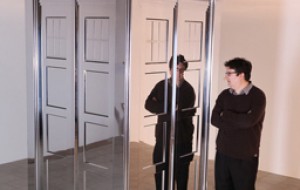
Much funnier is Annika Ström’s Ten Embarrassed Men, a group of identically dressed middle-aged actors, who huddle around en masse looking awkward, organized by the artist as a response to the representation of women in art fairs. How it really works is by providing a welcome bum note to the atmosphere of overweening economic confidence (however hyperbolic) that surrounds it. David Shrigley’s stand at Stephen Friedman Gallery is, as you’d expect, properly LOL-funny, which makes his presence at the art fair a bit anachronistic, and his appropriation by the art mainstream an ongoing puzzle. The artist himself was in attendance, painting temporary tattoos on people’s arms. I watched him slowly paint a fly on a man’s forearm. Everyone looked on, looking serious, filming on their phones.

Continue reading »