This Magic Moment: Diana Thater, Jeffrey Wells at the Santa Monica Museum of Art

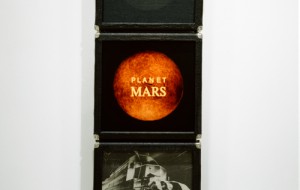
Diana Thater, "Los Angeles Theatre Marquee," 35mm production still from "Between Science and Magic," 2010. Courtesy the artist.
The Oscars, aka prom night for Hollywood, are just around the corner! Who does The Academy love more: the noble savage, the noble soldier, or the noble soldier-turned-savage? Are you on the edge of your seat or what?
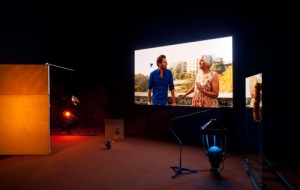
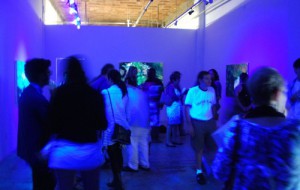
If you answered “or what” to that question, you might prefer to spend this Sunday at the Santa Monica Museum of Art, whose current exhibitions offer an excellent antidote to “movie magic.” Disassembling that particular phrase is the crux of preeminent video/film/installation artist Diana Thater’s newest work, Between Science and Magic. Thater’s installation (also on view across the country at David Zwirner Gallery until March 13) features a film of a magician repeatedly performing the iconic rabbit-in-a-hat trick, while Jeffrey Wells’s concurrent exhibition, Seeing While Seeing, represents a clever manifestation of Wells’s own distinctive approach to deconstructing parallel themes of illusion, trickery, and suspension of disbelief.

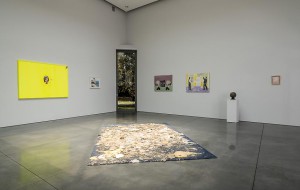
Jeffrey Wells, "Seeing While Seeing," installation view, 2010. Courtesy Santa Monica Museum of Art.
The low-tech trompe l’oeil animations in Wells’s installation are just as psychedelic and phantasmagoric as the high-end CGI phosphorescent forests in Avatar, and are far more lively and dimensional. As you enter the museum’s project room, the walls begin to dissolve before your eyes. With a series of subtle projections, Wells deftly liquifies two corners of the room into wiggly lines, while strange after-image-like rectangles appear and disappear around the two pictures that hang on adjacent walls. Even as you attempt to anchor yourself by reading the exhibition’s wall text, the letters begin to dance off the page, glowing and pulsating. The exit sign suspended at the top of the doorway echoes itself onto the nearby ceiling and opposite wall, as though reflecting itself onto a watery surface. The effect of the work is simultaneously disquieting and invigorating. Suddenly, the world around you feels malleable, porous, and oddly comical. The projectors are revealed, but it’s not entirely possible to determine exactly how Wells produces these strange effects – and you kind of don’t want to know. Wells, like a magician, has performed a trick that leaves his audience buoyant with pleasant bewilderment and inquisitiveness.
Meanwhile, on the other side of Wells’s mutating wall, Diana Thater addresses both the intersection and divergence of art and magic in her installation commissioned by the SMMoA. I must say that I find it a bit of a stretch to describe this particular work as an installation, although Thater herself would probably argue that projecting her film on the wall of the Santa Monica Museum constitutes it as such. I would disagree entirely with this classification were it not for the two speakers that amplify the mechanical whirring of her two film projectors. This effect ultimately allows the work to fill the vast space of SMMoA’s main gallery, rather than simply existing on a single plane. In addition, the piece is comprised of two separate films, though the projectors align to produce a symmetrically balanced split-screen effect.
I Am Not Neda
I drove into a Westwood parking garage late on Monday and saw that the attendant had been crying. After an uneasy moment–I wasn’t sure where compassion and polite distance met in a situation like this–I asked, “Are you okay?” It’s such a disingenuous question but it seems to work when you want to say, “I give a damn.” The attendant half-smiled and averted her eyes in a way that made me think she wouldn’t answer. When she handed me my change, however, she said, “My mother died.” I don’t know what I expected, but that wasn’t it. “No!” I exclaimed. “You shouldn’t even be here.” I wish I hadn’t said that. How do I know where she should or shouldn’t have been? I don’t know anything about her or her pain. All I know is that, in general, death hurts.
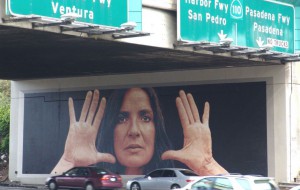
Tuesday night, an event at UCLA’s Hammer Museum dealt with death in a way that was less discriminating than I would have liked. The Museum joined forces with PEN USA to present a reading titled, “I Am Neda.” The event promised to bring together dissident poets and to celebrate freedom fighters in Iran. I went because, like so many others, I found the video of Neda Agha-Soltan, the unknown makers of which just received a George Polk Award for Videography, emotionally searing. I also went because the Neda phenomenon seems so heavily visual that I wanted to see how poetry could claim her image.
The Neda video that went viral on June 20, 2009, showed a young woman, shot through the chest during a protest, dying with renegade grace. When she fell, her legs bent and flopped tom-boyishly, seemingly disregarding the mores of a propriety-obsessed society, and her loosely-fisted hands slowly collapsed to frame her blood streaked face. All of this made her an easy symbol for freedom. She was also young and attractive, so her photograph translated well to signs and posters that started appearing in the days following her death. International correspondents began calling her “the face of a revolution” and the “voice of freedom.” She was an icon before anyone actually knew who she was or what she had been doing on the day she died.
If You Can Remember the ’60s, You Weren’t There

Ed Ruscha, "The Los Angeles County Museum on Fire," 1968, oil on canvas. Courtesy edruscha.com.
When I moved from Berkeley to Los Angeles five years ago, I thought I was done living in a town that was devoted to perpetually remembering the ’60s. But I soon discovered that Los Angeles also carries a mega-torch for that transformative decade. It’s easy to see why that era is appealing and continually inspiring these California cultural centers, respectively—it was during the 1960s that Berkeley distinguished itself as a hub of counter-cultural development and progressive action; meanwhile Los Angeles finally began to transcend its reputation as a vapid entertainment factory and, peeking out from under New York’s shadow, started to develop into prominent epicenter of contemporary art.
In her latest post, my co-columnist Catherine Wagley recounted how, during a recent panel discussion at LACMA, a young man asked what he should “take from” from art produced before his time. It just so happens that LACMA has good news for those of us who agree with Catherine’s conclusion that younger generations should make the most of things and “take as much as [they] possibly can” from the art of previous generations. This week, the 1960s art world became even easier to remember for those of us who weren’t really there (and even those of us who were). Two days before Steve Jobs introduced Apple’s slick Kindle rival, LACMA announced the creation of an online Reading Room–a virtual space in which the museum will present digital versions of LACMA’s publications. While the virtual Reading Room will eventually include more current books, their inaugural collection is exclusively comprised of out-of-print publications that focus on the Los Angeles art scene during the late 1960s (and late 1950s). Now, the iPad Generation can virtually experience catalogues from ten seminal exhibitions including Six Painters and the Object, Six More, Art in Los Angeles: Seventeen Artists in the Sixties, and Late Fifties at the Ferus.

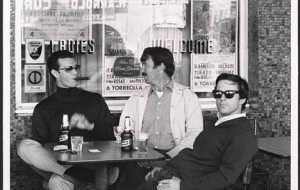
Ed Moses, John Altoon, Billy Al Bengston, and Irving Blum, 1959. Claxton Photo, courtesy ferusgallery.com.
Speaking of which, the Ferus Gallery, which exhibited almost all of the artists currently featured in LACMA’s Reading Room, has been enjoying a major revival. Last weekend, in conjunction with Art Los Angeles Contemporary (yet another new LA Art Fair, this time held at the Pacific Design Center), New York dealers Tim Nye and Franklin Parrasch mounted an exhibition entitled Ferus Gallery: Greatest Hits Volume I, at the exact site of the original Ferus storefront gallery space at 736-A North La Cienega Boulevard, which has served as a tailor shop in the intervening decades. The exhibition featured Ferus veterans John Altoon, Larry Bell, Billy Al Bengston, Bruce Conner, Joseph Cornell, Jay DeFeo, Llyn Foulkes, Craig Kauffman, Ed Kienholz, Roy Lictenstein, Ed Moses, Ken Price, Ed Ruscha, and Andy Warhol. Word on the street is that Nye and Parrasch may take the show on the road, reprising it at The Armory Show this Spring.
Hollis Frampton Revival
Last November, I attended a panel discussion, held at LACMA, on photographs of man-altered landscape. The images in question—coolly composed prints by Stephen Shore, Lewis Baltz, and Robert Adams, among others—all hailed from the 1970s. Of all the panelists, only Douglas Crimp had been a full-fledged adult when the images first debuted. The others, including MOCA curator Philipp Kaiser and LACMA’s Britt Salvesen, had still been in the thick of growing up.
The ages of the panelists didn’t seem to matter much until, during the Q&A, a poised student who introduced himself as “born in 1990” commented that, while the photographs appealed to him because of their obvious skillfulness, he wanted to know what someone his age was supposed to take from work created years before his birth. The panelists understandably stumbled—how do you convince someone to value a history he didn’t experience?
A new screening series featuring the work of experimental filmmaker Hollis Frampton brings this weird tension between the oldness and edginess of “historical” work into exciting focus. Frampton, who began his art-making career as a photographer, made most of his films in the 1960s and 1970s, toying with the physical medium of film as much as with its narrative potential (in Frampton’s Critical Mass, screened last Sunday, a couple quarrels continuously and the breaks, repetitions, and strange overlaps in the frames make human behavior seem absurdly circular–the medium and story are indistinguishable). He also gave incisively smart interviews, and wrote about the practices and ideas behind film-making in a voice that managed to be both theoretically acute and imaginatively candid.
A recent book of Frampton’s writings, collected and edited by Bruce Jenkins, has contributed to an upswing in Frampton enthusiasm over the past two years. During the same time, Los Angeles gallerist Leila Khastoo began considering a potential exhibition of Frampton’s photographs, many of which have never been seen. This proved more difficult than anticipated, since the photographs belonged to public institutions and acquiring them would require a fair amount of finagling. But the process brought Khastoo in contact with Adam Hyman, Executive Director of the Los Angeles Filmforum. Hyman had also been interested in Frampton for some time (Filmforum screened Frampton’s Magellan series ten years ago, but most of Frampton’s work has not been screened in L.A.) and the two decided to collaborate.
Looking at Los Angeles: Pass the Deitch-ie

Mr. Deitch's Summery Treat 2006, Courtesy Saatchi Online Daily Magazine; LA's Museum of Contemporary Art, Courtesy Monica Almeida/The New York Times.
If you’re like me, you’ve already been inundated with a whole range of opinions on MOCA’s announcement this week, and it’s only Thursday. Whether they are ultimately booing or cheering, everyone and their mother seems to be up in arms about the board’s unanimous decision to hire Jeffrey Deitch as the new director of Los Angeles’s foremost contemporary art institution.
Deitch’s reputation as both a savvy business man and over-the-top sensationalist precede him. In various rhetorical feats, these two aspects of Deitch’s notorious career are being claimed by both sides of the argument, simultaneously leveraged as selling points by supporters while being cited by naysayers as evidence that MOCA will find itself hurtling, once again, toward catastrophe. Deitch himself told The New Yorker in 2007, “‘I helped create this whole thing of a professional art-advisory service, and also this fusion of art and entertainment…I’m not sure which one the old school despises more.’”

Deitch floating up and away from NYC, 2007. Courtesy The New Yorker.
It’s been nearly five years since I looked straight into the bespectacled eyes of Deitch. Against my better judgment, I was auditioning for his reality TV show ArtStar, amidst warnings from my New York friends that Deitch was a “polarizing figure.” As it turned out, my audition was unsuccessful and ultimately, so was the TV series. But even if nobody watched it, the show was encircled by countless heated debates, and the move was indeed polarizing. The main concern, of course, was if a reality TV show about art would further erode the problematically shrinking gap between intellectual innovation and populist entertainment.
This week, Bravo announced the details of a copycat art reality TV show, entitled Work of Art: The Next Great Artist (for which I may or may not have also auditioned). News that the show will feature art world heavyweights Simon de Pury, Jerry Saltz, and Jeanne Greenberg Rohatyn has surely dominated the art blogosphere this week. However, Deitch’s appointment by MOCA, coincidentally announced less than 24 hours later, has eclipsed a revival of the debate first sparked by ArtStar. While the Merchant of MOCA controversy traverses essentially the same territory as the reality art TV conundrum—i.e. the complicated intersection of creativity and commercialism—the stakes are much higher in the case of the former.
Looking At Los Angeles: Against The Deluge
Looking back before moving forward is such an endearing habit—like brushing your teeth before breakfast—that it’s hard to resent the sweeping, often grandiloquent judgments that accompany the end of each year (last year, when Daniel Birnbaum called a documentary by Alexander Kluge “a labyrinth as absorbing as any great cultural work of the past century,” I was more than willing to embrace the hyperbolic praise as truth). But now, at the close of a decade in which art often moonlighted as a history project and calculated reticence often seemed more provocative than raw expression, looking back seems especially difficult because looking back is what much of the decade’s art tried to do.
Charged with the thorny task of reviewing ten years’ worth of art, critic Jerry Saltz came up with a strange combination of showmanship and doom. Writing in New York Magazine, he pinpointed Jeff Koons’s towering, endearingly overstuffed Puppy (the version that debuted at Rockefeller Center in June 2000) as the decade’s turning point, “an artifact from the last days of ‘the end of history.’” Appearing a year before 9/11, Koons’s sculpture was an over-ambitious attempt to make guilelessness monumental. It embodied a lighthearted moment of spectacle that would begin to lose its footing (even though as it continued to hold its own in art markets). Puppy, according to Saltz, “laid a beautiful, ghastly laurel wreath at our doorstep. If it could speak, it would say, ‘After me, the deluge.’”
But if Koons’s flower-coated monster represented the end of a certain kind of spectacle (and I think Saltz is right in suggesting that it did, though misguided, perhaps, in the esteem he awards it), then it’s the art that came after Puppy that deserves attention. The decade should belong to artists who saw the supposed deluge as a reason to stop trying to make history and start rephrasing, breaking apart, and rearranging their cultural heritage, freeing repressed fragments of meaning in hopes of informing an unknown future.
Collier Schorr’s Jens F. project still stands out to me as an eloquent example of this sort of rephrasing. Schorr (Season 2) restaged Andrew Wyeth’s portraits of his muse Helga, placing an adolescent boy in feminine poses, subtly turning his body in ways that seemed difficult and unnatural. She treated appropriation, not as something transgressive, but as something tenderly introspective and revealing. Another example, Elad Lassry’s self-described post-picture generation work, is fugitive in that it liberally borrows from commercial iconography. But it’s professional in its sleek, minimal distillation of the ideologies latent in each image. For Lassry and for Schorr, wading through our lineage of cultural imagery isn’t just a prerequisite to moving forward; it’s actually a way of interacting with present and future.
Fittingly enough, Los Angeles has ended the decade with its galleries and museums brimming with art that looks back. At LACMA, a whole exhibition of landscape photography from 1975—New Topographics—has been rephrased. The motivation: simply acknowledging art’s “ongoing concern for man’s use of the land.” On the second floor of Steve Turner Contemporary, Amir Zaki collected antique images, spanning from 1870-1950, of Southern California’s evolution, curating a mini-visual history. At Blum & Poe, Drew Heitzler has remixed films from the ‘60s, removing the narrative arc in order to emphasize strange movements and interactions that plot once repressed.
Looking at Los Angeles: Squeak Carnwath’s Unique Lexicon Channels the Universal
“Most of life is invisible to the naked eye,” proclaims Invisible, a painting in Squeak Carnwath’s new exhibition at Peter Mendenhall Gallery in Los Angeles. At first glance, it appears that the statement is scrawled in pencil onto notebook paper, but upon closer inspection, we see that Carnwath has formed the picture with only oil paint. As with all trompe l’oeil painting, upon discovering that we have been tricked by a pictorial sleight of hand, we find ourselves seduced into carefully examining its mechanics. In doing so, we may discover that–as with life itself–most of the happenings within Carnwath’s paintings are invisible to our naked eye. And–apologies readers– almost all of its happenings are invisible to the camera lens.

Squeak Carnwath, "New Research," 2009. Oil and alkyd on canvas over panel, 70" x 70". Courtesy Peter Mendenhall Gallery.
Ghostly marks hover beneath the filmy surface of each canvas, suspended at varying depths within countless luminous semi-transparent layers of paint. Observing the work becomes a process of active excavation, rather than passive looking. Even though more discernible words and images float to the glowing surface, they do not congeal into a single pictorial narrative, but force the viewer to assemble, bit by bit, his or her own meaning. Perhaps this demand for subjective interpretation accounts for why, according to curator Karen Tsujimoto, “the critical establishment has largely been occupied with the formalist and painterly aspects of [Carnwath’s] work, ignoring its iconographic features…”
Virginia Woolf, whom Carnwath identifies as a major influence, writes, in To the Lighthouse, “What is the meaning of life?…The great revelation had never come. The great revelation perhaps never did come. Instead there were little daily miracles, illuminations, matches struck unexpectedly in the dark…” During my days as an undergraduate at UC Berkeley, I studied with Squeak Carnwath. In the same way that Carnwath’s paintings offer up discrete images and statements that are simultaneously obtuse and resonant, her teaching style is characterized by the offering of koan-like anecdotes and assertions about the nature of painting, and the role of the artist in contemporary society.
Guts Get Out of Hand

Tareq and Michaele Salahi with Joe Biden.
On 7 AM on Thanksgiving morning, I was sitting on my aunt’s couch in Atlanta, watching news coverage about the “uninvited, well dressed Virginia couple” that had crashed Obama’s dinner party the night before. I was thinking about how gutsy you have to be to think you can outsmart the Secret Service—or maybe it’s not guts at all, just senselessness. The funny thing is that it’s often almost impossible to tell the difference between what’s gutsy and what’s senseless.

Act Up, "Silence=Death," 1986. Silence=Death Project, Copy of original from the collection of the New Museum, New York. Photo: Katya Kallsen.
Before going to Atlanta for the holiday, I visited friends in Cambridge, MA, and went to see ACT UP New York: Activism, Art, and the AIDS Crisis, 1987–1993, curated by Harvard’s Helen Molesworth and graduate student Claire Grace. The exhibit chronicles key years of AIDS activism through posters, footage, and hours worth of video interviews (the transcripts of which can be read here). When I first walked into the Carpenter Center gallery, clowns with garish makeup were projected on the wall closest to the door. They were prancing around on urban streets and, not long into the video, filmed by Diva TV correspondents, a police van rolled in. Officers started to arrest the less-than-congenial clowns, another instance in which guts could have been confused with craziness. I knew, because of the context, that the clowns had an important cause behind their behavior—a cause so dire that their outlandishness seemed completely proportionate–and so it was the police that struck me as excessive. But, to someone unaware of the circumstances, the clown’s obstinacy must have seemed over-the-top.
2 weeks ago, while still in Los Angeles, I attended a Sunday afternoon walk-through of LACE’s I Feel Different, an exhibition full of gutsy work that makes sense on an emotional level but often seems rationally absurd, even tasteless. Early on in the tour, curator Jennifer Doyle explained the origins of the exhibition title: Doyle had been visiting her sister when her petite niece had an unmatchable tantrum and let loose cries of agony and anger that didn’t seem like they possibly could have come from such a small body. When Doyle’s sister put the little girl to bed, the girl held a blanket up to her chin and said, “I feel different.” That sentence seemed perfect.
Looking at Los Angeles: The Public School
Gold Leafing. Sadism & Masochism. Practical Electro-Mechanisms. The Coming Insurrection. What do these topics have in common? Perhaps with some head-scratching we could ferret out a few threads, but here’s the one I’m going to address: they are all examples of courses offered by The Public School in Los Angeles. Not to be confused with Los Angeles’ public school system, The Public School operates under the auspices of Telic Arts Exchange, a nonprofit organization nestled in amongst a stretch of contemporary commercial galleries in LA’s Chinatown. The notions of public and private have been a hot topic in our Looking at Los Angeles posts, perhaps because there is more of the latter than the former, and the arenas that are demarcated as public often fail to deliver.
The Public School, however, is true to its name and functions as a site of porous, transmutable, open and democratic educational exchanges. Anybody can propose a class. Anybody can express interest in that class. Once a critical mass of people express interest, anybody can offer to teach the class. A small committee moderates the final steps of the process, including finding an instructor and scheduling the course. However, committee members typically step down after several months, making room for new committee members to join and keeping the system as open to transformation as possible. The result, as you can see from the extensive list of courses offered, is an incredibly varied selection of subjects, ranging from pragmatic to esoteric, concrete to abstract. Yet all classes share a collaborative spirit, owing, most likely, to the democratic method employed in actualizing each course.
Developed in early 2008 as an arena for discourse related to Telic’s exhibitions, The Public School began to grow immediately. Within months, Telic co-directors Sean Dockray and Fiona Whitton decided to discontinue Telic’s long-running program of exhibitions, performances, lectures, happenings, etc. and concentrate on The Public School. Since that time, affiliate public schools have been initiated in five other cities. Dockray answered my questions via email from Brussels, where the newest arm of The Public School opened last week.
Public Art, Private Viewing

Marilyn Minter, "Green Pink Caviar," 2009.
When I heard that Marilyn Minter’s video, Green Pink Caviar, would be showing on the Mezzanine of The Standard Hotel, I imagined something exquisite: maybe the projection would appear on a balcony that curved around the hotel’s lounge, visible to those below and above it. Mezzanine is, after all, the French rendition of something Italian, a word that slides romantically off the tongue and conjures images of wrap-around railings. I was sure seeing Minter on the Mezzanine would be a singular experience. And it was, just not the kind I expected.
Apparently, when The Standard says “Mezzanine,” it more or less means “hallway.” Projected on a back wall, a few yards away from two gold-doored elevators hotel guests seem to use sparingly, Minter’s video played at a slight angle and the hotel’s mood music drowned its soft soundtrack. Usually, Minter’s work makes glamor visceral and slightly repulsive, but in a subliminal way. In this dark hallway, glamor became visceral in the grainy, horror movie sense. The long-tongued model in the video–who, filmed from below a glass surface, licks up colorful syrups–looked like an over-sexed alien, the type David Lynch might think up.
But what bothered me most was that I was supposed to be experiencing a public art project. While I stood there watching, no public joined me and the few people who passed—mainly men in their early 30s, one of them wearing the an L.A. Lakers shirt with silver embossing—didn’t even seemed to notice the video.
Los Angeles, like many other cities, has welcomed an influx of public video and billboard art over the last few years. Many of us within the art community have celebrated this influx as noble, as if art is fighting back against the commercial videos and digital billboards that saturate urban neighborhoods. Lately, however, I’ve found myself questioning that nobility.