Revolution 2.1 | The Year of Accountability: 2012 in 10 Music Videos

January 17th, 2013
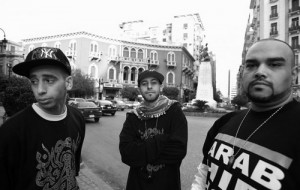
Egyptian hip hop trio Arabian Knightz.  Photo courtesy of the artists.

Egyptian hip hop trio Arabian Knightz. Photo courtesy of the artists.

If 2011 was the year of euphoria, 2012 was the year of accountability. This is the cycle of revolution. As the struggle continues throughout Arab countries in the Middle East, it’s important to remember that democracy is not a quick-fix pill, and a revolution doesn’t fail by process but by abandonment from every citizen. If the following ten music videos, all produced this past year, are any indication, the spirit of the Arab uprisings is loud and clear in its quest to reclaim political and national identity, reframe the Middle East narrative to tell the story of the citizens not the despot, and remind that a revolution is only as good as the people who hold each other accountable to see it through.    

“Kelmti Horra” by Emel Mathlouthi  

One of the most iconic images to come out of the Tunisian protests was of a young woman, dressed in a red coat, returning from exile in France, singing a cappella in a crowd of chanting protesters. The video went viral, and two years later, Emel Mathlouthi (one of Aslan Media’s five music artists to watch in 2012) celebrates her country’s revolution with her 2007 signature song, which became an unofficial anthem for the uprisings that took place after the self-immolation of street vendor Mohamed Bouazizi in December 2010. Calm, confident, sensual, and determined, her tight and almost operatic vocal harmonies both compliment and contrast the song’s simultaneous mournful nostalgia and firm declaration for dignity, human rights and individual freedom.        

“Ana Mawgood” by City Band  

One of the most innovative Arabic music videos to come out of 2012, City Band’s “Ana Mawgood,” released on the first anniversary of Egypt’s January25 uprisings, is simultaneously a confrontation of the brutal violence carried out by the military against protesters, a tribute to youth who have been killed, and a declaration of solidarity to make sure the continuing revolution does not lose momentum. Think Kiss-meets German Expressionism-meets Arabic flair.      

Continue reading »

Revolution 2.1 | Talkin’ ‘Bout My Revolution

October 18th, 2012


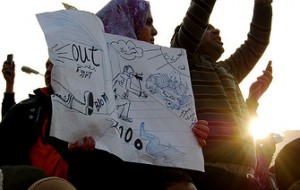
Photo credit: Rowan El Shimi via Flickr.

Arabic metaphor took on a whole new meaning in December, 2010, when a young Tunisian vendor so enraged with the confiscation of his cart set himself on fire to protest the economic conditions that drove him to choose death over silence.  Exactly one month later, an Egyptian restaurant in Cairo chose the same fate.  But these weren’t cut-and-dried suicides.  In a world where language is lyrical, filled with innuendo, the self-immolations of Mohamed Bouazizi and Abdou Abdel-Monaam Hamadah came as rude awakening calls.  The message?  Poetic-speak of the past isn’t going to get you out of unemployment or even the artistic underground.  Serious reform needed a new language altogether – blunt, concise, unforgiving, obstinate.  To the establishment: Leave, period. The very material that protest slogans are made of.

“When they were shouting ‘People Demand the Overthrow of the Regime,’” wrote Iranian cultural scholar and Columbia University professor Hamid Dabashi, “they did not mean just the political regime; they meant also the régime du savoir and the language with which we understand and criticize things… This is the language of revolt in the Arab world.  In the making of that revolt, language is everything, for language is where worlds reside: the one in which we live, and the ones awaiting emergence that have already spoken… It is also the language that makes them familiar to us.”

Continue reading »

Revolution 2.1 | The Dictator Will Be Tagged: Power, Revolution Graffiti and the Deconstructed Superhero

August 16th, 2012


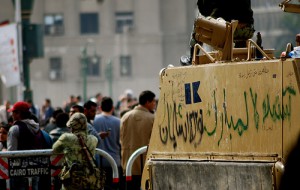
Graffiti on Tank in Tahrir Square. Photo courtesy Rowan El Shimi, via Flickr.

“The words of the prophets were written on the subway walls and the tenement halls.”

-       “Sounds of Silence,” Simon and Garfunkel

Amidst all the other messages spray-painted around Tahrir Square, calls to action and demands for ousted President Hosni Mubarak’s resignation last year, one military tank stuck out.  “The revolution is in Tahrir,” it read, “no sleeping in bed.”

It was a common consensus amongst protesters, who rallied, and continue to speak out, to replace government corruption with reform, and despite sugar-coated concessions that underestimated a country’s intelligence by treating amendments like band-aids, that one thing was clear: the energy of the people refuses to wane.  Instead, it continues to ceaselessly evolve as revolutionaries and reformers persistently provoke themselves and each other as creativity splinters through the cracks of worn-out censorship.  In this sense, art fueled the revolution by giving the disenfranchised–the outsiders, the rebels, the refugees, the critics–a second draft to rewrite their country’s cultural memory.

Graffiti depiction of Gaddafi, Libya. Photo courtesy of Aslan Media via Flickr.

Before the Arab Spring, authorities used public art as a means of propaganda, a projection of autocratic state power as status quo.  Massive canvases depicting faces of the regime hung from buildings all throughout cities, staring down like Big Brother, like constant surveillance on any form of dissident activity. “This history of art is a sequence of successful transgressions,” wrote Susan Sontag.  “Traditional art invites a look.  Art that is silent engenders a stare.”  Most of the time, these faces were accompanied by background images invoking nationalism or even Islam, suggesting what Joseph Campbell called “clues to the spiritual potentials of the human life.”

Continue reading »

New Column | Revolution 2.1: Art and Resistance in the Middle East

August 16th, 2012

We’re very pleased to announce the Art21 Blog’s newest column, Revolution 2.1: Art and Resistance in the Middle East, penned by former guest blogger Safa Samiezade’-YazdRevolution 2.1 focuses on the second chapter of the Arab Spring, from the creative expression that flourishes within both the establishment and underground–documenting, questioning and reflecting the cultural and societal changes of a country rebuilding itself in the 21st century.  Samiezade’-Yazd will look at revolution within the greater Middle East in all its romanticism, competing ideologies, letdowns and triumphs, under the critical lens of the cultural forms it inspires–art, music, poetry, and performance. The column will also explore how artists, performers and writers document their countries in resistance and rebirth, while also holding reform accountable for following through on the poetic justice that ignited the “delayed defiance” (as Hamid Dabashi puts it in his book The Arab Spring) of an individual country and a region as a whole.

Currently based in Denver, Colorado, Safa Samiezade’-Yazd is an Iranian writer and editor whose expertise falls into two categories: contemporary art/performance and the Middle East. Together, the two give her a unique perspective on the depth of a region that is usually overshadowed by its politics. Safa currently edits the arts, film and music sections for Aslan Media Initiatives, an online non-profit news source on the Middle East and its diasporic communities. Her three one-woman shows explore Iranian identity in America–one through the veil, the second through Khomeini, and the third through the Islamic practice of temporary marriage. All three have been performed in Colorado, Vermont, and New York City, and one was presented at the Women Playwrights International Conference at the University of Mumbai.  Recently, she co-curated the first festival of Iranian theater to be presented in the United States, which earned recognition in Backstage Magazine, The New York Times Arts Section, NPR’s All Things Considered, WNYC, BBC Radio, Frontline’s Tehran Bureau, and Voice of America’s Persian News Network, which re-aired her interview as a “Best of VOA” segment.  Safa holds an undergraduate degree from the University of Denver and a Masters of Fine Arts degree in Interdisciplinary Art from Goddard College.

Revolution 2.1 will post on the 3rd Thursday of each month.