Creative Killing?
Recently I was on the subway and looked over the shoulder of a teenager playing a video game on his iPhone. The objective, at least it seemed, was to shoot at people on the street from a rooftop in order to score points. Sort of like a “sniper” video game. At one point in the video it looked as though a family was crossing the street and without flinching the teenager simply picked them off one at a time to rack up more points.
I played video games where I shot things as a child, but those things were never, ever people. People aren’t things. I was most often aiming at space aliens or fuzzy pixilated rockets being launched in my direction. My Mom didn’t even want me pointing a toy gun at someone, never mind playing a video game where I piled on the points by shooting people down.
So here’s what I don’t understand…
While writers such as Christopher J Ferguson assert there isn’t enough evidence to link video games to societal violence and violent crime (and believe me, he makes a good case) do we really need proof that these kinds of games influence aggressive behavior in order to begin taking a stand against graphic violence towards fellow human beings as “entertainment”? Do art educators need proof before we begin deconstructing these games with our students and really get into what they’re about? While killing people on a screen isn’t actually killing, do we need to wait for something in particular to question why we want to send Junior into his room to kill people on the tv?? Manufacturers of video games roll these things out like there is no tomorrow. Some of the more graphic series include:
- Manhunt
- Mortal Kombat
- Grand Theft Auto
- Modern Warfare
- Resident Evil Zero
- Postal
- Splatterhouse
The list goes on. All involve violent killing and often players actually get extra points for “creative” kills.
But what exactly is creative about killing?
While the NRA is quick to blame video games for violent behavior because they would much rather talk about something else besides banning assault weapons and ammunition (thank you, Governor Cuomo), I think that organizations like the International Game Developers Association could have a dramatic impact on the future of video games worldwide if the “creative” end of gaming wasn’t so consistently connected to killing people on a video screen.
More Moments, More Dialogue
Happy New Year!
This week I want to follow up on the two most recent posts, Speak About What’s Unspeakable and Teachable Moments in 2012, because there are some loose ends to attend to.
First, just to update last week’s column regarding some of the most teachable moments in 2012, it was brought to my attention that I missed a few:
Rineke Dijkstra’s retrospective at the Guggenheim, along with Zoe Strauss at the Philadelphia Museum, taught us that portraiture most certainly can go beyond appearances and telling stories. It can even teach us about ourselves.
A new teaching assignment at NYU, which included supervising the Saturday Visionary Studios program for high school students taught me that thematic courses, not just units of study, can be exciting for teachers and students alike.
Scaling back the more traditional format for TASK and using very few supplies taught us that you don’t need a ton of materials to achieve the goals intended, as we did with Oliver Herring this past July to kick off our 4th year of Art21 Educators in New York City.
Finally, revisiting Richard Long’s “A Line Made By Walking” was another teachable moment that has become, for me, a metaphor of sorts when it comes to teaching with contemporary art.
Now, getting back to Speak About What’s Unspeakable, which was written just after the Sandy Hook Elementary School shootings in Newtown, Ct, I want to share an update on some next steps for my own classroom….
I am in the midst of writing a unit of study for the 2nd semester titled That’s Entertainment?? Students in my high school foundations classes will be doing research into children’s games, video games, films and television shows that in some way make the act of harming or killing other people the main objective. I believe that one way to construct a dialogue about what has happened at twenty-one K-12 schools since 2000 is to begin having frank discussions in the classroom about America’s obsession with violence. Continue reading »
Teaching with New York Close Up: David Brooks Tears The Roof Off
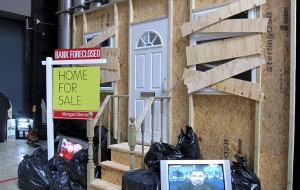
David Brooks Tears The Roof Off is an apt title for one of our most recent New York Close Up films this summer. Within the first 60 seconds of a pretty intense tour that runs under eight minutes we get to hear Brooks passionately describe the housing boom that has threatened the Everglades in South Florida, a place he has personally visited for decades. We are then introduced to an installation titled Desert Rooftops inspired by this crisis and completed right here in New York City… literally on the last undeveloped lot in Times Square.
While the housing industry shamelessly encroaches on the protected Everglades, here we see midtown skyscrapers “framing” this “viral” layout of rooftops connected- sprawling- throughout the space. Brooks acknowledges that the work is perhaps difficult at first to recognize as art, but as the viewer engages with it and makes associations it becomes clear that something curious is going on and this isn’t some three-dimensional promo for a roofing company… even if Fox News couldn’t figure it out (and does the anchorwoman say “Home Depot” or “Home Thiebaud”? Just asking).
Brooks’ work can appeal to students in different ways, opening up a mixed bag of questions and assumptions, such as:
- What kinds of things can we use to make art?
- Does having an explanation or narrative help or hinder the viewer’s experience?
- What kinds of associations can viewers make engaging with a work such as this?
- Can public art tell stories that “white cubes” cannot? If so, how… and why?
- How can more artists make environmentally conscious work and not mirror a “resource-devouring” industry like home construction?
Students who watch the film can also investigate how past and present examples of suburban sprawl have affected other places, as well as the things that have been produced by artists and others in response.
Finally, David Brooks talks about Desert Rooftops being “instigated” by the space in Times Square but I think it actually plays a little tug-of-war with it. These rooftops, seeming to grow like weeds from the small plot, are practically being watched and scrutinized by the surrounding buildings that tower over them. They spread throughout the plot quite freely yet the fence reminds everyone that this is the end- this is the edge of the frame. And in this way the work goes on to speak about both sprawl and a kind of containment.
Occupy This
Yinka Shonibare MBE says in his season 5 segment that he would like to have the “trappings of wealth” himself, even though he may be criticizing it. And being made a Member of the Most Excellent Order of the British Empire is classic irony. It’s like giving Occupy Wall Street protesters keys to the city. But then again, maybe we should be giving these people keys to the city instead of forcing them to stop setting up and speaking up. Instead of blocking out reporters, maybe the mayor should be giving the press police escorts into the action. “Occupy” protests are calling attention to the inequality of 99% feeling the ever-increasing weight of a financial foot across their throat. People continue to struggle without jobs, health care, and especially hope. The fact that Occupy Wall Street protesters do not have specific “demands” doesn’t bother me. Calling attention to inequality in this way is a positive thing. More voters- from any political party- need to add their voices to the protests. (New York Close Up artist Martha Colburn recently filmed an Occupy Wall Street protest. Check it out here).
Working with a theme like inequality in the classroom can be a challenge. Similar to teaching about racial prejudice, there’s a ton that may go unsaid in a class discussion, but that doesn’t mean it isn’t important for students to think about (and even write about) these things. What do our students imagine Occupy protesters stand for, or want? What would they do if in charge of the protests? How can they get involved, even if they’re not able to actually attend?
When I think about teaching with the theme of inequality in the classroom, I am first interested in the ways it can be taught at different grade levels. For example, in elementary school, students can be taught that shared decision making and collaboration is important for positive interaction among people. Working with an artist such as Oliver Herring can be a good place to start, as he works with others to help make his photographs and videos.
Middle school students, especially given the recent popularity of anti-bullying campaigns, can be exposed to the work of season 3 artist Krzysztof Wodiczko, especially in his Art21 Exclusive “Peace”, as he encourages viewers to speak “what is unspeakable” in order to avoid a “death of democracy”. If this doesn’t connect to Occupy Wall Street, I don’t know what does.
Finally, high school students might look into the season 4 segment featuring Allora and Calzadilla as they share the story behind their interactive work, “Chalk (Lima)”. Here, students get the opportunity to learn about protest in a way that is unconventional and non-violent, to say the least. Unless, of course, you consider “arresting” chalk particularly violent.
Other Art21 artists that address inequality in their work include Mark Bradford, Jenny Holzer and Alfredo Jaar, to name a few. And if you have used Occupy Wall Street in the classroom or taught about inequality with contemporary art, please share your story.
This week, let’s give thanks for the Occupy Wall Street protesters and Occupy protesters in dozens of other cities as they speak up for 99% of the 99% unable to stand alongside them.
Joy and Revolution: Talking with Adam Weiler of Ambrose
If you’re not familiar with Ambrose, well…. you should be. A few months ago on a trip to work with teachers at the Holland Area Arts Council in Michigan I was fortunate enough to meet Adam Weiler, the creative director of this atypical after school club, and immediately became interested in the work his high school artists were producing. The website for Ambrose perhaps says it best:
Ambrose is the greatest after school club in the world. Every month we feature a guest artist, develop a new tee, and complete a skill building collaborative project. Our goal is to grow citizens with strong capacities for creative problem solving, design thinking and entrepreneurship.
I became interested in Ambrose not just because they produce really cool t-shirts, but also because of the buzz that surrounded this group from the moment I landed in Grand Rapids. Many people, including teachers taking the weekend workshop with Art21, had nothing but positive things to say about the work Ambrose has done and the effect it has on kids who participate. Below is part one of an interview I conducted with Adam Weiler this summer:
Joe Fusaro: Tell me a little about how Ambrose is different from other “after school clubs” and how do you sustain participation in this kind of thing when so many projects like Ambrose start strong and then fade over time?
Adam Weiler: When we were first starting the program we surveyed both local business owners and creative professionals to see what they were looking for in potential employees. We found both sides wished they had a deeper understanding of the other- businesses wished they were more creative and creatives wished they had a better understanding of business. This focus on the business side of art and the art side of business sets us apart. Since we’re not associated with or funded by a school system we’ve been forced to take our own medicine and find a funding model that works in order to keep the program going. This year we launched a new line of shirts where our visiting artist of the month designs a shirt that we print with students. We’re constantly trying to find new workable ways for students to be involved in all aspects of the project such as planning, production, branding, etc…giving them more ownership and say in the direction of the workshops.
Regarding student participation – in a lot of ways Ambrose is like any other after school program. Every year students graduate and new students enter – group dynamics and energy are variables that constantly change. I think the personal attention of committed volunteers have helped retain students over the last three years. Professional adults in our community have been really excited about giving back in a way that connects with their passions. We have a solid group of weekly volunteers that are talented, genuinely like each other, and care about students’ development. It’s a trifecta, if you will, and I think it creates a culture that students want to be a part of.
JF: So how do you select artists to work with the group?
AW: The guest artists thus far have been friends of our community and friends of friends. It’s pretty grassroots. There are some really well organized creative networks in our region…and generous. When we’ve reached out to individuals they have been more than willing to help out, which is encouraging.
JF: And when you say students “graduate”, do you mean from high school, or is there some kind of graduation from Ambrose? Do students have the option of working with Ambrose after they are out of high school?
AW: Graduate from high school. We’ve noticed a real need for creative community amongst students who have graduated from school but aren’t pursuing college degrees. Up until this year the program hasn’t had any hard boundaries so those students still stop in for the occasional workshop. Occasionally during college breaks we’ll have “alums” come back to share what they’ve been learning, what whey wish they knew, and validate the importance of foundational skills (drawing from life / observational skills). This year we’re doing things a little differently. There will still be an open door to alums coming back but we’re going to have a hard graduation that marks a student’s initiation into the next phase of development.
5 Questions for Contemporary Practice With Gregory Sholette
Artist, scholar, organizer, and professor, Gregory Sholette embodies multiple ways that artists can interrogate history, politics, and public discourse. Through his initial work with the group REPOhistory (1989-2000) (as in, “repossessing history”), he, along with other art groups and individuals of the 80s and early 90s, effectively drew attention to the artist as a social and political actor. Sholette’s collaborations with REPOhistory also presented art works as vehicles for addressing submerged socio-political histories, such as in the group’s Lower Manhattan Sign Project (1992-1993), in which they posted signs around Manhattan offering information about “the unknown or forgotten history of Manhattan below Chambers Street.” Sholette has also been an active participant in PAD/D (Political Art Documentation and Distribution [1980-1986]), an organization devoted to the publication and distribution of documents regarding the intersection of aesthetic politics and activism. Most recently Sholette has founded an archive for futures that “never happened” (The Imaginary Archive, 2010-present), and has been involved with The Institute for Wishful Thinking, an organization that attempts to harness the “untapped” potential of artists by soliciting proposals for projects which might effect governmental and social change.
Despite Sholette’s robust participation with other artists and activists and his tendency to only exhibit his own work in group shows, the works and projects he has produced independently of collaboration feedback vitally into a more collective practice (something he discusses at length below and in a previous “Inside the Artist’s Studio” feature). Meeting Sholette in person, I was struck by his interest in subjects ranging from the popular to the occult and counter-cultural. Sholette’s range of interests are brought to a focus in the book Dark Matter: Art and Politics in the Age of Enterprise Culture, in which he considers artworks that have fallen through the cracks of official art-historical discourse. Such works offer sites of (potential) resistance and autonomy inasmuch as they are not perceived as “art” proper and so remain liminal to the expropriative tendencies of cultural capital. Works by the “outside” artist, the craft artist, the hobbyist, the amateur, and the self-critical “drop-out” appear throughout Sholette’s book, offering examples, if not models, of what art can do guided by different values and habits.
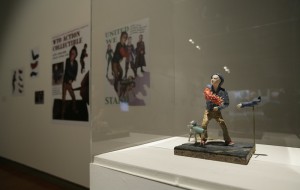
After the work of the film-essayist Chris Marker or the literary theorist Walter Benjamin (two professed heroes of the artist), Sholette turns his attention to the abandoned and unattended, cultural products so prosaic that they would seem neither worthy of our critical attention, nor our powers of reappropriation. The stuff ripe for re-use in Sholette’s work one would hardly call “redemptive,” and yet something is redeemed through the artist’s taking them up—a potential to make legible things just below the attention, what becomes “dark matter” because the culture at large just doesn’t know where to put it. Through the use of action figures in particular, a preferred format of hobbyists, he addresses problems ranging from post-Fordist labor practices (i am NOT my office, 2002-2004) to representations of Italian Fascism (Deconstructing Mussolini, 2007) and the exploitation of child workers (Little Workers Collectibles).
Sholette’s dirty messianic approach also comes across in his appropriation of dioramas, window and museum displays, and souvenirs. Playing upon our familiarity with these 19th century formats, Sholette moves fluidly between sentimentality and criticality, ironic abandon and the recognition that, as Walter Benjamin famously wrote (and Sholette quotes through a particular work of his citing the relationship between John D. Rockefeller’s founding of the New York MoMA and management of his public image after a mining disaster): “There is no document of civilization which is not at the same time a document of barbarism.” Moving within the flicker of “civilization” and “barbarism,” Sholette tells history slant, through the eyes of the losers, the unrecognized (and unrecognizeable), citing the places where anomalies and antagonisms crucial to history’s retelling “flash-up.”
Community Arts Training Institute: A Conversation with Roseann Weiss

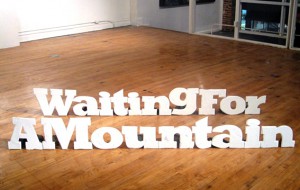
Stan Chisholm, "WaitingForAMountain," 2010. Installation at Art Dimensions Gallery, St. Louis. Chisholm is a graduate of the CAT Institute.
During my time as a guest blogger for Art21, I’ve examined various initiatives that have transformed the cultural landscape of St. Louis. Despite the city’s dwindling population, the arts are prospering in St. Louis, as evidenced by the ever-increasing number of contemporary art organizations, the abundance of creative activity on Cherokee Street, in Grand Center, Old North, and Hyde Park, and the social commitment of artists like Juan William Chávez and Theaster Gates. As I was thinking about how I’d like to wrap up my examination of the St. Louis art scene, I felt the need to more precisely pinpoint the catalyst for cultural activism within the city.
I began this formidable task by arranging meetings with culturally engaged social workers. Social work, like art, is constantly re-defining itself and expanding its perimeters. Over the past year, I’ve become increasingly aware of the growing number of Master of Social Work (MSW) graduates who, coming out of Washington University’s Brown School of Social Work, have pursued careers in the arts. The marriage of social work and contemporary art forms a crucial partnership in arts-based community development. Equipped with macro-level analysis and evaluation skills, the social workers I met with helped me better understand our current artistic movement within the broader social context of St. Louis.
First I met with Lisa Harper Chang, the Community Projects Director at the Pulitzer Foundation for the Arts. In 2007, Chang established the initial partnership between the Pulitzer and the Brown School and her contributions have since paved the way for future MSW students—such as Emily Augsburger and Megan Johnson—to fulfill their social work practicums at the Pulitzer. Next I met with Regina Martinez, an artist and social worker, who, as I mentioned in my previous post, is working with Theaster Gates and the Rebuild Foundation to start a community arts center in Pagedale, St. Louis. After that, I interviewed Claire Wolff, founder of Urban Studio Café, a non-profit coffee shop in Old North that used its proceeds for arts programming. Lastly, I met with Amanda Moore McBride, Associate Dean for Social Work at the Brown School, who explained to me that the program’s recent emphasis on cultural activism evolved from a movement from within the student body. Each of these meetings demonstrated how social workers are increasingly helping to refine the goals of community art initiatives in our city.
Creative Rebuild: Theaster Gates in Hyde Park, St. Louis

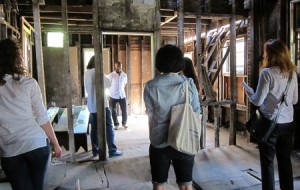
Theaster Gates leading a tour of a once-abandoned home that is now central to his creative rehab efforts in Hyde Park, St. Louis. Image courtesy of the Rebuild Foundation.
Artist Theaster Gates likes systems. And what he likes more than a system itself is knowing how to leverage it. Though formally trained in handling clay, Gates also uses the structure of neighborhoods, cultural institutions, and universities as his artistic medium.
Over the past few years, Gates has earned a reputation for his social-based practice, in which he intertwines art, urban planning, and community activism. In a recent conversation, he expressed frustration with the accepted scope of what it means to be an artist. He particularly dislikes the phrases “artist as change agent,” “artist as social worker,” or “artist as entrepreneur.” Gates explained that “the word ‘as’…shifts the possibility that an artist could be entrepreneurial, or have interest in the social, or have interest in architecture. It says you have to be ‘both this and this.’ It separates a person into these compartments. Versus: ‘I’m an artist and my skill set includes these things.’” With degrees in Ceramics, Urban Planning, and Religious Studies – and a brief stint in Pre-Pharmacy – Gates embodies the myriad identities that can be folded into being an artist.
Though Theaster Gates is nearly a household name in Chicago and is widely recognized throughout the art world – he was included in the 2010 Whitney Biennial – he recently has garnered attention in St. Louis for his cultural revitalization initiatives. Last year, Gates founded the Rebuild Foundation, combining the various facets of his practice within a single non-profit organization. The Rebuild Foundation brings together artists, architects, developers, educators, and community activists to help revitalize under-resourced neighborhoods. It currently manages projects in Detroit, Omaha, Chicago, and St. Louis. In just one year alone, the Rebuild Foundation, with the energetic on-site commitment of Dayna Kriz, has become a major force in St. Louis’s Hyde Park neighborhood. Located in north St. Louis, Hyde Park is a historic neighborhood that has fallen upon hard times as a result of post-war deindustrialization and the ensuing population decline.
Of Monuments and Memorials: St. Louis Modernism and Juan William Chávez’s Pruitt-Igoe Bee Sanctuary

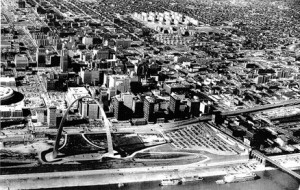
Saint Louis skyline with Eero Saarinen's Gateway Arch in the foreground and Minoru Yamasaki's Pruitt-Igoe housing development in the back right. Image from "The Pruitt-Igoe Myth" documentary.
Notable attention has turned to what many consider the golden age of modern St. Louis—the 1950s—when the city reached its highest population and garnered international attention for its architectural contributions. However, within this renewed interest in mid-century St. Louis is also an attempt to detach the persisting nostalgia for the past from the actual social, economic, and political circumstances that were at play.
At its best, mid-century St. Louis produced celebrated icons—Minoru Yamasaki’s 1956 Lambert air terminal and Eero Saarinen’s 1965 Gateway Arch. During its less proud moments, modern architecture failed to adapt to the unique demands of our city, exposing the shortcomings of its “universal” ideals. In St. Louis and beyond, discussions on the failures of modern architecture often center on Yamasaki’s Pruitt-Igoe housing development. Completed in 1956, the monumental public housing project was razed only twenty years later. Its demolition was felt around the world, and in 1977, historian Charles Jencks famously claimed that the destruction of Pruitt-Igoe marked “the day Modern architecture died.”
When constructed in the mid-1950s, Pruitt-Igoe represented the hopeful vision that the city of St. Louis would maintain its steady population growth. As government officials and other stakeholders saw it, increased populations meant increased real-estate values. As a result, low-income housing was tasked with cleaning up the sprawling slums through systematically concentrating people in modern high-rise structures. At its peak, Pruitt-Igoe housed roughly 15,000 people in thirty-three eleven-story buildings. However, the rapid onset of white-flight and suburbanization revealed the many flaws in this plan. Pruitt-Igoe failed for a number of reasons, including Yamasaki’s architectural design, inadequate maintenance of the building, and decreasing tax dollars for public housing. Released in February of this year, a new documentary titled The Pruitt-Igoe Myth paints a much more complicated picture of Pruitt-Igoe than has been told in the past, sharing first-hand accounts of former tenants that help to humanize the housing development.
Pushing the narrative beyond the trials of modernism, artist Juan William Chávez explores creative possibilities for the still unoccupied land where Pruitt-Igoe once stood. As I introduced in my first post, Chávez is a pivotal force in the St. Louis art scene, founding Boots Contemporary Art Space on Cherokee Street in 2006 and winning the Great Rivers Biennial at the Contemporary Art Museum St. Louis in 2008. Just last year, Chávez closed Boots, moving beyond the gallery walls to focus his practice on community engagement. In 2010, Chávez curated Urban Expression: Theaster Gates for the Pulitzer Foundation for the Arts. His cultural activism has recently earned a great deal of attention and this year Chávez was awarded the Missouri Arts Award for Individual Artist and received the prestigious Art Matters Grant.
5 Questions for Contemporary Practice with Sanford Biggers

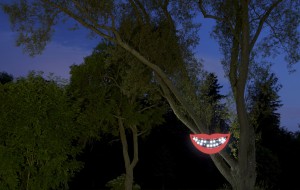
Sanford Biggers, "Cheshire," 2008. In situ, aluminum, plexiglass, LEDs, timer, 67" x 33" x 10". Courtesy the artist and Michael Klein Arts, New York, NY.
Images from popular culture abound in Sanford Biggers’s work, and particularly from hip-hop, East Asian Buddhism, and the Antebellum and Afro-Futurist African-American. Two images that have become particularly emblematic for me among his works are the post-Pop Art-ish, cherry red lips of his signage-sculpture, Cheshire, in reference to the grinning cat made famous by Lewis Carroll’s Alice in Wonderland. It is also the Buddhist Mandala, the patterns of which cover the floor-tiling of the artist’s Mandala of the B-Bodhisattva II, upon which break-dancers pop, lock, and spin invoking the cosmic intuitions of the hip-hop dance form.
The images are telling of Biggers’s dual commitments. On the one hand, to a world of appearances, of masks that represent cultural and personal survival, the need to change one’s appearance in order to persist. If you recall, the Cheshire cat lost his body becoming only his grin in order to avoid decapitation by the Queens of Hearts in Carroll’s tale. On the other, there is an aspect of all of Biggers’s work that reaches towards the vertical, divine, and cosmic through the quotidian and culturally synthetic. A pair of nunchucks, one of the martial arts weapon revered by hip-hop and soul music in the 70s, is encased within a glass display (Nunchucks). In the installation, The Afronomical Ways, one enters a room with a mirrored floor. Upon the ceiling is a DayGlo Zodiac chart in which the signs of the Zodiac have been replaced by men and women making love in a variety of positions—a different position for each sign. In another piece, Hip Hop Ni Sasagu (In Fond Memory of Hip-Hop), Biggers has melted down hip-hop ‘bling’ (jewelry) into a set of bells that will eventually be played by an ensemble in Japan at a Zen Temple. Whereas one associates hip-hop jewelry with a very American form of materialism, one typified in many rap songs, melting them into bells transmutes them into forms both ephemeral and eternal, transitory yet specific. While, as Biggers notes in an interview, the bells will probably long outlast him, their tones linger and mix in the air only for a moment, struck among other bells—both ancient and newly cast—in the improvisatory performance of Hip Hop Ni Sasagu.

Sanford Biggers, "The Somethin' Suite," 2007. Multimedia performance commissioned by Performa 07, New York, NY. Courtesy the artist.
Biggers makes me think again and again of the culturally hybrid and plastic. While I don’t think his relationship to Buddhism/East Asian forms is at all insincere or put on, it also seems to me that almost anything could find a place in his inclusive cosmology—a cosmology that becomes commonplace in its ability to translate and transform disparate, if not at times antagonistic, cultural materials. The plastic qualities of Biggers’s work also reach backwards into time, exploring the future as a condition of the past, and vice versa. Some of this exploration involves an investigation of museum archives and curatorial regimes, such as in Nunchucks, but also in various works such as Olmec Afropick where Biggers has placed a wooden hair-pick depicting a clenched fist raised in the air, the image of Black Power, next to a sculpture of African origin depicting a similarly clenched and raised fist. In another work, Janus, one sees encased the head of Vanilla Ice opposite MC Hammer, repurposed from rap action figures of the two. Within the museum it is as though mythological time compresses and blends, conflating chronologies and heterogeneous cultural durations. Resemblances are struck, but they also clash and ricochet. As Biggers discusses below, works like his Jocko, which references the ubiquitous jockey lantern of many an American lawn, send one back to original cultural referents, referents that may have meant something radically different in their original contexts than they do today. So with time certain mytho-historical images crystallize, while others split apart, fragment, and obscure, following their divergent arrows of time.