Grand Canyon Journal 3: The Painter of Video to Life
Our previous guest blogger, Karthik Pandian, continues his Grand Canyon journal in the following post. — Ed.
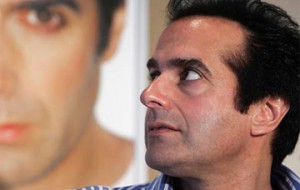
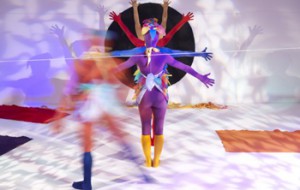
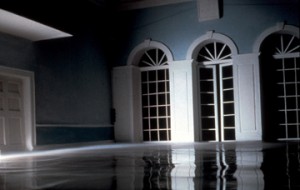
Has there ever been such an elegant dramatization of the power of illusion as David Copperfield’s “The Painter”? Art and magic share the stage (which strangely recalls both David Letterman’s set and Monica’s apartment from Friends) in a trick that only gently conflates the initial discomfort of Harold and Maude with Copperfield’s problems with the law. This trick has surprisingly old-fashioned art direction compared to the techno-industrial fetishism we’ve come to expect from Copperfield. Perhaps this is to suggest that art is the dustier of the two illusory practices, in need of far more maintenance by doddering old maids. Indeed, in the first few moments of the video, Copperfield’s artist puts down the paintbrush in favor of the magician’s rose. While “The Painter” is certainly not his most spectacular trick, it thematizes an emerging struggle between art and magic that is surprisingly relevant to the experience of post-thematic Las Vegas today and does so through a romantic vision of geriatric love without recourse to even a single bathtub!
“Video to Life” provides more evidence to support our hypothesis that members of the Italian architecture collective Superstudio art-directed Copperfield’s performances after they disbanded in 1978. The recurrence of the motorcycle in his oeuvre (it’s one of his go-to entrance and exit strategies) also warmly reminds us that we got here not only from the Grand Canyon on David Copperfield’s magic carpet, but also Ed Harris’s trusty steed. But what “Video to Life” also brilliantly dramatizes is how video as conjured by television, and not painting or even performance, is the central medium of Copperfield’s work and of the countless magicians that follow in his footsteps to take advantage of this already deeply illusionistic medium. However, rather than play with the formal codes, framing and documentary pretentions of television in the age of the flatscreen á la David Blaine (who is the verité-dedicated Jean Rouch of illusion) and Criss Angel (the more gothic Grunewald-ian who gets extra points for location scouting and the use of available light), Copperfield is more like the Nam June Paik of magic, preferring to use TV-like objects in his performances. The box in “Video to Life” is in between an inverted rear-projection TV (with the projector on the outside) and a magic hat which Copperfield pulls televisual objects out of. Copperfield works his magic by conducting the beliefs and disbeliefs that are entangled in this strange object. These include our belief in the light projected from a projector and the shadows cast by a body moving before it, our disbelief in the images projected from that projector or any TV, but also our totemic belief in television as a medium that speaks to us and that we have the potential to occupy. Thus, there is another immaterial projection, embodied by the physical projector at the bottom of the frame, that speaks to our desire to enter the image, to get on the motorcycle, to be Copperfield: “David Copperfield.”
A Look Into the Future with Saya Woolfalk

- Saya Woolfalk, “No Place: A Ritual of the Empathics,” 2009. Courtesy of the artist.
This November, New York City will once again be abuzz with PERFORMA, the sprawling biennial dedicated to performance art. This year’s event boasts participation by more than 90 artists at over 70 different venues. I’m personally excited about a new piece by Saya Woolfalk at the Studio Museum in Harlem, titled A Ritual of the Empathics.
Woolfalk works across media, combining painting, performance, sculpture, and video to “playfully re-imagine the representational systems that hierarchically shape our lives.” Her works are characterized by plush multicolored costumes and toy-like forms, and a coloring book aesthetic marked by fruit punctuated landscapes, sharp-toothed creatures and a palette pink aplenty. But taking her inspiration from ethnographic, feminist, and psychoanalytic theory, Woolfalks’s worlds of whimsy are for your more sophisticated inner child.
Over the last four years, Woolfalk has built up the complex tale of No Place, a fictional land inhabited by Empathics, Pleasure Machines, Cleaners and other characters (comparable to the narratives of Season 2 artist Trenton Doyle Hancock). In the conversation below, Woolfalk explains her project No Place, and how she uses fantasy to depict our present reality and multiple futures.
This interview was conducted by phone.
***********
Nicole J. Caruth: Will you start by explaining the basic storyline underlying your recent work?
Saya Woolfalk: Sure, there’s a lot of information to take in. [On my website], you’re looking at a multi-part project for which there are three temporalities: the present, the future, and the future of the future. The future of the future is the No Place project, which I predominantly worked on [as a resident] at the Studio Museum in Harlem. In the exhibition there, I showed [among other pieces] Ethnography of No Place, a six chapter ethnographic film, which is basically a series of important parts of our present culture (birth, death, etc). I worked with anthropologist Rachel Lears to both imagine and document this place. Continue reading »
What’s Cookin at the Art21 Blog: A Weekly Index
Sports and art are holding hands. Trong Gia Nguyen takes us to first base with that and other news relating to Art21 artists.
Bruce Willis was a pub rocker, Scarlett Johansson an indie vocalist, and Paul McCartney an abstract painter? Ben Street reflects on cross-over artist Steve McQueen’s addition to the Venice Biennale.
What does the Mütter Museum have to show? Guilty pleasures and the off-beat alike from Daniel Fuller.
No Nukes! Get involved with the art of Lisi Raskin.
Yup, it’s hot. It’s August. And it’s never too late to add to your reference archive. A Marlene Dumas exhibit is a source of inspiration for Joe Fusaro.
Imagine what character you would play? An Xiao whispers her secret. (P.S. - Cao Fei’s work is awesome, in the most true sense of the word.)
Photography may “feel visually right” but is factually wrong. What does Season 5 artist Florian Maier Aichen have to say about Fantasy?
Hungry for some Green Pink Caviar or how about a visit to Above June Lake? Catherine Wagley finds that Marilyn Minter brings us in while Florian Maier-Aichen pulls away, yet both professionalize fantasy.
The past as noir and domestic spaces in faraway places? Juan Juarez knocks on the door of artist James Casebere and shares the consequent vintage BOMB interview.
Meet Josiah McElheny’s long time assistant and collaborator Anders Rydstedt in this week’s Exclusive video.
Still hungry? There’s more where that came from. Stay tuned.
James Casebere interviewed by Roberto Juarez
Welcome back to BOMB in the Building, where each week we feature a vintage BOMB interview relating to a Season 5 artist or theme. This week we look to the work of James Casebere, who, like Florian Maier-Aichen, has been aggressively pushing the boundaries of what photography is and could be with his tabletop simulations of archetypal institutions. “Casebere’s photographs evoke our deepest fears and longings,” wrote Roberto Juarez, who interviewed the photographer in BOMB 77, Fall 2001. “Perhaps this is because his images captivate our collective imagination, the one ruled by instinct.” Read the full interview here.

James Casebere, "Monticello #3," 2001, digital chromogenic print, 48×60”. Courtesy Sean Kelly Gallery, NY.
Roberto Juarez: I have my ideas of why you used black-and-white photographs in your earlier work, but tell me—why did you use black and white instead of color?
James Casebere: Black and white had more to do with memory and the past. Color was too much about the present, I associated it with color TV, which was not a part of my past. I wanted the images to be related to a sense of history, let’s say, whether personal or social. And I think black and white adds a certain level of abstraction.
Roberto Juarez: What were the images, in the Penn Station installation?
James Casebere: Most of it was a synthesis between two bodies of work, a combination of domestic space in the foreground with romantic, faraway places in the background. I tried, in part, to simulate the experience of sitting on a train, looking out the window. But the foreground might also be a dining room, or a kitchen, or a café.
Roberto Juarez: How did you create that? Was it a layering of pictures through exposure, or was it from a model that you built?
James Casebere: I built a model. Half the time, there’d be a frame dividing the foreground from the background. The backgrounds were images of the American West, corrals, and also one image of a sinking canoe, and one which was simply an outdoor train platform. There was a mission facade in another image. I was trying to create a sense of wistful reverie.
Roberto Juarez: The West is a very romantic idea in the American psyche. I’ve gotten invitations to submit proposals for light boxes in train stations. It’s become such a fad, or an easy art form for public projects to take on, because it’s not that expensive. But you were early.
James Casebere: I used a light box for a show I did at Franklin Furnace in 1981. It sat in the window, facing the street. I was never interested in the context of a fine art photo gallery. I was really interested in the usefulness of art—in a Constructivist sense, or as in the Bauhaus or de Stijl. What all these movements shared—and they overlapped, of course—was the belief that art should not be broken up into separate disciplines. An artist might make paintings, design buildings, do graphics, photographs and sculpture. It was very multimedia. They also shared the belief that an artist had a purpose, a usefulness within the context of the larger society.
I was looking at how art worked within the larger social world and wanted to place my work where most people see other photographs. So I wanted to put my images into the advertising context, the way conceptual artists like Dan Graham were using pages in a magazine as their art. The magazine is one kind of public space, street signs are another. I wanted to design things that relate to people’s everyday experience. People like Dennis Adams and Jeff Wall began using light boxes at about the same time as myself. Adams actually designed the public spaces, the bus shelters, to show them in. There were Holzer’s broadsides, and Barbara Kruger’s billboards. It was the same impulse. We were all thinking about mass media. One of the first images I shot in New York was of a courtroom which I made into a poster, and put up anonymously around Lower Manhattan. There was that anonymous poster phenomenon going on in the Lower East Side at that time.
Professionalized Fantasy

Florian Maier-Aichen, "Above June Lake," 2005, C-print
If I were to name art’s King and Queen of sleek professionalism, Florian Maier-Aichen and Marilyn Minter would take the crowns. They compliment each other, Maier-Aichen bringing out Minter’s reliance on textured terrain and Minter reminding us that Maier-Aichen works within a bodily lexicon. But the artists belong together because they both obfuscate fact expertly. They produce such seductive pictures of the world (tongues swooshing amidst jewels, landscapes crusted in blood-red soil) that my first reaction is to guilelessly fall into the illusion they’ve fashioned. Yet the illusion is so shallow—really, Maier-Aichen and Minter work only with surfaces—that I can’t fall far. It’s a funny paradox: fantasies have to be carefully manufactured and refined before they become fantastic. Then once presented, glossily produced spin-offs on human desire supposedly let us access our raw, innermost selves, as if looking into what we want leads us to who we are.
Unfortunately, it doesn’t usually work that way. Fantasy is notoriously disinterested in authenticity, which is precisely why I find the story behind Marilyn Minter’s Green Pink Caviar captivating. Apparently (I didn’t hear this account first-hand, but I’ve heard it often enough to embrace it), Minter had been thinking about painting with her tongue when she called up Ford Modeling Agency—who else would you call?—and asked for a long-tongued, full-lipped model. Ford sent Louisa Taadou, a slender girl from Marseilles whose lips are the heaviest feature on her otherwise wispy face. Louisa used her tongue, framed by carefully painted lips, to lick colorful pastries off of a glass surface while a camera watched from below.
This whole sequence of events evidences capitalism at its most abstract. Minter has an idea, she decides to execute it, and she calls an associate to request the services she needs. Her associate sends over the proper material—a girl who, upon understanding the task at hand, skillfully wills her anatomy to perform. No one questions the props, in this case the meringue and crumbs, lipstick and glass surface; all parties simply do their job. The resulting video and images, called Green Pink Caviar (a title that reveals little about Minter), do the professionalism that enabled them proud. The self-contained works of art co-opt the culturally determined standards of desirability on which they rely (fashion, confections, cosmetics). Cheeks and chins, flattened against glass, play into the rhythm of the crumbs and filling that move across the frame, looking too primordial to be edible. The lips, less hungry than obedient, do their job with requisite relish. Minter gets so close to her subject that it loses its identity and retains only sensuousness.
Here, it would be easy to turn to a conversation about feminism and objectification (a conversation certainly worth having in relation to Minter), but I’m more interested in what it means to fabricate fantasy through expertly co-opting particularities, which is where Florian Maier-Aichen comes in.
Meet the Season 5 Artist: Florian Maier-Aichen
The above video is excerpted from the Season 5 episode Fantasy, premiering on Wednesday, October 14, 2009 at 10pm (ET) on PBS (check local listings). Fantasy presents four artists — Cao Fei, Mary Heilmann, Jeff Koons, and Florian Maier-Aichen — whose hallucinatory, irreverent, and sublime works transport us to imaginary worlds and altered states of consciousness.
Who is Florian Maier-Aichen and what does he have to say about fantasy?
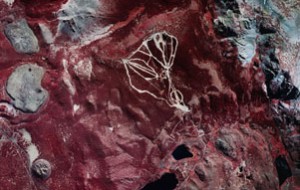
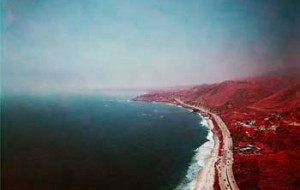
Florian Maier-Aichen was born in 1973 in Stuttgart, Germany; he lives and works in Cologne, Germany and Los Angeles. Alternately romantic, cerebral, and unearthly, Florian Maier-Aichen’s digitally altered photographs are closer to the realm of drawing and fiction than documentation. He embraces difficult techniques, chooses equipment that produces accidents such as light leaks and double exposures, and uses computer enhancements to introduce imperfections and illogical elements into images that paradoxically “feel” visually right, though they are factually wrong. Often employing an elevated viewpoint (the objective but haunting “God’s-eye view” of aerial photography and satellite imaging), Maier-Aichen creates idealized, painterly landscapes that function like old postcards. Interested in places where landscape and cityscape meet, he chooses locations and subjects from the American West and Europe—from his own neighborhoods to vistas of the natural world. Looking backwards for his influences, Maier-Aichen often reenacts or pays homage to the work of the pioneer photographers of the nineteenth century, sometimes even remaking their subject matter from their original standpoints. Always experimenting, he marries digital technologies with traditional processes and films (black-and-white, color, infrared, and tricolor), restoring and reinvigorating the artistry and alchemy of early photography.
On the subject of fantasy in art, Maier-Aichen describes liberties with which artists, including himself, have taken with picturing the American West, using his work The Best General View as a reference (in the forthcoming Season 5 book):
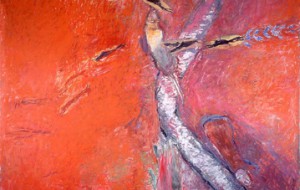
When I look at American landscape painting from the nineteenth century I always have in mind one painting of Yosemite by Albert Bierstadt. Yosemite is already such a theatrical place—almost like a too-drastic landscape—and Bierstadt just added more to it. He turned it into a complete fantasy by getting rid of the facts and enhancing every other aspect of Yosemite. Half Dome is an iconic image, but when I saw that Carleton Watkins had used it in one of his photographs back in the nineteenth century, it became more significant for me. Suddenly I wanted not to remake the same image but to go there and work with the subject.
I couldn’t access Watkins’s standpoint anymore because it was overgrown, so I used Glacier Point which is next door. It’s the most generic vista or viewpoint that you can get in Yosemite. It wasn’t a perfect day when I took the photograph, and I didn’t mind because it was just a starting point. I drew in the entire background with the blue sky and the clouds, and I brought in the bushes to make some foreground space. So in the end the image, except for Half Dome, is not really the way it looked when I took the picture.
What happens in Maier-Aichen’s segment in Fantasy this October?
“Photography used to be like alchemy back in the nineteenth century,” says Florian Maier-Aichen, who uses the computer to introduce imperfections and detach his photographs from reality, bringing them closer to the realm of drawing. Shown capturing his source images with a traditional large-format camera, the artist introduces painterly touches to his photographs with the aid of a digital stylus and tablet. “Illustration is just another level of abstracting,” he says, “it lifts you to another layer that is not necessarily linked to realism and it opens up your own world or your own myth-making.”
Inspired by the idealized quality of postcards and maps, the segment shows how the artist remakes images of landscapes, from a nostalgic nighttime scene of Stralsund in GDR times to epic vistas such as a pass in the Swiss Alps, ski slopes in the Sierras, Half Dome in Yosemite, and the failed St. Francis Dam near Santa Clarita (all works 2005-09). “Photography grew together with the discovery of the American West,” explains Maier-Aichen at his home and studio in Los Angeles, anchoring his fascination with the surrounding landscape to a romantic notion in Germany of California as “the end of the world.”

Florian Maier-Aichen. "Untitled," 2005. C-print, 72 x 90 1/2 inches. © Florian Maier-Aichen, courtesy Blum & Poe, Los Angeles and 303 Gallery, New York.
What else has Maier-Aichen done?
Florain Maier-Aichen studied at Högskolan för Fotografi och Film, Göteborg, Sweden; the University of Essen, Germany; and earned an MFA from the University of California, Los Angeles. Maier-Aichen’s work has appeared in recent major exhibitions at Museo Thyssen-Bornemisza, Madrid, Spain (2008); Museum of Contemporary Art, Los Angeles (2007); Yvon Lambert, New York (2007); and the Whitney Biennial (2006).
Where can I see more of Maier-Aichen’s work between now and the Art21 premiere this October?
Maier-Aichen is represented by Blum & Poe gallery in Los Angeles and 303 Gallery in New York.
What’s your take on Maier-Aichen’s inclusion in Season 5?
Tell us what you think by leaving a comment below!
The Cosplay Ethic
I’ll let you in on a secret: I’m a bit of a cosplay fanatic. Yes, these days I sport DKNY glasses and sleek monochromatic clothing, but my urban fashionability is merely a cloak for a tremendous amount of geekery. To be fair, I don’t cosplay myself. When I was most active, I served more as the tagalong, helping with costumes and the like, and these days, I focus on photographing others, rather than participating myself.

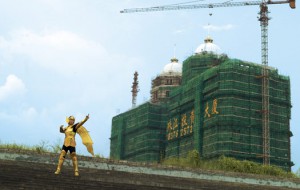
Cao Fei, "Golden Fighter (COSPlayers Series)," 2004. © Cao Fei, courtesy the artist and Lombard-Freid Projects, New York.
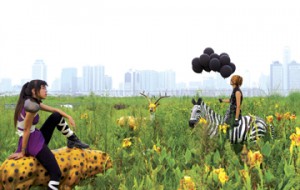
But there will always be a special place in my heart for cosplay, so you’ll understand my excitement when I first stumbled upon Cao Fei’s visual work at The Thirteen: Chinese Video Now, a group exhibition at PS1 three years ago. In the video, cosplayers venture through the streets of a rapidly-growing but desolate Guangzhou, acting out epic battles while the normalcy of the city chugs along. In both her photos and videos, we see cosplayers outside the glitzy-geekery of anime and comic conventions and immersed in the context of the everyday.
The work itself is visually stunning. The contrast of the colorful costumes with the staid backdrop of the city speaks to the fantasy projected in cosplay culture, and how much that fantasy can clash with the mundanities of making a living, getting along with parents and growing up in a country that itself is coming of age in the 21st century.
The series struck a personal chord in me in particular, as it reminded me so much of my cosplaying friends. After each convention, I’d watch them shed their outfits, cram into nondescript cars, don school uniforms and work attire, argue with their parents, watch television and just generally return to a normal life. In their heads, they still wanted to live the epic lives of Tifa Lockheart and Naruto, normal life be damned, and they’d immerse themselves in anime message boards and costume-making circles in anticipation of the next big event.

Cao Fei, "Yanmy at Home (COSPlayers Series)," 2004. © Cao Fei, courtesy the artist and Lombard-Freid Projects, New York.
Does art expand our ability to imagine? Cao Fei’s series is no doubt imaginative. After my first exposure to her work, I found myself lost in her images, and I started seeing swords and fireballs coursing through the streets of Manhattan. But it’s also the imagination of her subjects that helps bring these photos to life. In their eyes is a world far removed from the anxieties of a developing China, a world where people (not always human) fly and shoot fireballs and twirl weapons effortlessly, and the fate of the universe rests in the balance. In so many ways, Cao Fei’s subjects are as much artists as the artist herself.
Perhaps it’s my bias as an artist, but engaging in art, creating art both as a response to and in imitation of others’ work is often the best way to step into an artist’s imagination, whether it be faraway surrealist dreams or sharp technical realism. Rather than passively absorb the stories told in hard-to-find DVDs of their favorite Japanese animation, cosplayers take the experience further by creating these worlds in their daily lives. They construct three dimensional costumes based on two dimensional designs and act out alternate storylines inspired by a limited series run. In other words, their imaginations come alive.
On Virtual Worlds: An Interview with Filmmaker Victor Pineiro, Part 2
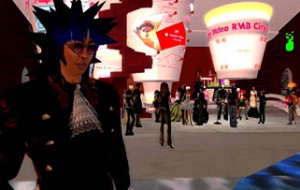
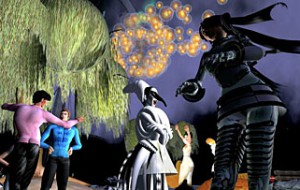
Cao Fei. Production still © Art21, Inc. 2009.
Online platforms have always been social environments. “Web 2.0″ was not the birth of the social Web. Rather, it marked a point when Web technologists, recognizing the social nature of the Web, developed and deployed the tools to make social interaction easier for audiences of all ranges of technical familiarity, and to make social activity more prominent across Web publishing platforms.
Video games, too, have always been social experiences that were enhanced with addition of online components. From the early days of MUDs (Multi-User Dungeon), to their evolution into MMORPGs (Massively Multiplayer Online Role-Playing Game), to the online capabilities of the current generation of home video game consoles, online gaming removed the barrier of geographic location from the gaming experience and allowed gamers to always have a pool of other players readily available.
Following up on last week’s interview with Second Skin producer and writer, Victor Pineiro, for this second part, we talked about the online and offline social aspects of gaming culture, the joys of Mario Kart, and a few more odds-and-ends around the production of Second Skin.
[For readers in the New York City area, Second Skin screens tonight, tomorrow, and Sunday at The Tank in Hell's Kitchen]
Jonathan Munar: There’s clearly an element of “social” in these virtual worlds. How would you describe social interaction in these games?
Victor Pineiro: I would argue, as controversial as it may sound, that gamers are actually more social than non-gamers, because being social is built in and facilitated by their activity of choice. Rather than socialize with a handful of people at a bar or someone’s house, or even dozens of people at the occasional party, MMO gamers are consistently socializing with hundreds of other gamers. Most gamers in virtual worlds belong to a guild—a group of gamers that are usually hundreds or thousands strong, and who communicate all the time through the game or online message boards. This is no longer limited to typing—a large portion of gamers use applications to voice-chat with fellow guildies, dozens on the same voice channel. So what you have is, in effect, these enormous conference calls, but tied to shared experiences all the gamers are having together. If you compare the typical gamer’s evening with the typical person, there’s no contest—even at our most social, we’re hardly interacting with dozens or even hundreds of people on a daily basis. For a gamer, that’s their usual Tuesday night.
An interview with Tom Sachs by John Kessler
Welcome back to BOMB in the Building, where each week we feature a vintage BOMB interview relating to a Season 5 artist or theme. This week, inspired by Jeff Koons’s discussion of public art, we reconsider the work of Tom Sachs on the occasion of his 2003 show Nutsy’s, which exhibited at the Bohen Foundation in New York before traveling to the Deutsche Guggenheim in Berlin. “Sachs’s highly personalized use of materials and processes is rooted in bricolage, a French word for do-it-yourself,” wrote John Kessler, who who interviewed Sachs for BOMB Issue 83, Spring 2003. “His work addresses a wide range of issues including appropriation, branding, consumerism, globalization, entertainment and functionality.” Read the full interview here.

Tom Sachs, "Hermès Valuemeal," 1998, hot glue, ink and paper, 18×12 x 12". Courtesy of Tom Sachs Studio.
John Kessler: Your work is very populist, and I wonder if that’s the main reason you haven’t been given the critical attention you deserve.
Tom Sachs: I find it disappointing. I read October and Arts and Artforum in college, and I always thought that when I moved to New York, I would be engaged in conversations like that. But there was never a movement toward the real. People didn’t go all the way. It’s too threatening to the art world system to have art that works, because part of what makes it so strong is that it is insular. You need to be a little provincial to keep your things tight. That’s partially why I’m not as interested in art as I am in media and technology.
JK: There are so many ideas in your work, like failed utopianism, functionalism and design, high and low culture, surveillance and globalization, that I would imagine critics could really bite into. That is, if they don’t want to talk about hot glue and duct tape.
TS: Well, it’s like Barnett Newman said, it’s what ornithology is to the birds.
JK: You’re talking about criticism?
TS: There is a lot of art that has its pants down, so to speak, and gets the critical attention. I think the popularity of my work doesn’t leave a void for critics to fill. It’s a very complete world; it’s anti-elitist. There might as well be a sign on it saying, ‘This doesn’t need anyone to explain it.’
Meet the Season 5 Artist: Jeff Koons
The above video is excerpted from the Season 5 episode Fantasy, premiering on Wednesday, October 14, 2009 at 10pm (ET) on PBS (check local listings). Fantasy presents four artists — Cao Fei, Mary Heilmann, Jeff Koons, and Florian Maier-Aichen — whose hallucinatory, irreverent, and sublime works transport us to imaginary worlds and altered states of consciousness.
Who is Jeff Koons and what does he have to say about fantasy?
Jeff Koons was born in 1955 in York, Pennsylvania; he lives and works in New York. Koons plucks images and objects from popular culture, framing questions about taste and pleasure. His contextual sleight-of-hand, which transforms banal items into sumptuous icons, takes on a psychological dimension through dramatic shifts in scale, spectacularly engineered surfaces, and subliminal allegories of animals, humans, and anthropomorphized objects. The subject of art history is a constant undercurrent, whether Koons elevates kitsch to the level of Classical art, produces photos in the manner of Baroque paintings, or develops public works that borrow techniques and elements of seventeenth-century French garden design. Organizing his own studio production in a manner that rivals a Renaissance workshop, Koons makes computer-assisted, handcrafted works that communicate through their meticulous attention to detail.
On the subject of fantasy in art, Koons discusses the inspiration for his work Puppy (in the forthcoming Season 5 book):
After the French Revolution, artists had all the freedom they wanted to use art in any manner. But Louis XIV was a symbol of what happens to art under a monarch (whoever controls it, it will eventually reflect his or her ego and simply become decorative). I was making reference to that because if I wanted that responsibility or had that opportunity, the same thing would eventually happen. Puppy (1992) is a large floral sculpture made out of 60,000 large flowers. I conceived that piece really thinking that it would be the type of work that Louis would have the fantasy for. He’d wake up in the morning, look out of his palace window, and think, “What do I want to see today? I want to see a puppy, and I want to see it made out of 60,000 plants, and I want to see it by this evening. Go to it!” And he would come home that night and voilà, there it would be!
What happens in Koons’s segment in Fantasy this October?
“Art should be something really powerful,” says Jeff Koons, “but at the same time, there’s morality that comes along with that.” Koons argues that “objects are metaphors for people” and views art as a vehicle for communication that “can connect you through history” and empower viewers to accept their own pasts, cultures and desires.
The segment begins in the artist’s busy studio in Manhattan, where his computer-aided but hand-made paintings and sculptures develop slowly, with a large team of dedicated assistants, in the manner of a Renaissance workshop or atelier. The segment shifts to a major retrospective at the MCA Chicago (2008), where Koons provides a detailed analysis of two carved wood sculptures—Bear and Policeman and Ushering in Banality (both 1998)—as exemplifying the ethical and spiritual dimensions of art.
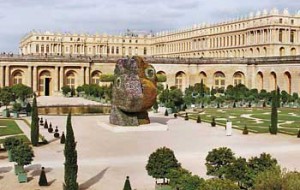
The segment concludes outside Paris at the Chateau de Versailles, where Koons is the first contemporary American artist to have a solo exhibition (2008-09), showcasing the mathematical planting of the giant flower topiary Split Rocker (2000). Koons imagines his Self-Portait (1991) bust as having a conversation with King Louis XIV, and compares his own attention to detail—in the works Michael Jackson and Bubbles (1998), Balloon Dog (Magenta) (1994-2000), and Lobster (2003)—to the joyous decoration of the palace’s period rooms and gardens.

Jeff Koons. "Split-Rocker," 2000. Installation view of "Jeff Koons Versailles," October 9, 2008-April 1, 2009, Chateau de Versailles, France. Stainless steel, soil, geotextile fabric, internal irrigation system, and live flowering plants, 441 x 465 x 426 inches. © Jeff Koons, courtesy the artist.
What else has Koons done?
Jeff Koons studied at the Art Institute of Chicago, and received a BFA from the Maryland Institute College of Art, Baltimore (1976), and honorary doctorates from the School of the Art Institute of Chicago (2008) and Corcoran College of Art + Design, Washington, D.C. (2002). Among the awards he has received are Officier of the French Legion of Honor (2007); the Artistic Achievement Award from Americans for the Arts (2006); and the Skowhegan Medal for Sculpture (2002). Recent major exhibitions have appeared at Château de Versailles, France (2008); the Metropolitan Museum of Art, New York (2008); Museum of Contemporary Art, Chicago (2008); Neue Nationalgalerie, Berlin (2008); Victoria and Albert Museum, London (2006); the Guggenheim Museum, New York (2002), and other institutions. Koons has participated in the Bienal de São Paulo (2002); Venice Biennale (1990, 1997); Sydney Biennale (1990); and the Whitney Biennial (1987, 1989). He was elected as a Fellow to the American Academy for Arts and Sciences in 2005.
Where can I see more of Koons’s work between now and the Art21 premiere this October?
Jeff Koons maintains an extensive website of his own work. His recent Popeye Series can be seen in London until September 13 at the Serpentine Gallery.
What’s your take on Koons’s inclusion in Season 5?
Tell us what you think by leaving a comment below!