(UC Crisis) Post 3: Try Not to Do This Again
In a series of special posts, guest blogger alum Marc Herbst and regular contributor Catherine Wagley chronicle the University of California education crisis. Following is Wagley’s take. — Ed.
When I was in college, a woman named Chris Gaunt worked in our main library. She would frequently disappear for a day or more. She’d go to Des Moines, our state capital, or to D.C., or even Muscogee County, Georgia. She’d protest torture of detainees, war funding, or unfair trials. If she was gone for an especially long time, she’d been taken into custody, maybe for assaulting a peace officer — which can be hyperbolic for going limp upon arrest — trespassing in a Senator’s office, or crossing a line set up by police. Gaunt, who had the kind of short perm women get when their not-quite-gray-but-getting-there hair no longer warrants hassle, wore sweatshirts with collars and didn’t look like trouble. Though her disappearances were as predictable as her wardrobe, we students respected her more each time she returned.
“Civil disobedience in the United States has a very specific legal tradition,” said Ricardo Dominguez, in a video clip aired by Fox 5. “That is, you do a non-violent mass action. The police come, they take you in, they book you, [you spend] 24 hours in jail. You go before the judge, the judge says, ‘try not to do this again, and then you go do it again and you go through the same thing.’” But Gaunt, who has spent upwards of 6 months in jail, knows that the penalty for civil disobedience can be more severe, especially if you insist on “doing it again.”
Dominguez, like Gaunt, works at a university — though he’s a tenured professor at UC San Diego, not a librarian — and has a penchant for crossing lines. Unlike Gaunt, who primarily identifies as a peace activist, Dominguez identifies as an artist. In his May 7 post on this site, Marc Herbst detailed Dominguez’s most recent line-crossing and explained how Dominguez’s online laboratory, b.a.n.g. lab, staged a virtual sit-in to protest the University of California’s budget cuts and tuition hikes. Protesters “sat” on the UC Office of the President’s website and the few hundred who participated became the equivalent of thousands, thanks to a “spawn” feature that multiplied the effect of each computer.
Herbst also described markyudof.com, a hoax site hosted by b.a.n.g. lab and created by UC Riverside professor, Ken Ehrlich. The hoax site, which launched a few days before the sit-in, announced President Mark Yudof would resign to “go back to school to study the history of social movements.” Yudof did not, of course, really resign, or give social movements a shout-out. And even though Dominguez’s and Ehrlich’s work in digital activist art contributed to their employment at UC schools, they turned their expertise on the wrong target. An investigation into the legality of their actions is underway.
Pardon this Brief Commercial Interruption: Liz Magic Laser

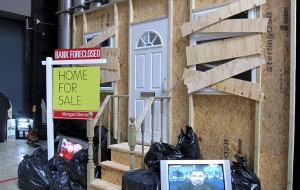
Liz Magic Laser, "chase," 2009-10. Production still from performance, Courtesy Derek Eller Gallery, NY.
Currently on view at Derek Eller Gallery in New York, Liz Magic Laser’s chase (2009) stems from interpretation of Bertolt Brecht’s Man Equals Man (1926), performed by eight different actors in various bank vestibules throughout New York City. The ongoing project unfolds in the gallery as a feature-length video and a theatrical set for an ancillary performance of The Elephant Calf, a one-act farce that Brecht originally intended to be the final scene of Man Equals Man, but later made as an addendum to the script.
The Elephant Calf, performed at the exhibition’s opening, is an absurdist tale of an elephant calf who is tried and convicted of murdering his mother despite the fact that his mother is very much alive and no evidence exists to condemn him. The play makes clear that truth is often a matter of opinion backed by mob rule. Applying the same blustery irrationality that blogger Andrew Breitbart uses to dismiss every racist comment attributed to the Tea Party, claiming that the epithets are plants by the left wing media, or the faulty reasoning behind George W. Bush’s search for his WMD MacGuffin, the Elephant Calf is the parable version of Man Equals Man, a condemnation of the convenient truths that drive the logic of war.
While chase makes clear the parallel between war’s distortions and a phantom economy based on mortgage-backed securities and credit default swaps by situating the play in a bank lobby, it is questionable whether invoking Brecht has the subversive potential it once had. In an age where détournement comes in the guise of Jon Stewart and the absurdity of the theater is no match for the absurdity of the nightly news, even Brecht’s alienation technique seems up for grabs. The most subversive potential of chase may lie in its repurposing of the ATM vestibule as public space.
Like the Surveilance Camera Players, Laser’s actors are well aware that they are playing for not one, but many cameras. Yet they do not act in accordance with the rules of conduct that normally govern such occupied territory. Latin America has a long tradition of marrying theater and politics in an effort to liberate civic space. Laser may want to consider some of these approaches, such as Augusto Boal’s invisible, legislative, or analytical theater. Beyond that, an actual deliverance from wag-the-dog politics may require leaving the gallery behind to develop new techniques that can interrupt the speed at which every act of resistance is reclaimed by ever-agile corporate technologies.
(UC Crisis) Post 2: The Feeling of Embalming Education
In a series of special posts, guest blogger alum Marc Herbst and regular contributor Catherine Wagley chronicle the University of California education crisis. Following is Herbst’s second installment. — Ed.
Creativity doesn’t occur in a vacuum. Cultural and political expression find a unique voice in relationship to context. As Dada can’t be understood without World War I, nor Jackson Pollock without the Cold War, the creations of the University of California art professors I discussed in my last post should be understood in a field of wider aesthetic, rhetorical, and historic action.
The University of California occupation movement, which gathered Ricardo Dominguez’s and Ken Ehrlich’s productive energy, occurs in this state of affairs: budgets are tight, social services are slashed, corporations are bailed out. The priorities seem clear: profits over people.
At the turn of this decade, the inversion of that phrase, people over profits, was a clarion call for the globalization movement. Though equally radical in tactics, the emergence of the social imagination spawned by a global Internet allowed artists and activists to embody an entirely different creative frame. Emerging with the pageant-like protests of this era was a language of hope. Social space, utopia, other worlds — the globalization movement allowed for these sort of dreams.
But as California beggars itself and its crowing institutions — cutting classes, raising costs, outsourcing labor — dreamy talk just does not communicate.
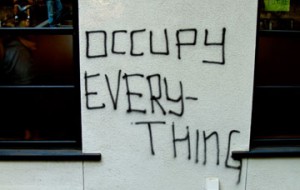
Therefore instead of “Another World is Possible,” students, faculty and staff who began occupying the central and northern California campuses of the University of California this fall say, “We Have Decided Not to Die.” “Occupy Everything, Demand Nothing.” “We Are the Crisis.” “We Want Everything, Demand Nothing.”
Thus emerges a movement out of the graveyard.
(UC Crisis) Post 1: The Story of a Movement – Overview
To explain the recent investigations into the web-art projects of both Ricardo Dominguez and b.a.n.g. lab collaborators at UC San Diego and Ken Ehrlich of UC Riverside is to tell a story of social movements. This is the first of a several blog-posts written by myself and Art21 Los Angeles correspondent Catherine Wagley that tell the story. In this post, I will summarize the basic facts around what happened and provide the simplest of backgrounds to the case.
With the announcement of a 32 percent tuition increase, the antagonism between the UC systems directing regents and many of their students, faculty, and staff was on the rise. Spurred on by a powerful manifesto and an inspiringly radical movement of campus building occupations that began in Northern California in September and only continued to build, March 4, 2010 was planned to be a major day of protests around education throughout California. March 4 proved that the movement was spreading well into what had been the relatively quiet UC campuses of Southern California. The radical edge of the movement has been built upon a variety of very evocative slogans, including We Have Decided Not to Die, We Are the Crisis, and No Future.
….
On the morning of the fourth, Ricardo Dominguez, formerly of the Critical Art Ensemble and now with the Electronic Disturbance Theatre, set up and publicized a virtual sit-in, an Electronic Civil Disturbance (ECD) attack on the UC Office of the President website from the UC-sponsored b.a.n.g. lab server. The theatre piece, set up as contemporary protest, allowed people to act in solidarity with the day’s protesters by loading up a constantly updating webpage. With enough participants in the online protest, the act can slow down or, if you will, blockade a website.
Eve Essex and Cornelius Cardew
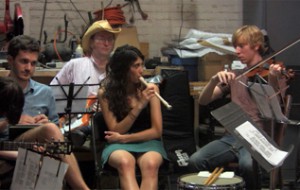
Continuing the tenuous thread I’ve begun to weave, today’s post concerns Eve Essex, an artist I’ve been interested in since she was a resident with the Berwick Research Institute in Boston, MA. One of her recent projects is a reenactment of British composer Cornelius Cardew’s Scratch Orchestra. Cardew formed the Orchestra in the 1960s, bringing together professional musicians and amateurs to play non-traditional, group-created scores as a form of social activism. Eve’s reenactments of the original Scratch Orchestra rehearsals ask participants to operate in the present and past at the same time, realizing a forty-year-old utopian vision. Is this an antidote for political apathy or a caricature of earnestness? Eve calls it “theater” — does that make it more or less genuine (or neither)? I’m interested to know if anyone else sees a relationship between this project and Stuart Sherman’s inscrutable performances, detailed in my first post.
Inside the Artist’s Studio: Corey J. Escoto

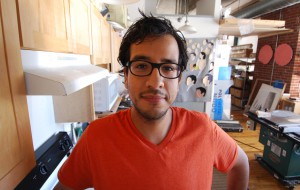
Corey Escoto at his studio
Corey Josiah Escoto is an artist based in St. Louis, MO. He also happens to be a tranquil, discreet, and steady 26 year-old art surprise who acts, talks, and walks like himself. Escoto is wisely pacing himself, revealing a few of his qualities at a time while continually giving me the impression he is learning, paying attention, and alert without letting it show.
Humble at heart, he has exhibited nationally, internationally, and widely throughout Texas, his home state. He was one of three artists selected for the Great Rivers Biennial at the Contemporary Art Museum St. Louis in 2008, where I first became acquainted with his work, as well as a recipient of the Gateway Foundation Grant. His work has been included in the traveling exhibition New American Talent 23, the Texas Biennial (2007), and has recently shown internationally in exhibitions such as Le Souvenir (Weimar, Germany); Seven Days Brunch (Basel, Switzerland); and Decollecting (Dunkerque, France).
Escoto’s work explores the inevitable conflict between idealism and futility that results from endeavoring to better a troubled world and understanding the tensions of a crowded planet. Complex critiques of world reform organizations are examined through the lens of economics, religion, satire, food, and politics. An ever-expanding collection of vintage United Nations memorabilia continues to inspire and influence much of his work’s earnestly idealistic sentiment.
Corey is living at his studio; he is not working from home. He has created the conditions where he attends to all his creative callings, one of them being cooking. Last time at his place, a friend of mine and I made a memorable exit with a dozen delicious homemade tamales. Either way, a studio visit at Escoto’s will leave you with a fine aftertaste.
Georgia Kotretsos: Please walk us through your current studio situation.
Corey Josiah Escoto: My studio is a really nice live/work space on the second floor of an old brick building in downtown St. Louis. It is poorly insulated and has 12-foot ceilings and big south-facing windows that get really great light and a beautiful view of Washington Street especially at sundown.

The floor below me is a cafe and entryway to the building, above me is another artist, and my next door neighbor has a noisy dog, so I can make as much racket as I need to when making work or playing music in the studio. I have to work in a spot that will allow me to make noise and a place that is not wall-to-wall carpet. I used to live in a small apartment in the university area, but that did not work out for me as I was living next to a bunch of quiet and studious academic types. On occasion, they would leave me semi-polite post-it notes about their displeasure with the shrill sound of “extended periods of high pitched commotion” or their distaste of “old country music being played at unacceptable hours of the night.”
The long narrow space with windows is my main living and working area. This part includes the kitchen, my large table, my computer desk, large freestanding tools, chairs, book and storage shelves, crates, couch, and materials. I have lots of tools (air compressor, miter saw, table saw, hand tools of all kinds) that I use from time to time.
W.A.G.E. Against the Machine

Art Workers Coalition, "Art Workers Won't Kiss Ass," 1969, primaryinformation.org, 2008
Last September, as part of Creative Time’s Democracy in America: The National Campaign event at the Park Avenue Armory, activist group Working Artists and the Greater Economy (W.A.G.E.) stumped for the rights of artists to be compensated fairly for their labor by art institutions in the United States. The economy has taken a bigger hit since then, which makes W.A.G.E.’s work even more important. The Brooklyn-based collective was formed in 2008 by artists A.L. Steiner, K8 Hardy, and A.K. Burns, and the group’s expanding membership includes artists, performers, independent curators, and all others who share their cause. W.A.G.E. cites exemplar, working models beyond our borders overseas and overhead—organizations such as the Canadian Artists’ Representation / Le Front des artistes canadiens (CARFAC), whose efforts resulted in the 1988 Canadian Artists’ Representation Copyright Collective (CARCC), which legally established a fee schedule for artists to be paid every time their work is exhibited at a gallery, museum, or institution that receives federal funds.
As a cultural worker myself, I am all for such a system that treats and compensates artists like true professionals. However, I am not totally convinced that something like CARCC could effectively work here, though something is better than nothing. CARCC’s established fee schedule affected only galleries and museums that received some kind of federal money, so commercial galleries don’t apply. And in the United States, funding for the arts is so abysmal that it seems a radical shift in the structure of the arts umbrella is truly what is needed.
Recently, I conducted an interview with W.A.G.E. via email, and gathered their thoughts on some of these issues.
TRONG G. NGUYEN: Who are the founding members of W.A.G.E., and what are your backgrounds—have you always been political activists and artists?
W.A.G.E.: Working Artists and the Greater Economy (W.A.G.E.) was formed in Brooklyn, NY in 2008. We’re a group of artists, performers and independent curators who believe that we should be paid for our labor by U.S. art institutions. The group is open to anyone who would like to join that cause, and embraces seasoned activists, non-activists and anything in-between.
TGN: Do you view W.A.G.E. as an art collective or lobbying group?
W.A.G.E.: We’re an activist and consciousness-raising group.
TGN: W.A.G.E. participated in Creative Time’s Democracy Convergence Center event last September, before the elections. Tell us more about your performance and what you hoped it would accomplish. Was it preaching to the choir, or did you felt the event actually did some good beyond the art world?
W.A.G.E.: We find that although we’re speaking to our peers, the issues we raise—and strategies we’re attempting to develop—weren’t being actively discussed in the arts community; therefore, people have responded with a huge amount of support, surprise, and relief to hear a voice that acknowledges their specific situations as artists, performers, and arts workers.
TGN: You reference the Art Workers Coalition of 1969, which criticized MoMA’s collecting practices and focused on artists “working conditions” in general. Although well-intended, a number of the artists who were initially involved have essentially become entrenched in the gallery and museum systems they previously railed against. Do you think this intrinsic hypocrisy needs to be dealt with before the system can truly be changed? And if so, how?
W.A.G.E.: This question is framed curiously, but indicative of the perception of arts workers both within and outside the arts community. W.A.G.E. finds it unnecessary to frame this as a dichotomy: one doesn’t need to be outside the system to criticize or effect change. We’re comprised of, and welcome, all artists and arts workers- regardless of income, or market notions of career status or notoriety. We’re not eschewing market success. Our cause is to counter the hypocritical assumption by U.S. public and private art institutions that artists and arts workers don’t require monetary compensation for our work. Hollis Frampton addressed this in a letter he composed to MoMA in 1973 where, among other things, he outlined the workers in all the industries he supports by merely making his film work; ironically, this includes not only film manufacturers, processing labs, print labs, etc, but also the arts administration staffers as well. As noted in his letter, he was the only one not being paid for his work. The museum offered to pay him in “love and honor.” This was 35 years ago and overall, the terms have largely remained unchanged—except for the cost of living.
Letter from London: Guernica Revisited

Goshka Macuga's installation at the Whitechapel Art Gallery
It seems impossible now that an institution like the Museum of Modern Art would lend, say, Les Demoiselles d’Avignon or The Red Studio at all, let alone to a small public art gallery in the east end of London. But that’s pretty much what happened in 1939, when Picasso’s huge Guernica (painted in 1937) was loaned by MoMA, after pertinacious efforts by the Communist Stepney Trade Union Council, to the Whitechapel Art Gallery in order to raise public awareness of and garner sympathy for the Republican effort in the Spanish Civil War. That a painting—and a painting that takes tragedy as its general subject, owing as much to Poussin or Rubens as anything from contemporary life—was thought to have sufficient persuasive punch to drive the message home is the stuff of an agitprop daydream (imagine that happening now!). The thing is, though, Guernica isn’t only a painting. It’s a Picasso, and the logistics of the loan itself were impressive enough to embolden the gallery’s message. Although the Whitechapel was (and remains) free to enter, the admission charge in 1939 was a pair of workman’s boots, at Picasso’s suggestion, which the gallery lined up in ranks in front of the painting as a gesture of solidarity, like a phantom army. At the end of the exhibition, the boots (a couple of hundred pairs) were then sent to the Republican fighters in Spain. The painting went back to New York, and eventually to Spain, where it is now.
Now, as part of the redesign and expansion of the Whitechapel, Goshka Macuga (nominated for the Turner Prize last year) has brought Guernica back…sort of. In 1955, Nelson Rockefeller purchased Jacqueline de la Baume Dürrbach’s tapestry of the painting, made in collaboration with Picasso. On Rockefeller’s death in 1985, the tapestry was loaned to the United Nations building by his widow, where it still hangs outside the UN Security Council. That tapestry has returned to the Whitechapel for the duration of Macuga’s installation, where it’s been placed among archived materials pertaining not only to the original loan of the painting and the history of far-left activism in the east end, but also to the current loan of the tapestry and recent protest events around the G20 summit in London.
The “sort of” is important, though. Just as it’s sort of Guernica—and there’s a combination of amazement and disappointment at seeing the tapestry, which becomes a sad reminder of what it isn’t—the installation is sort of political. Macuga’s installation has a compelling melancholy to it, not just in its hesitance to complement the screaming rawness of Picasso’s painting (the very fact that it’s the tapestry, rather than the original, plants a pair of quotation marks around the image), but in its reminder of a gentler, more honest, more optimistic age, when apple-cheeked Dickensian Communists in Les Mis rags lined up with boots in hand to learn about the badness of war (many of whom would have fought in World War I, and wouldn’t need that spelled out for them). And there is something of the smugness of the art establishment behind Guernica’s history. When the tapestry was covered over with a blue curtain while Colin Powell made the case for weapons of mass destruction, the art world couldn’t stop congratulating itself for having the guts to declare that war is horrible, no matter what The Man says (It’s been said that the blue curtain was hung there for ease of translation to a TV screen; whatever the reason, announcing anything in front of Guernica would be like reciting Wordsworth at a Slayer gig anyway).
My fellow Americans, let’s roll.
On March 28th, Philadelphia hosted a day-long marathon dialogue on the intersections of art and the possibility of social/political change. The day’s events included a symposium on Curating and Activism at the Moore College of Art & Design and a local stop-over of Jeremy Deller’s It Is What It Is: Conversations About Iraq. Continuing from his last post, Daniel Fuller, Senior Program Specialist at the Philadelphia Exhibitions Initiative, recaps Deller’s project.

Photo by Tasha Doremus
After being obsessed for years with books and TV documentaries on the conflict in Iraq, Jeremy Deller conceived It Is What It Is: Conversations About Iraq, as a mobile museum that would bring the emphera of war to American towns. Deciding it would be disingenuous to preemptively respond to and articulate a partial history of an unfinished war, he decided to bring together those with first-person experience in Iraq to talk about it while others, including himself, listened. Deller admits, “I’m a nosy person.”
So, with the help of Creative Time curator Nato Thompson, Deller assembled a road trip crew. Jonathan Harvey, an Army Platoon Sergeant (and Philadelphia native); Esam Pasha, an Iraqi-born translator, artist, and journalist; and Lonnie, the road manager, joined Deller and Thopson and headed out on a three-week, thirteen city, cross-country tour. After nearly six weeks at the New Museum, the crew spent two days in the South—in Washington, DC, right on the National Mall and on the campus of Virginia Commonwealth University in Richmond. We were lucky enough to persuade them to make a loop up to Philadelphia before heading west to Cincinnati.

Photo by Tasha Doremus
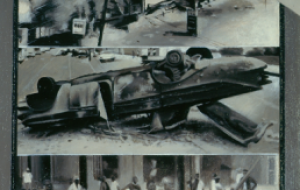
As soon as we broke for lunch, the vast majority of the Curating & Activism panelists and observers hustled out to the Parkway in hopes of hailing a cab to take us over to the National Constitution Center on Independence Mall. A visitor to this section of Old City on a Saturday afternoon is generally greeted by reenactors adorned in colonial costumes, Ride The Ducks tour quacks, and horse-drawn carts on cobblestone streets. On this particular day, as we pulled up to the Mall, we saw a Winnebago towing a demolished, burned-out car parked in front of the “We The People” wall of the Constitution Center. In 2007, a car bomb was detonated on Al-Mutanabbi Street in an intellectual and literary Baghdad neighborhood. The vehicle housing the bomb was obliterated, but the shell of a car we saw in Old City had been parked further down the same Baghdad street. Serving as something of a monument for the 38 people who lost their lives to that bomb, it was a heartbreaking visual spectacle.
During our short lunchtime assembly, it was great to see the project being received so sincerely by an audience of tourists patriotic enough to spend a day in the cradle of the American Revolution. Pasha and Harvey seemed completely at ease, putting faces and voices behind a country and war to which we Americans are all now inextricably tied. They engaged the viewers in a dialogue that connected to the sting of alienation some of us feel when we have no place to express our grievances. The pair was respectful to all exchanges, all ideologies, and offered in return the best straightforward, non-partisan responses they could provide given the messy, unresolved situation. The day was not about headlines sanitized through the media and it didn’t try to draw definitive conclusions. It was about direct connections with those that have survived the ongoing Iraqi violence.
As a nightcap, our entire symposium again trekked over to a packed Slought Foundation where we were treated to further explanation of the project and a question-and-answer session with Deller, Nato, Pasha, and Harvey. Throughout the conversation, the four maintained their mission was not a formal declaration of their stance on the war. Some audience members called this provocation and accused them of being morally bankrupt. Of course, as informed rational beings they each have a position on the conflict, but the RV—with its dreadful object towed behind—is not intended to be about them. They are presenters, impartial facilitators of dialogue. For me, it seemed in the end that whichever side of the issue you fell on—anti-war or pro-war (like the Catholic nun who stopped by the RV in the afternoon)—viewing the destroyed car would reaffirm your position. Perhaps the greatest benefit to this project has been for soldiers who were able to share unscripted, cathartic tales with others who have been through similar ordeals. As a civilian, watching from afar, I cannot begin to fathom coming to terms with the aftermath of their job. A video on the project’s website (where you can follow the project’s cross-country trail) shows a college-age veteran calmly trading horror stories with Pasha and Harvey as his girlfriend quietly, uncomfortably, stands by. It is clear as you watch her face that he is telling stories she had never heard—that what he is sharing are things he thought he shouldn’t burden her with.
As Harvey pointed out, military humor is macabre, its darkness a coping mechanism and a way of distancing soldiers from the situation. They have a special way of looking at their job—to “keep rolling,” to “stay the course.” Even in the dimness of violence, “it is what it is.”
Curating and Activism at Moore College of Art & Design
Daniel Fuller, Senior Program Specialist at the Philadelphia Exhibitions Initiative, recently helped organize the Curating and Activism symposium at Moore College of Art & Design. The following is a recap of a day of public conversations, on issues of responsibility, and a short interview with the artist Sharon Hayes.

From L: Martha Wilson, Lorie Mertes, Steve Kurtz, Adam Pendleton, Sharon Hayes, Stamatina Gregory, Srdjan Jovanovic Weiss, and Michael Rakowitz. Photo by Gabrielle Lavin.
This past fall, when Janet Kaplan and Lorie Mertes first approached us at the Philadelphia Exhibitions Initiative about co-organizing a symposium on curating and activism, it was an exciting time. Ours: Democracy in the Age of Branding was at Parsons, Creative Time’s Democracy In America: The National Campaign was coming to a conclusion at the Convergence Center at the Park Avenue Armory, and Elizabeth Peyton was hustling to add her portrait of Michelle Obama to the New Museum retrospective. Everyone was gearing up for a historic election and there seemed to be a massive groundswell of grassroots organizing, both in the art world and everywhere else. The times have certainly changed since we first started planning the symposium, and that Saturday’s symposium was about how to maintain the level of fervor that propelled so many to the streets in the lead-up to November.
We conceived of a series of grouped conversations that would examine multiple ways in which curatorial activities can be directed toward social and political activism. The three panels included:
Curating and Self-Organization—Facilitating Interactions
featuring Katherine Carl/Srdjan Jovanovic Weiss + Michael Rakowitz + Carin Kuoni
The Project of Performance—The Body and the Public
featuring Sharon Hayes + Adam Pendleton + Martha Wilson
Models of Participation and Modes of Activism
featuring Stamatina Gregory + Steve Kurtz + Anton Vidokle
By bringing architects, artists, curators, and academics to the table, we hoped to provoke various opinions and strategies on how to effectively navigate the power dynamics involved in curating for social change. The general themes which seemed to be revisited with each panel were thoughts on participation and accidental activism. We repeatedly listened to a number of approaches to finding loopholes in the language of the law.
In regards to the battle for empowering “calls to action,” Martha Wilson got the crowd’s attention early when she declared that, “all art should be activist art and that all other is crap,” but Anton Vidokle made a plea for artists to be “radical,” not just use the “wishy-washy” term “activist,” saying that he sometimes goes to demonstrations “not as an artist, but as a person.”
In the aftermath of the symposium, I was able to reconnect via email with one of my favorite artists for a little follow-up question-and-answer. Coming of age in performance through identity politics in the downtown dance scene, New York-based Sharon Hayes works in performance, installation, and the production and perception of linguistics. Her staged speeches create opportunities to re-present the theater of politics in yesterday into contemporary public spaces. Her recent project for Creative Time, Revolutionary Love 1 & 2: I Am Your Worst Fear brought together 100 performers from the gay, lesbian, and transgendered communities of Denver and St. Paul to simultaneously read a love letter outside of the Democratic and Republican National Conventions. The script employed confessional texts from the Gay Liberation movement of the 1970s to confront audiences through a critical examination of love and war.

Sharon Hayes, Martha Wilson, and Lorie Mertes, Rochelle F. Levy Director & Chief Curator of The Galleries at Moore. Photo by Gabrielle Lavin
Daniel Fuller: This will be a bit out of context, but I’d like to quote you from Who Cares: “War changes everything and nothing.” Six years after the invasion of Iraq, it seems as though Obama’s exit strategy includes leaving through Afghanistan. As this or these wars drag on, so many become numb to the situation–as something going on “over there.” How does the probability of these wars being further extended impact or influence your work? Do you also find this numbing or is it strangely inspiring or reinvigorating to your artistic work?
Sharon Hayes: To me, a citizen of the U.S. whose government and military have been occupying, bombing, and leveling sanctions on Iraq and Afghanistan to greater and lesser degrees for my entire adult life, the continuation of these policies and activities are never inspiring or reinvigorating. On the other hand, I also wouldn’t say that the Obama administration’s plan for Afghanistan causes me numbness. Rather, I must admit I am perplexed and anxious, perplexed as to why Obama decided to escalate the fighting there and anxious about the impact it will have on the people in the region, the project and efforts to close Guantanamo, etc. In terms of my work, I have felt the need since the inauguration of Barack Obama in January, to work collectively with friends and colleagues to read, write, talk and think about the change (because I think it is a change) that Obama brings and brings to our work as artists.
DF: It’s been said that activism too often begins behind a computer, but if it stays there, it’s dead. Is participation, real live participation—a gathering in a town square—already a form of activism?
SH: I remember you asking this to the last panel and what popped into my head immediately then and still sticks now is NO! Participation, in and of itself, is not activism. People participate in activities, conversations on the internet, baseball games, college basketball tournaments, paint ball games, etc…and these things are not activism just because of their participation in them. It seems by “a gathering in a town square” you are already placing the frame of some political engagement onto your hypothetical scenario, but even still, going to a town square meeting that John McCain organizes during his presidential campaign is also not activism—political participation, sure. And perhaps many people who attend consider themselves activists in other facets of their life, but their attendance pure and simple does not, in my mind, constitute activism.
What your question begs is a clarified definition of activism, which is one of the questions and needs that came up on Saturday. Someone else can offer an abstract definition of activism. I can say the kind of activism that I am interested in is collectively engaged, potentially disparate, fragmented, and even pathetic activities whose aim is to increase the ability of poor, disempowered, disenfranchised, marginal groups and individuals to live lives that are safe and fulfilling to them and to resist the powers that decrease and impede on such safety and fulfillment. That includes increasing the access we all have to the resources we need to maintain a shared healthy, safe, and fulfilling set of lives over time.