Teaching with El Anatsui
This weekend I will be back with friends and colleagues at the University of Michigan Museum of Art (UMMA) to facilitate a teacher workshop about working with Art21 education materials and teaching with El Anatsui’s gorgeous exhibition, When I Last Wrote To You About Africa. This being Art21’s second visit to UMMA, I am looking forward to once again working with Pam Reister, Jann Wesolek, and all of the participants joining us this weekend.
El Anastui, one of my favorite artists from Season 6, is in some ways an educator’s dream. His sculptures and installations reference history, culture and memory while simultaneously exploring the possibilities of found materials and different processes for making art. And while Anatsui is best known for his stunning, draped metal sculptures, there is more to the work with than meets the eye… and that’s quite a bit to begin with.
For example, if we step back four decades ago to Anatsui’s initial work in Ghana, the artist began using materials from his immediate surroundings—carving into wooden trays much like those sold in markets to display fruit and vegetables—and then creating works with adinkra-like symbols prominently featured. As Olu Oguibe describes in the magnificent catalogue that accompanies the show, Anastui has been guided by the following principles since this early work:
- Pay close attention to location and environment
- Learn whatever you can from local practitioners
- Use found objects and materials from your surroundings, especially your immediate surroundings
- Let the medium and materials suggest, even dictate, the form
- Acknowledge the potential for art to serve as a metaphor or visual allegory
Anatsui’s ceramic sculpture from 1978, Omen, explores how brokenness can somehow inspire new life and healing. From the small burst of an opening to the coating of manganese that speckles the surface formed from damaged ceramic pieces, Anatsui’s work can represent ideas about fragility and even political instability in Africa.
Visionary Studios: Getting Started
Anyone who knows me often asks about how I coordinate three jobs. I teach two high school classes and serve as department chair in my school district, work as Art21’s education advisor, and teach a class at NYU in the department of Art and Art Professions. This semester I was thrown a little curveball and asked to teach a completely different class at NYU- School Arts: Issues in Pedagogy and Curriculum (Secondary). The course, an intense fourteen weeks where graduate students explore current questions and topics in secondary art education, also has a component where each student takes part in teaching a Saturday course for high school students. This Saturday program, called Visionary Studios (a title I happen to love), asks New York City high school students to sign up for nine weeks of classes around a chosen theme. So, instead of signing up for extra-curricular classes with titles like “Mixed-Media” or “Ceramics” or “Painting”, students this fall are asked to choose from “The Changing City”, “Under Pressure”, “Transformation” or “Soundscapes”. Instead of offering classes that are media-centric, classes are thematic where teenagers can explore the theme through a variety of approaches over nine weeks. Students in the graduate course not only explore current issues in art education and teaching for social justice, but they also plan units of study and individual lessons for these Saturday classes, as well as team-teach every Saturday morning.
It’s a lot of work.
This Saturday is the first session with our high school students and I am excited for the possibilities that exist within the curricula that has been developed so far. Big, and sometimes challenging questions are driving the themes, such as:
- How can art be transformative?
- What role(s) does pressure play in our environment?
- How does sound shape our daily experience?
- What makes a city?
Artists already being considered to inspire students include Ai Wei Wei, Allora and Calzadilla, Cindy Sherman, Do-Ho Suh, El Anatsui, Eleanor Antin, Kerry James Marshall, Krzysztof Wodiczko, Mark Bradford, Mike Kelley and Yinka Shonibare, to name just a few.
Going into the first session this weekend, my student teachers will obviously be thinking about how to get off to a good start. After all, these high school students are coming from all over the city to attend classes on Saturday mornings. One doesn’t need a roadmap to realize that you better have some good stuff to share, otherwise you will be left with dwindling enrollment. Students will simply stop coming if the course isn’t exciting and engaging.
So what does getting off to a good start look and sound like in a situation like this (or, for that matter, in most courses)? It involves students coming in, being warmly welcomed and getting to know who is teaching. It involves students getting to know their classmates a bit and why they have chosen to be there. It involves sharing interests and broad goals for the course. It involves talking about which directions the theme can take. Most importantly it involves building community and trust from the start. Once that gets rolling, students can begin to feel comfortable creating quality work that will address the theme.
I am also excited for the start to our Saturday sessions because the student teachers will be developing curriculum with the students vs. having each and every lesson planned out ahead of time. Student teachers will be asking different kinds of questions to explore how these high school students want to investigate the four themes vs. being told how the themes will be approached. They will even be asked to help form the supply lists for each of the courses instead of having a “set” of supplies to work with from the start.
Wish us luck. More to come.
Teaching with New York Close Up: David Brooks Tears The Roof Off
David Brooks Tears The Roof Off is an apt title for one of our most recent New York Close Up films this summer. Within the first 60 seconds of a pretty intense tour that runs under eight minutes we get to hear Brooks passionately describe the housing boom that has threatened the Everglades in South Florida, a place he has personally visited for decades. We are then introduced to an installation titled Desert Rooftops inspired by this crisis and completed right here in New York City… literally on the last undeveloped lot in Times Square.
While the housing industry shamelessly encroaches on the protected Everglades, here we see midtown skyscrapers “framing” this “viral” layout of rooftops connected- sprawling- throughout the space. Brooks acknowledges that the work is perhaps difficult at first to recognize as art, but as the viewer engages with it and makes associations it becomes clear that something curious is going on and this isn’t some three-dimensional promo for a roofing company… even if Fox News couldn’t figure it out (and does the anchorwoman say “Home Depot” or “Home Thiebaud”? Just asking).
Brooks’ work can appeal to students in different ways, opening up a mixed bag of questions and assumptions, such as:
- What kinds of things can we use to make art?
- Does having an explanation or narrative help or hinder the viewer’s experience?
- What kinds of associations can viewers make engaging with a work such as this?
- Can public art tell stories that “white cubes” cannot? If so, how… and why?
- How can more artists make environmentally conscious work and not mirror a “resource-devouring” industry like home construction?
Students who watch the film can also investigate how past and present examples of suburban sprawl have affected other places, as well as the things that have been produced by artists and others in response.
Finally, David Brooks talks about Desert Rooftops being “instigated” by the space in Times Square but I think it actually plays a little tug-of-war with it. These rooftops, seeming to grow like weeds from the small plot, are practically being watched and scrutinized by the surrounding buildings that tower over them. They spread throughout the plot quite freely yet the fence reminds everyone that this is the end- this is the edge of the frame. And in this way the work goes on to speak about both sprawl and a kind of containment.
Long Walk
I came across a photograph of Richard Long’s A Line Made By Walking this past weekend and was especially drawn to it in the midst of a late spring swelter. Rather than a more standard suggestion for educators or a possibility for the classroom this week, I wanted to share some recent thoughts about this particular work and perhaps use the time (in the season of developing SLOs) as an opportunity to reflect on its broader connections to teaching.
First, a few connected (and disconnected) notes…
- A Line Made By Walking exists as a photograph of an act. Richard Long has done us all a big favor by framing the act and making visible what many people would have never seen. His photograph serves to focus the viewer.
- Long is interested in simple lines and shapes- straight lines, circles, spirals- because they are timeless and belong equally to all moments in history. The work is timeless because it can be anywhere. Any time.
- When I share this work with students, many often respond by asking if it’s an Andy Goldsworthy piece. Andy Goldsworthy was eleven when Richard Long created A Line Made By Walking in 1967.
I see Long’s A Line Made By Walking as a metaphor for teaching. He makes visible his process, which is quietly relentless. He creates order through a meditative act. He provides focus. He makes us see something quite simple in a completely new way through transforming the process of making a line.
Can we do this for our students? Can we teach and emphasize process more often than product? Can we create an order and the conditions for learning through experimentation? Simultaneously, can we provide focus? Can we offer alternatives to the habitual through our teaching? Can we help students to even perhaps make work that is… timeless?
Ambiguity and Teaching with the Photography Robert Adams

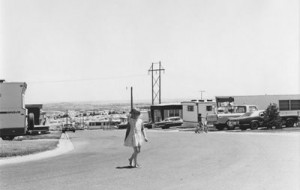
Robert Adams, "Adams County, Colorado," 1973 Courtesy Fraenkel Gallery, San Francisco and Matthew Marks Gallery, New York
The LA Times’ Leah Ollman hit it on the head last month when she wrote in Art in America:
To embrace opposing emotions can yield frictional sparks and wonderfully uneasy tension; it can complicate and deepen the response a work generates.
Ollman was discussing the work of Robert Adams in her excellent article, Romantic Realist, as well as the current retrospective, “Robert Adams: The Place We Live” at the Los Angeles County Museum of Art. While Adams himself may admit to being in pursuit of beauty through his photography, his work clearly highlights, “…where and how nature and culture meet”- for better or worse.
Teaching with and sharing Adams’ photography with students can allow for a broader understanding of what makes a great picture. Do we look for precise technical qualities, superb composition and a story the viewer can take away, or do we allow for ambiguity and multiple story lines in photos that simultaneously transport the viewer and force them to hold up a mirror? Adams talks about telling the truth and having to “simultaneously accept what one had to accept” during the Exclusive video, “Robert Adams: Working Along Freeways”. His photo of a garbage truck, while inducing “revulsion” in Adams’ words, is beautiful at the same time. His photo of a young girl walking through a huge trailer court evokes loneliness and sadness while depicting an extraordinary light and landscape.
In Art21’s season 4 educator guide, one of the activities suggested after viewing Robert Adams’ segment asks students to create a visual essay of their own region using books, newspaper and magazine articles, the internet, and interviews with teachers, neighbors… even family members. Through the process of gathering these kinds of images, there is an opportunity for students to see the parallels of beauty and ugliness in change. Working with Adams’ photos, students can further their understanding of how ambiguity, ambivalence and uncertainty play a role in making works of art that affect the viewer on multiple levels and push the definition of what can be beautiful, not to mention illuminating.
Thinking About Interdisciplinary Teaching with Mark Dion’s Neukom Vivarium
This past spring at the National Art Education Association’s annual conference in Seattle, Art21 brought Mark Dion not only as a keynote speaker, but also to explore his work and consider the possibilities for interdisciplinary teaching, especially through his interactive Neukom Vivarium.
On the heels of last week’s post, I would like to share a few excerpts from a group conversation that took place last April in Seattle between Art21’s Director of Education, Jessica Hamlin and the following panel members:
- Jenn Wilson, manager of education and school programs at the Seattle Art Museum
- Kristin Jamerson, an ambassador at the Olympic Sculpture Park and one who works directly with the Neukom Vivarium helping facilitate dialogue with people who come to see the work
- Jessica Levine, a 6th grade middle school science teacher in Seattle
- Tamara Moats, an art history teacher at the Bush School in Seattle
- Mark Dion
Jessica Hamlin: We have a lot of documentation about Neukom Vivarium but it’s a very different experience to actually be in it and to think about it as a living, breathing thing. And after you make something like Neukom Vivarium, what happens when you have a really dynamic, living, breathing thing that’s both a work of art and an ecological system? What does it mean for both how we teach art, for how we think about what museum education does, for how we think about talking to other people who are not necessarily looking for art or science, but are simply interested in coming in out of the rain one day? And what does it mean as an artist to create something like this and then think about what its legacy is afterwards?
Jenn Wilson: We get to have a place like Olympic Sculpture Park that allows us to kind of push the boundaries of what an art museum conversation is into the world of environmental science, sustainability, and ecology. For me, I get to work a lot with teachers and educators to kind of push the boundaries of conversations about not only what art is but also what science is.
Jessica Levine: I come to my science education from a background in biology and environmental studies. I’m also an artist and photographer doing my work in the Seattle area. I consider the work that I do teaching about the science of sustainability and that means that thinking about sustainability as a context is more a methodology in teaching science and approaching that work, so arts integration is of course very important and the inquiry spirit of both science and art is essential. But I also come to the work in the classroom from being a wilderness educator and a landscape ecologist, so for me Neukom Vivarium is an important piece in Seattle as a place-based educator to have a space to go to within the city to experience the wilderness that is just west of here. I think my first initial connection with the piece was sort of it as a specimen and looking at the connection between small detail and large scale understanding of, in this case, sort of an ecosystem. Having the nurse log taken from a forest and brought to the city environment allows that juxtaposition to sort of come right into your face and say: What is wilderness? What is natural? What is nature? It gives us that opportunity to sort of really investigate and be in that green space to confront those questions personally. I’m particularly impressed that the piece also reveals the human aspect of natural history and so it pays homage to our natural history’s greatest with Rachel Carson’s name on the wall and others that are there. If one is to look at the log itself and then turn around to see the artists interpretations, the things on the tiles, and the curiosity cabinet that exists there, you discover that science is a human endeavor and art of course is a human endeavor and those two, both art and science, those are at the very nature of what it means to be human and that process of asking questions. Continue reading »
Of Monuments and Memorials: St. Louis Modernism and Juan William Chávez’s Pruitt-Igoe Bee Sanctuary

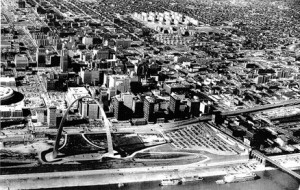
Saint Louis skyline with Eero Saarinen's Gateway Arch in the foreground and Minoru Yamasaki's Pruitt-Igoe housing development in the back right. Image from "The Pruitt-Igoe Myth" documentary.
Notable attention has turned to what many consider the golden age of modern St. Louis—the 1950s—when the city reached its highest population and garnered international attention for its architectural contributions. However, within this renewed interest in mid-century St. Louis is also an attempt to detach the persisting nostalgia for the past from the actual social, economic, and political circumstances that were at play.
At its best, mid-century St. Louis produced celebrated icons—Minoru Yamasaki’s 1956 Lambert air terminal and Eero Saarinen’s 1965 Gateway Arch. During its less proud moments, modern architecture failed to adapt to the unique demands of our city, exposing the shortcomings of its “universal” ideals. In St. Louis and beyond, discussions on the failures of modern architecture often center on Yamasaki’s Pruitt-Igoe housing development. Completed in 1956, the monumental public housing project was razed only twenty years later. Its demolition was felt around the world, and in 1977, historian Charles Jencks famously claimed that the destruction of Pruitt-Igoe marked “the day Modern architecture died.”
When constructed in the mid-1950s, Pruitt-Igoe represented the hopeful vision that the city of St. Louis would maintain its steady population growth. As government officials and other stakeholders saw it, increased populations meant increased real-estate values. As a result, low-income housing was tasked with cleaning up the sprawling slums through systematically concentrating people in modern high-rise structures. At its peak, Pruitt-Igoe housed roughly 15,000 people in thirty-three eleven-story buildings. However, the rapid onset of white-flight and suburbanization revealed the many flaws in this plan. Pruitt-Igoe failed for a number of reasons, including Yamasaki’s architectural design, inadequate maintenance of the building, and decreasing tax dollars for public housing. Released in February of this year, a new documentary titled The Pruitt-Igoe Myth paints a much more complicated picture of Pruitt-Igoe than has been told in the past, sharing first-hand accounts of former tenants that help to humanize the housing development.
Pushing the narrative beyond the trials of modernism, artist Juan William Chávez explores creative possibilities for the still unoccupied land where Pruitt-Igoe once stood. As I introduced in my first post, Chávez is a pivotal force in the St. Louis art scene, founding Boots Contemporary Art Space on Cherokee Street in 2006 and winning the Great Rivers Biennial at the Contemporary Art Museum St. Louis in 2008. Just last year, Chávez closed Boots, moving beyond the gallery walls to focus his practice on community engagement. In 2010, Chávez curated Urban Expression: Theaster Gates for the Pulitzer Foundation for the Arts. His cultural activism has recently earned a great deal of attention and this year Chávez was awarded the Missouri Arts Award for Individual Artist and received the prestigious Art Matters Grant.
Gastro-Vision | Gone Shrimping!
Forrest Gump was one of those rare films that changed the way people think about random everyday stuff, from a box of chocolates to a new pair of sneakers to the way one pronounces the name Jenny. For me, the film comes to mind when- or wherever there are shrimp. In one of the film’s most memorable scenes, Forrest and Lieutenant Dan, following many failed attempts at shrimping and a nearly fatal hurricane, finally get their first big catch. C-shaped crustaceans wriggling on their once barren boat deck are at that point more than just food: they symbolize an entire narrative of loss and perseverance. Just imagine if Forrest and Lieutenant Dan had been artists.
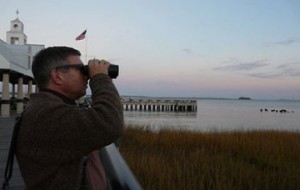
Eric Leshinsky and Zach Moser, artists in residence at the University of Houston’s Cynthia Woods Mitchell Center for the Arts, have dedicated three years of their practice to working as shrimpers in Galveston Bay, the second largest seafood-producing bay in the nation (after the Chesapeake). Shrimp Boat Projects was conceived five years ago, following hurricanes Katrina and Rita. “After those hurricanes, shrimp boats were still an iconic symbol of the Gulf Coast, but a lot of them were idle, washed up onto the shore, or out of commission,” says Leshinsky. “Looking for ways of regenerating those boats or activating that symbol was a starting point [for us].” Moser adds that they we’re also “growing tired of the Gulf Coast only being able to define itself within the spectrum of disaster.” In looking for “a productive way” of talking about the area, the artists came to shrimping—a complex regional industry that functions at the intersection of ecology, economy, commerce, and culture.
Leshinsky and Moser are taking their work seriously, laboring almost as if their livelihoods depend on it. “It’s a goal of ours to be committed to learning the profession well enough so that what comes from it is as relevant to as many shrimpers as possible. A big part of that is paying the dues of working on the boat.” The guys recently Skyped with me from the boatyard where they have been working for the past four months, roughly twelve hours a day in relentless Texas heat, rehabbing their salvaged vessel, The Belinda K. This part of their ride has already been choppy: their boat was scheduled to launch with the beginning of the Texas Bay shrimping season in late spring, but necessary boat repairs have put them months behind schedule. In about a week, The Belinda K. will finally return to the water with Leshinsky and Moser as her deckhands. Their captains, a few hired local experts, will take turns on the boat, teaching the artists how to shrimp in their first year. “We’re going to try and go out as much as possible,” says Leshinsky. “We’re humbled by how much we need to learn.”
EVERYTHING TRANSFORMS

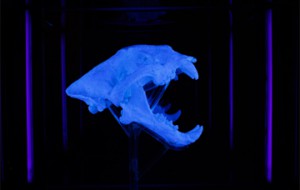
Maya Kramer, “There Is Nothing You Can Measure Anymore,” 2010. Laundry detergent, black light, pump, vitrine. Courtesy the artist.
I first met Maya Kramer at a dinner party she was hosting at her home in one of the tree-lined compounds of the former French Concession in Shanghai. But it was only after we opened the second bottle of wine that I found out she was an artist.
After completing her MFA in sculpture at Hunter College, Maya worked in the curatorial department of the Guggenheim Museum for three years. She first visited China in 2009, to take up a six-month residency at the now-closed True Color Museum in Suzhou, a privately owned contemporary art and performance venue that had been set up by musical entrepreneur Chen Hanxing. Maya was the first foreign artist to be invited to China for the museum residency, and left her mark with a wishing well installation in a grove of paper trees that whispered random desires through hidden speakers.
The idea of establishing a solo practice in China presented a challenging way of both working and living, but two years on from the residency, she is now happily ensconced in the burgeoning art world of Shanghai. Her art practice is concerned with the environment, often consisting of sculptures made from everyday paper waste. She has since extended into collaborative projects, working with notions of value and exchange.
We spoke a few times in Shanghai about the many differences between America and China, the new types of work being explored in the vast number of galleries and museums opening across the country, and especially about the problems of not speaking the language (she does, while I barely scrape by). When I arrived back in New York recently, I interviewed Maya about her work and what she thinks of the now volatile relations in the art world between China and the USA.

Maya Kramer, “There Is Nothing You Can Measure Anymore,” 2010. Laundry detergent, black light, pump, vitrine. Courtesy the artist.

Maya Kramer, “There Is Nothing You Can Measure Anymore,” 2010. Laundry detergent, black light, pump, vitrine. Courtesy the artist.
Din Heagney: I’m intrigued by There Is Nothing You Can Measure Anymore, a vitrine with a tiger skull made from laundry detergent that dissolves over time as water slowly drips on it. The connections you’ve made between endangered animals, pollution, and museum aesthetics make it a very tight piece.
Maya Kramer: Upon completing this work, I was quite excited as it was one of those rare instances where the result matches with one’s original conception. For a while, I’ve been trying to come to grips with a rapidly deteriorating ecology and our place in the world. But in the end, I’ve started to see that everything dies and transforms; it’s inescapable and has nothing to do with us.
I wanted to point to this concern for the environment by fusing various symbols, an x-ray (a diagnostic tool used to examine an underlying problem), a tiger skull (an animal nearly extinct), and laundry detergent (an everyday pollutant), and then have all those concerns literally fall apart.
Teaching with Contemporary Art: The First Three Years
This week Teaching with Contemporary Art here on the blog turns 3. Frankly, I can’t believe that I’ve been writing this column for three years. At the same time, it has flown by much like academic years often do.
To celebrate I want to share some of my favorite posts from the first three years (I say the first three because if I keep from screwing things up maybe there will be another three). Links to each are provided.
A few months after beginning the column, Mining Ideas was published and began the conversation about ways of utilizing sketchbooks in the classroom. Then In-Progress initiated what would be multiple visits to the notion of in-progress critiques.
After only a few months on the job, the powers that be were crazy enough to allow me to interview Eleanor Antin for a two-part post titled Myths, Metaphors and More. Part 1 looked into how Eleanor prepares for exhibits and handles the occasional label of being “controversial”, while part 2 discussed how she uses allegory in order to slow viewers down and really see her work.
A particularly cranky but timely post, What is an Art Contest?, zoomed in on contests without criteria and It Takes Two… or Two Hundred examined how artists today rely increasingly on others in order to realize their work.
Right around TwCA’s first birthday the post Make Less Art asked readers to think about what a quality art curriculum looks and sounds like beyond the production of objects. A few months later one of my favorite posts, …. and the Not-So-Powerful, allowed me to begin sharing stories about learning experiences related to things that haven’t gone so well in my own classroom.
Where Am I? outlined some specific strategies for starting the school year and If the Shoe Fits, Pay For It zoomed in on the (still) timely report by the Center for Arts Education regarding the state of affairs in New York City schools.
My second blog interview turned out to be another surprise, pleasure, and blockbuster for the column. Janine Antoni and I spent about an hour talking about teaching, finding a balance between being an artist and a parent, as well as discussing her most recent exhibit at Luhring Augustine. Part 1 and part 2 are posted separately. Check it out!
Interview number three presented Esopus editor Tod Lippy, who discussed his magazine-as-art and his relationship with education and educators.
For TwCA’s second birthday I wrote the post Better Than Ketchup and Vaseline, which shared the dangers of teaching with film without previewing beforehand. The column also offered some simple steps to take in order to prepare students for complex and easily misinterpreted works.
Which brings us to year three…