Feedback Control

October 24th, 2012

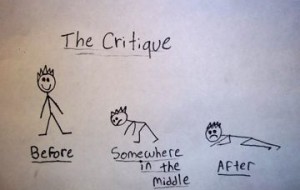
Image: toneworld.co.uk

Giving good quality feedback can sometimes make the difference between students completing mediocre assignments and high quality works of art. This week I want to offer some suggestions for what to do when students are “done” but we know they aren’t. We’ve all been there at some point- a student finishes an assignment long before the suggested amount of time or they’re simply staring at a sketch that’s basically a good idea about to hatch.

First, and this may seem obvious, but having students respond to the prompt, Tell me about this so far allows them to give us some context when it comes to what they’re thinking and where they want to go with the work. It also communicates that we are genuinely interested in the work and want to learn more vs. simply asking them to plow ahead for a few more minutes. Often, a student will respond to this kind of prompt and it will open up possibilities for next steps all on its own.

As described last week, having students frame their idea or theme as a question , or helping them form a question, can allow for broad opportunities to explore their work in different ways. Once a student moves towards forming a big question they begin asking themselves how else the idea can be approached.

Asking students what they hope viewers will think about (vs. asking them to describe how they want viewers to “react”) gives us more information about the story and intent behind the work. If students want viewers to think about something specific we can make suggestions about how to get there. And once we have some basic information about where the student wants to go or what they’re driving at, it sometimes makes good sense to offer open (vs. closed) suggestions. For example, “What kinds of things can be happening to communicate the weather you describe?” is much different than, “You could really use some lightning and darker clouds.”

Even simple questions such as, “What’s the next step?” communicates that we have expectations for the work to go a little further.

How do you get students to think about going further on works of art, even when they’re “done”? Please share your ideas!

Eleanor Antin Takes Over @Art21 on Twitter

October 22nd, 2012

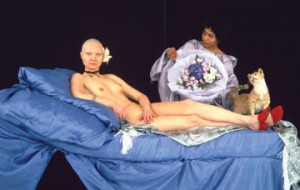
Eleanor Antin during a re-creation of her performance "Before the Revolution" (1979) at the Hammer Museum, Los Angeles, 2012. Courtesy Los Angeles Times. © Robert Gauthier. Photograph by Robert Gauthier.

Mark your calendars: As part of the Art21 Blog’s current Flash Points topic on storytelling, artist Eleanor Antin will take over the @Art21 Twitter account to perform a very special reading this Friday, October 26, from 2:00–3:00 p.m. EST.

Through posts of 140 characters or less, the artist will “read” stanzas of a story from her memoir, Conversations with Stalin, before embarking on four additional performances throughout New York City.

This will be the first time that we have invited anyone—let alone one of our featured artists—to speak through our Twitter account. Likewise, this will be Eleanor Antin’s first-ever “social media” performance. Needless to say, we appreciate your participation and feedback!

To witness Eleanor Antin speak and perform in person is already a unique and special experience; but, to read along with the artist through 140-character posts, a new participatory element is introduced to the concept of a public reading, and the pace and tone of the story itself will come across in a completely different way.

The artist encourages audience participation throughout, and will respond to questions submitted by audience members following the live Twitter “reading.”

From 2:00–3:00 p.m. EST this Friday, follow along with @Art21 and the hashtag #AntinCWS, ask questions, and see what else Eleanor Antin has to say.

Until then, we will welcome any advance questions via Twitter or the comments of this post. A full list of the artist’s New York City performances is below.

Continue reading »

Visionary Studios: Getting Started

October 10th, 2012

Image: newspaper.li

Anyone who knows me often asks about how I coordinate three jobs. I teach two high school classes and serve as department chair in my school district, work as Art21’s education advisor, and teach a class at NYU in the department of Art and Art Professions. This semester I was thrown a little curveball and asked to teach a completely different class at NYU- School Arts: Issues in Pedagogy and Curriculum (Secondary). The course, an intense fourteen weeks where graduate students explore current questions and topics in secondary art education, also has a component where each student takes part in teaching a Saturday course for high school students. This Saturday program, called Visionary Studios (a title I happen to love), asks New York City high school students to sign up for nine weeks of classes around a chosen theme. So, instead of signing up for extra-curricular classes with titles like “Mixed-Media” or “Ceramics” or “Painting”, students this fall are asked to choose from “The Changing City”, “Under Pressure”, “Transformation” or “Soundscapes”. Instead of offering classes that are media-centric, classes are thematic where teenagers can explore the theme through a variety of approaches over nine weeks. Students in the graduate course not only explore current issues in art education and teaching for social justice, but they also plan units of study and individual lessons for these Saturday classes, as well as team-teach every Saturday morning.

It’s a lot of work.

This Saturday is the first session with our high school students and I am excited for the possibilities that exist within the curricula that has been developed so far. Big, and sometimes challenging questions are driving the themes, such as:

  • How can art be transformative?
  • What role(s) does pressure play in our environment?
  • How does sound shape our daily experience?
  • What makes a city?

Artists already being considered to inspire students include Ai Wei Wei, Allora and Calzadilla, Cindy Sherman, Do-Ho Suh, El Anatsui, Eleanor Antin, Kerry James Marshall, Krzysztof Wodiczko, Mark Bradford, Mike Kelley and Yinka Shonibare, to name just a few.

Going into the first session this weekend, my student teachers will obviously be thinking about how to get off to a good start. After all, these high school students are coming from all over the city to attend classes on Saturday mornings. One doesn’t need a roadmap to realize that you better have some good stuff to share, otherwise you will be left with dwindling enrollment. Students will simply stop coming if the course isn’t exciting and engaging.

So what does getting off to a good start look and sound like in a situation like this (or, for that matter, in most courses)? It involves students coming in, being warmly welcomed and getting to know who is teaching. It involves students getting to know their classmates a bit and why they have chosen to be there. It involves sharing interests and broad goals for the course. It involves talking about which directions the theme can take. Most importantly it involves building community and trust from the start. Once that gets rolling, students can begin to feel comfortable creating quality work that will address the theme.

I am also excited for the start to our Saturday sessions because the student teachers will be developing curriculum with the students vs. having each and every lesson planned out ahead of time. Student teachers will be asking different kinds of questions to explore how these high school students want to investigate the four themes vs. being told how the themes will be approached. They will even be asked to help form the supply lists for each of the courses instead of having a “set” of supplies to work with from the start.

Wish us luck. More to come.


Test This

October 3rd, 2012

Image: creationbaumann.com

This school year has started out like none other in recent memory. The fascination to quantify practically everything in education has now moved steadily into art education, as discussed in last week’s interview with Jessica Hoffmann Davis. Here in New York and across the entire country art educators (well, all educators, actually) are being forced to administer pre-assessment tests that “establish a baseline” of “what students know and are able to do” at the beginning of a course. These same assessments are then given at the end of the course and compared to the pre-assessments in order to “measure growth” in student learning.

Now let’s just say there wasn’t any problem with measuring growth this way. Let’s say that students spitting out what they “know” in a class session and trying to measure things through timed tests was actually better than student portfolio assessment built up over time. How can art educators face the current round of demands on the state and local levels and actually make this stuff useful?

If nothing else, this current obsession with testing and attaching numbers to everything that isn’t nailed down allows teachers to take a hard look at their curriculum and ask about the specific things they would actually like to compare over time. It asks teachers to think about the big goals of the courses they teach and then issues the challenge of concisely putting questions and activities together that may come somewhere close to measuring what students learned.

For example, at the beginning and the end of a course teachers may ask their students:

  • How do artists create works of art today vs. the artists of 10, 20, 100 or 500 years ago? What are the differences… and the similarities… between art of the past and the present?
  • How do artists get ideas? How do they give ideas form?
  • Where is art?
  • How do we go about understanding work that’s complex or challenging?
  • Why is context important in order to understand and make sense of contemporary art (and, for that matter, ALL art)?
  • What constitutes high quality works of art?
  • In art, is the idea behind the work more important than the formal qualities of the work itself? Is it the other way around? Is there a balance that must be established? If so, how?

I could go on all day.

What I am trying to say is this: In the midst of putting your ducks in order and complying with the current round of demands related to assessment, it’s important for contemporary art educators to do anything and everything possible to make this poorly structured situation a somewhat meaningful one. Let the assessments we create allow a glimpse into what we find essential learning because at least we, as art educators, still have control over what we define as the big, important goals for our courses. Most of us are still fortunate enough to not be in a position where someone in a suit is handing us a pacing guide that tells us what to teach on which date. And if that scenario ever gets close to reality, well, what can I say except I will probably see many of you in Albany and/or DC…


An Interview with Jessica Hoffmann Davis, Part Two

September 26th, 2012

This week it’s my pleasure to share part two of my interview with Jessica Hoffmann Davis. For part one of the conversation, please click here. Many, many thanks to those who sent along such positive e-mails and messages saying they enjoyed the first half last week. I have a feeling you will also appreciate part two….

Arts education advocates most certainly took a defensive posture in light of the shift to excel in math and science, and we continue to do so, especially facing steep budget cuts over the past few years and for the foreseeable future. How do you see a variety of arts advocates- even columns such as this one- helping to shape policy and not just discourse? After all, this seems to be at the root of the problem we face. Most people agree about the importance and benefits of the arts in schools but few put their money where their mouth is. How do we get more schools, especially public schools, to put this thinking into practice?

I like your optimistic view that “most people agree about the importance and benefits of the arts in schools.” Overall, I agree and feel strongly that advocates need to assume value rather than doubt—it sets the stage for a cooperative rather than adversarial conversation.

Your statement calls to mind something I encountered in my own efforts for school reform around the arts (i.e. starting a program in Arts in Education at the Harvard Graduate School of Education). When I first brought the idea up to then Dean Gerry Murphy (who in the end was the guardian angel of the arts in education and helped us move to a place of recognition and permanence), he spoke as if I’d heard it before: “Everybody cares about the arts in education but not instead of something else.” I think that is the prevalent view. I was speaking recently with a professor who teaches writing and history. She told me that she felt the arts education advocacy I was doing was “so important.” She went on to explain that the arts were good for students because they didn’t use much brain power and students could talk and socialize as they created works of art. Flabbergasted, I tried to turn the tide of our discussion in the direction of the kind of wonderful self-assessment students in an ensemble might do as they prepare for a performance of their work.

But both these perspectives are alive and flourish: “not instead of something else” and “don’t take much brain power.” Ironic really that the thing that came up most frequently from high school students was their view that the arts taught them to think in important ways that other subjects did not- beyond the right answer to critical analysis and interpretation. Think of math and someone saying, “Sure it’s important but not instead of something else” or “It doesn’t take much brain power.” We’d think these statements to be absurd. And yet the arts are easily as entrenched in scholarship, culture, and history, and still they struggle for a place that is always assured for mathematics. I don’t know why I always choose math for this comparison. I hope math teachers will forgive me and note carefully that I am not suggesting math is unimportant (not at all)-only that the arts are too. In sum, I believe the conversation is invaluable and needs to continue. More and more educators, whether they appreciate the arts or not, need to think hard about what it is the arts provide that other subjects do not. And we need to take a hard look at what we value in education and what place the essential learning that the arts provides deserves in our curriculum.

Looking to distinguished private schools for models for the public sector, reading guru Jeanne Chall used to say “What’s good for the rich can’t hurt the poor.” For this last book, I visited well known private secondary schools like St. Paul’s in Concord, New Hampshire where guess what? Arts requirements abound and arts courses have equal status with non-arts courses. And this model is not exclusive to that setting. Great schools take the arts seriously and include them in their course requirements. If we want our public schools to be great, we need to include arts learning and to take it seriously. While students in privileged schools may not be dealing with the same factors that make it hard for others to stay in school, we have found (see reports like the Staying in School report that I cite in my book) that in low performing high schools in New York City, when the arts are included, more students show up every day and stay to graduate. Finally attendance, the quantitative variable that makes the most sense to associate with the arts, is getting its due. Let’s keep talking and thinking and putting teachers and students at the front of the discourse and let’s be sure to include the policy makers who in the end I believe—whether they want to bring back the progressive era or to celebrate No Child Left Behind—are on the same page of wanting the best for our students in our public schools. Continue reading »

An Interview with Jessica Hoffmann Davis, Part One

September 19th, 2012

This week it’s my pleasure to kick off a two-part interview with one of my favorite authors in the field of education, Jessica Hoffmann Davis.

Jessica Hoffmann Davis has published and lectured extensively on the role and promise of arts learning, drawing not only on her own and other current research, but also on personal experience as a visual artist, writer, and educator. While her popular book, Why Our Schools Need the Arts (Teachers College Press, 2008), proposes a “new and unapologetic approach to advocacy for the arts in education”, I originally came to admire her work through reading (and re-reading!) Framing Education as Art: The Octopus has a Good Day (Teachers College Press, 2005), where she challenges non-arts education to be more connected to and like the arts.

Dr. Davis holds a Doctorate in Human Development and Psychology and a Master’s in Teaching, Learning, and Curriculum Environments from Harvard University where she went on to be a senior lecturer and to hold the university’s first chair in the arts in education. She retired from the Harvard Graduate School of Education in 2005, in large part to focus on a book about her mother and the extraordinary school she directed for almost four decades: the Hoffmann School for Individual Development in Riverdale, New York. Davis’s educational memoir, Ordinary Gifted Children: The Power and Promise of Individual Attention, was published by Teachers College Press in 2010.

This interview took place over the past two months and became what we finally started referring to as a “blogversation manifesto”….

To start, could you talk about some of what you’ve been working on lately and how this connects to your original passion for articulating the connection between education and art?

I left Harvard Graduate School of Education in 2005, after many years of teaching and publishing at the field juncture of human development and the arts in education (a term which includes but is not limited to art/s education). My breakaway book, Framing Education as Art: The Octopus has a Good Day (2005) proclaims that mainstream education would be improved by taking a lesson from (modeling itself after) the arts and arts learning. Of course even as I offered a framework for such modeling I allowed that there were versions of what I suggested already happening in the classrooms of what I call “artful” teachers. Nonetheless, at the heart of that work is a notion that seems to have eluded arts education advocates in recent years: specifically, that the arts provide essential learning that other subjects simply do not.

This positive view flourished in the 1920’s in the Progressive era when immeasurable student outcomes like creativity, empathy, and thoughtful citizenry had valued places in the agenda of student learning. But in the late nineteen fifties after the Russians had embarrassed us by launching a satellite into space before we did, there was a shift towards hard-edged disciplines like math and science in order to give our students the edge in international competition. This was at the expense of what was thought of as “soft” learning: visual arts, dance, music, theater, et. al. And arts education advocates ultimately gave in to the wave of priorities, arguing that the arts might make a difference in fostering creativity in these valued hard edged arenas, or that in fact the arts could be reconsidered as one of these hard edged arenas and taught in terms of factual information that could be measured on tests (the current prevailing and devastating ethic). And while the terms have changed along with educational fashion, the mandate to “sell” the arts as handmaidens to whatever is valued most in education has held sway. Will the arts make your IQ get higher? Yes, yes, listening to Mozart can do that. Will arts learning make you a better leader or someone better equipped to hold down a job? Absolutely; there are habits of learning (like “sticktoitiveness”) that the arts foster. Continue reading »

Ink | Political Art for a Contentious Time

September 14th, 2012


Brad Kayal. "Job Creators,” from “Occuprint 2012.” Color screenprint, 18 x 12 in. Published by Occuprint.org, edition of 100. Image courtesy Booklyn Artists Alliance, Brooklyn.

High political season is underway with a particular sense of urgency this year, and it seems that nearly every aspect of American culture has joined in the debate.  In keeping with a historical trend that began during the Enlightenment, prints are playing a role in today’s political arguments as a means of disseminating the views of artists and rallying the people.  Recent releases of note are the Occuprint Portfolio 2012 and Artists for Obama 2012.  Both are fundraisers to support their eponymous causes: the former was issued earlier this year through the Booklyn Artists Alliance–the latter debuted last night at Gemini G.E.L. in Los Angeles and will also be presented in its New York gallery in Chelsea later this month.

While these two print portfolios are both political in their aims, other similarities are few.  The facture and content of Occuprint, as may be anticipated, reflects the values and concerns of the grass-roots Occupy Movement that spawned it.  Issued in an edition of 100 with a net fundraising goal of approximately $30,000, the thirty screenprints it contains were selected from the thousands of submissions that have been posted for free download on the Occuprint.org website.  Since last fall, these have been sent in by relatively unknown designers from all over the world in support of the various political aims that have sprung from the Occupy Movement, including We are the 99%, the ballooning costs of higher education, the subprime mortgage crisis, as well as May Day.   The portfolio’s production was supported by pre-publication sales to twenty public institutions, including a number of top universities, and proceeds benefit the activities of Occuprint.org, a non-profit affinity group that operates independently of the Occupy Movement.

Continue reading »

Uncovering Works of Art

September 12th, 2012

Arturo Herrera, "Untitled", 2002. Courtesy Sikkema, Jenkins & Co., New York

Monday evening I had the pleasure of participating in a dynamite online conversation with our current group of Art21 Educators. We decided, based on some recent requests, to spend a little time actually looking at art together. While teaching, planning, and discussing ways of bringing contemporary art into the classroom are topics that come up a lot in our yearlong relationship, sometimes the simple act of looking at art together gets lost in the shuffle.

We focused on Arturo Herrera’s collage, Untitled, above. The group was initially asked about their interpretations and ideas about it:

Ca: Student made?

JH: Such an interesting comment- why do you say that?

D: I’m thinking “I saw the Figure Five in Gold”

S: Is this a photo of something sculptural or a painting?

A: It makes me think of paper graffiti…. dripping, tubes, lines, subway

G: I love that I don’t know what I’m looking at… what’s the scale?  The space is so deep but flat at the same time!

T: Thinking about paper cutouts…

M: It reminds me of a spiral made out of a simple piece of graffiti

Ch: It looks 3-dimensional but I think it is a 2-dimensional piece

M: Not graffiti- paper

T: Is it 3d?

Ca: I see what looks like some photo with some paint?

D: Charles Demuth painting – the gold floating in the air

Cr: Something about it makes me think of Warner Bros. Cartoons

CM: There are lots of layers within layers

A: Intestines!

M: Looks like some fun with an X-acto

J: Yes!

Ch: It looks like it might twist like a mobile

Ca: That looks like a sleeping loft up above

A: I just saw the bodies exhibit

D: Awesome

T: My brain wants to see more than I do but I don’t.  If that makes sense

C: it looks like a collage/painting . . . and the background creates the illusion of space and the overlay . . . flattens it out. A cabin interior or stage curtain?

J: Do tell…

D: Arturo Herrera, I’m looking for Disney

M: It looks like it is done in Photoshop or with a computer

CM: Are there some figures within it? The front piece (intestine shape)

M: Agreed- looks digital

T: I want the missing pieces

A: I want to unravel it

J: Nice

Then we revealed the “credit line” including the artist’s name and title of the work: Continue reading »

Building Trust On The Way In

September 5th, 2012

Starting off each new school year, one of my biggest concerns in the first few weeks is getting to know my students better in order to build trust. Without trust students will not take the risks necessary to break free from the habitual and try new things, which teaching with contemporary art will ultimately call for. And while getting kids to explain what they did over the summer is certainly one approach, I enjoy taking other roads that lead to creating community and a sense of possibility. Some suggestions include:

Keep it moving and give students different kinds of experiences in the first few weeks. Educators do themselves no favors by “starting a project” right out of the gate that keeps students in their seats, working alone, and only occasionally talking with the teacher. Create different opportunities in the first few weeks for students to talk with their classmates… and the teacher.

Look at works of art together. Give students the opportunity to see and react to works that will surface in the months ahead. Especially when it comes to teaching with contemporary art, familiarity and a little heads-up goes a long way. Ask students for comments and reactions to the works you share. Ask them what they think the works are about (vs. what they “are”). Take notes on their responses and use this information to help plan future lessons.

Sit with students. I know this seems almost silly to mention but it’s incredible how many teachers stand over their students all year long and never get at eye-level with them at their tables or desks. Building trust starts with having conversations face to face, not with students tilting their heads toward the ceiling waiting for approval.

Share out feedback, quotes and special moments. As we start the year with different kinds of activities and conversations, share out the feedback and ideas that students develop. Beginning a class with great ideas and quotes from the previous day tells students that we are really listening and value their perspective.

Finally, share a little of the power. Last year one of my colleagues, Deirdre Kenna, asked students about the supplies they thought they would need in the coming school year vs. trying to come up with a new supply list all by herself. After students have an idea about the kinds of things they will do in the course, allow them to help shape the course by giving them opportunities to add special materials, suggest steps within certain procedures, or add particular activities to some of the units of study that lie ahead.

Here’s wishing everyone a good start to the new year….


Polyculturalist Visions Revisited

September 4th, 2012
Ellen Gallagher. "Bird in Hand," 2006. Image courtesy of Tate Liverpool.

Ellen Gallagher. “Bird in Hand,” 2006. Image courtesy of Tate Liverpool.

My contribution to the Ideas issue, The Culture Wars, Reduxwas an essay about the ongoing crisis of representation in cultural institutions. I noted cultural critic Vijay Prashad, who advocates for a polyculturalism which views the world as “constituted by the interchange of cultural forms.” This addendum to my original essay highlights artists who represent a junction of ideas and concepts, use different materials that permits culture to move from one form into another, and invite engagement through multiple modes of discourse. Many second and third-generation postmodernists have overlooked these intersections, especially ones that have some bearing on contemporary considerations of race and gender in art. As a social construction, this development encourages us to negotiate, or stabilize, the meanings of their work. As they relate to creative practices, these are the major tracks and themes I will explore here:

Syncretism is defined as the collision or reconciliation of disparate beliefs, systems of thought and forms of expression. It has become associated with representations and belief systems that reflect the myriad of African, Amerindian, European, Asian and North American cultures from which they emerged. Here, this incorporation has allowed for a kind of covert resistance and a rich mixture of associations between representations and a variety of techniques and media. This term is closely related to bricolage or making do with whatever materials are on hand.

Black (native) vernacular technological creativity frames language that defines a relevant social group as a fluid assemblage of individuals who share a common meaning of an artifact. It opens up interpretive flexibility to acknowledge and consider a multitude of coexisting technological meanings for a variety of social groups, and creates an opportunity to study how African Americans, and other marginalized peoples, create their own relevant social groups that decide which technologies work for them and how to use them.

Continue reading »