Teaching with El Anatsui
This weekend I will be back with friends and colleagues at the University of Michigan Museum of Art (UMMA) to facilitate a teacher workshop about working with Art21 education materials and teaching with El Anatsui’s gorgeous exhibition, When I Last Wrote To You About Africa. This being Art21’s second visit to UMMA, I am looking forward to once again working with Pam Reister, Jann Wesolek, and all of the participants joining us this weekend.
El Anastui, one of my favorite artists from Season 6, is in some ways an educator’s dream. His sculptures and installations reference history, culture and memory while simultaneously exploring the possibilities of found materials and different processes for making art. And while Anatsui is best known for his stunning, draped metal sculptures, there is more to the work with than meets the eye… and that’s quite a bit to begin with.
For example, if we step back four decades ago to Anatsui’s initial work in Ghana, the artist began using materials from his immediate surroundings—carving into wooden trays much like those sold in markets to display fruit and vegetables—and then creating works with adinkra-like symbols prominently featured. As Olu Oguibe describes in the magnificent catalogue that accompanies the show, Anastui has been guided by the following principles since this early work:
- Pay close attention to location and environment
- Learn whatever you can from local practitioners
- Use found objects and materials from your surroundings, especially your immediate surroundings
- Let the medium and materials suggest, even dictate, the form
- Acknowledge the potential for art to serve as a metaphor or visual allegory
Anatsui’s ceramic sculpture from 1978, Omen, explores how brokenness can somehow inspire new life and healing. From the small burst of an opening to the coating of manganese that speckles the surface formed from damaged ceramic pieces, Anatsui’s work can represent ideas about fragility and even political instability in Africa.
Joy and Revolution: Talking with Adam Weiler of Ambrose, Part 2
This week’s column follows up on last week’s post and features part two of my interview with Adam Weiler of Ambrose, an atypical after school club in Holland, Michigan. If you haven’t already, check them out. You may even want to try the Makers Dozen to go….
Joe Fusaro: So what does a typical afternoon at Ambrose involve? What’s an after school session like for you and the students?
Adam Weiler: Students trickle in after school. We have healthy snacks available for them to munch on and at 3:30 we start community time where students and leaders tell their best and worst parts of the previous week (dubbed “Happies & Crappies”). The first Thursday of the month we’re joined by a guest artist who kicks off a collaborative project based on a process and we like to have them join in on “Happies & Crappies” too. After this we invite the guest artist to share their story, portfolio, and some lessons learned along the way (including the importance of the business side of art). The meat of the workshops are hands on projects focusing on the processes the visiting artist is known for… Brainstorming. Design Thinking. Graphic or Product Design. Paper Cutting. Typography. Drawing. Photography, etc. We try to do a short 1 hour project and exploration to get a taste of a process and then the following weeks we execute a larger group project based on that process around a theme.
JF: Do you have a favorite part when it comes to working on this project?
AW: Hands down it’s the relationships. With students – seeing them grow to connect with volunteers, community members and career pathways; and with staff – having a team that sees experiential education and the potential it has to change the world for the better.
JF: And where do you see Ambrose in a few years?
AW: Our goal is to do the best we can with what we’ve got. For now that means continuing the local work of building relationships with community partners, refining the curriculum and honing the business side of the program. We’ve figured out what it takes to make it happen full time for our community so that’s what we’re aiming for. When I dream about the future I think it’d be amazing to see Ambrose pop up elsewhere: groups of artist-educators from New York or Atlanta using the model to support local chapters. Kids all over the place getting pumped about design, problem solving, creativity and entrepreneurship. That’s a long way off…but one can dream.
Teaching with New York Close Up: Lucas Blalock’s 99¢ Store Still Lifes
Lucas Blalock’s only plan is to work… preferably in the evenings. He deals with a set of parameters that his tools provide and brings things he purchases at local discount stores into his apartment. From there it’s open season.
In a world filled with artists that create work in a myriad of settings, Lucas Blalock’s situation is fairly similar to the scenario many of our own students face- working at home and trying to hold down a full-time job (or a full-time class schedule) while attempting to make art in between. And while Blalock often creates art with objects he purchases and photographs, right in the living room of his apartment in Williamsburg, his process is quite unlike many of the students we work with.
In Lucas Blalock’s 99¢ Store Still Lifes the artist talks about discovering and creating visual problems in order to solve them vs. starting with an idea and finding a way to photograph it. Blalock comes at making art from somewhat of an opposite angle than what we may be used to, and certainly opposite of someone such as Paolo Ventura. Instead of following through on plans to photograph particular objects in certain ways, he allows himself to be attracted to different things… and then finds a way to solve the problem of making this thing interesting to a viewer, as well as himself:
Sometimes an object will really give me a simple problem to deal with. Other times it’s much more of a kind of flirtation with the objects in the studio that something gets pulled out of it.
There’s a big part of me that can see educators feasting on a short film like this (it runs about 6 minutes) because it shares examples of things that ARE working for Blalock and also finds time to share what happens when things AREN’T working. For example, towards the end of the segment, we see the artist wrestle (literally, physically) with trying to photograph some multicolored foam he brought into the studio. While obviously excited to use this material at the start, Blalock quickly becomes frustrated with it and decides to wait on trying to capture this particular subject matter. The inspiration may have been there, but the material wasn’t “doing” anything to impress him. Instead of forcing the issue, he simply remarks that he may have to hold the foam in the studio for a while before deciding how to work with it. He doesn’t throw it away. He doesn’t have a fit and trash the joint. He simply decides to wait.
Lucas Blalock’s 99¢ Store Still Lifes is an inspiring piece for teachers and students alike because it also illustrates how one can create a complex and stimulating context for making beautiful works of art in a simple space. But Blalock makes sure we understand it’s not easy. For every 20-25 photographs he takes and develops using his large format camera each week, only one or two “really work”. He goes on to explain that the most successful pictures are ones that “don’t fall into a category”. Perhaps an easy label means the work isn’t complex enough? Regardless, here’s to steering clear of categories.
Check out New York Close Up and please be sure to share any artists you are planning on working with… in and out of the classroom! See you next week.
Community Arts Training Institute: A Conversation with Roseann Weiss

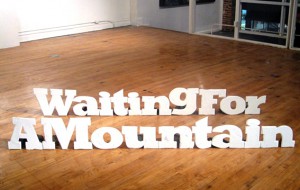
Stan Chisholm, "WaitingForAMountain," 2010. Installation at Art Dimensions Gallery, St. Louis. Chisholm is a graduate of the CAT Institute.
During my time as a guest blogger for Art21, I’ve examined various initiatives that have transformed the cultural landscape of St. Louis. Despite the city’s dwindling population, the arts are prospering in St. Louis, as evidenced by the ever-increasing number of contemporary art organizations, the abundance of creative activity on Cherokee Street, in Grand Center, Old North, and Hyde Park, and the social commitment of artists like Juan William Chávez and Theaster Gates. As I was thinking about how I’d like to wrap up my examination of the St. Louis art scene, I felt the need to more precisely pinpoint the catalyst for cultural activism within the city.
I began this formidable task by arranging meetings with culturally engaged social workers. Social work, like art, is constantly re-defining itself and expanding its perimeters. Over the past year, I’ve become increasingly aware of the growing number of Master of Social Work (MSW) graduates who, coming out of Washington University’s Brown School of Social Work, have pursued careers in the arts. The marriage of social work and contemporary art forms a crucial partnership in arts-based community development. Equipped with macro-level analysis and evaluation skills, the social workers I met with helped me better understand our current artistic movement within the broader social context of St. Louis.
First I met with Lisa Harper Chang, the Community Projects Director at the Pulitzer Foundation for the Arts. In 2007, Chang established the initial partnership between the Pulitzer and the Brown School and her contributions have since paved the way for future MSW students—such as Emily Augsburger and Megan Johnson—to fulfill their social work practicums at the Pulitzer. Next I met with Regina Martinez, an artist and social worker, who, as I mentioned in my previous post, is working with Theaster Gates and the Rebuild Foundation to start a community arts center in Pagedale, St. Louis. After that, I interviewed Claire Wolff, founder of Urban Studio Café, a non-profit coffee shop in Old North that used its proceeds for arts programming. Lastly, I met with Amanda Moore McBride, Associate Dean for Social Work at the Brown School, who explained to me that the program’s recent emphasis on cultural activism evolved from a movement from within the student body. Each of these meetings demonstrated how social workers are increasingly helping to refine the goals of community art initiatives in our city.
Creative Rebuild: Theaster Gates in Hyde Park, St. Louis

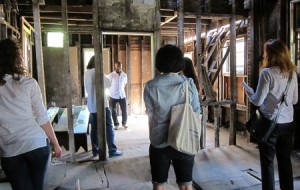
Theaster Gates leading a tour of a once-abandoned home that is now central to his creative rehab efforts in Hyde Park, St. Louis. Image courtesy of the Rebuild Foundation.
Artist Theaster Gates likes systems. And what he likes more than a system itself is knowing how to leverage it. Though formally trained in handling clay, Gates also uses the structure of neighborhoods, cultural institutions, and universities as his artistic medium.
Over the past few years, Gates has earned a reputation for his social-based practice, in which he intertwines art, urban planning, and community activism. In a recent conversation, he expressed frustration with the accepted scope of what it means to be an artist. He particularly dislikes the phrases “artist as change agent,” “artist as social worker,” or “artist as entrepreneur.” Gates explained that “the word ‘as’…shifts the possibility that an artist could be entrepreneurial, or have interest in the social, or have interest in architecture. It says you have to be ‘both this and this.’ It separates a person into these compartments. Versus: ‘I’m an artist and my skill set includes these things.’” With degrees in Ceramics, Urban Planning, and Religious Studies – and a brief stint in Pre-Pharmacy – Gates embodies the myriad identities that can be folded into being an artist.
Though Theaster Gates is nearly a household name in Chicago and is widely recognized throughout the art world – he was included in the 2010 Whitney Biennial – he recently has garnered attention in St. Louis for his cultural revitalization initiatives. Last year, Gates founded the Rebuild Foundation, combining the various facets of his practice within a single non-profit organization. The Rebuild Foundation brings together artists, architects, developers, educators, and community activists to help revitalize under-resourced neighborhoods. It currently manages projects in Detroit, Omaha, Chicago, and St. Louis. In just one year alone, the Rebuild Foundation, with the energetic on-site commitment of Dayna Kriz, has become a major force in St. Louis’s Hyde Park neighborhood. Located in north St. Louis, Hyde Park is a historic neighborhood that has fallen upon hard times as a result of post-war deindustrialization and the ensuing population decline.
Activist Archiving with Mona Jimenez
The oft-repeated cliche about the early video movement in the United States is that it was driven by groups of people who came together with a collective desire to put video technologies “into the hands of everybody.” And in many ways, these groups (or collectives) succeeded. Workshops were organized at community centers free of charge to introduce demographics less likely to experiment with video to the medium. Video helped encourage a generation of women, in the process of liberating themselves, to pick up cameras and make experimental media. And information was freely circulated and available to all, via numerous technical manuals and how-to’s, including those printed in the magazine Radical Software, the Spaghetti City Video Manual authored by New York collective The Videofreex, and Dan Sandin‘s and Phil Morton‘s Distribution Religion, which provided a step-by-step guide for recreating an Image Processor.
It is odd, then, given this proliferation of technical know-how, that forty years later, the the number of people with the ability to fix and repair analogue video equipment, and transfer and preserve video tapes (particularly the ½ inch reel-to-reel format popular in 1970s Sony Portapaks) is relatively few. Information has become consolidated, and even programs that aim to teach a new wave of prospective archivists and preservationists the skills to rescue the massive amount of media art created between, roughly, 1968-75, can only achieve so much (especially with dwindling funds and resources.)
According to Mona Jimenez, an associate professor in the Moving Image Archive program at NYU and a veteran of the early video movement herself, preservationists need to get organized. “People [in the archival/preservation community] need to be thinking like activists rather than thinking strictly like preservationists,” says Jimenez, continuing:
There has to be a way to feed those collections back into the communities that produced them to see if they have relevance. There has to be something that starts the process. There are too few people that can put their hands in a deck. Even the simple kind of troubleshooting that we used to do in the seventies. If there were people available then who could run half inch open reel decks, why is it now that so few people can? It’s not like there weren’t a lot of people out there who were running that equipment. We’re running so short of time. I feel like a lot of us have been screaming fire for a long time and nobody is paying any attention.
Turkish and Other Delights | Şener Özmen

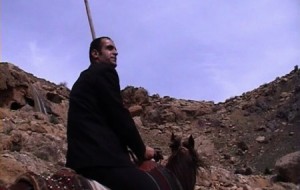
Şener Özmen with Erkan Özgen, "Tate'e Giden Yol (Road to Tate Modern)," video, 7'13" (still), 2003. Courtesy the artist and Outlet-Istanbul.
While preparing to travel to Diyarbakır, the largest city in southeastern Turkey, I discovered that telling Turkish people who live outside of that region that you’re going to visit Diyarbakır is akin to telling an average suburban American you’re going to hang out in an inner city housing project or along the wall dividing Israel and Palestine. Their eyes grow big, there’s a lot of gasping and “ooooh”ing, and they ask you, incredulously, “why would you want to go to Diyarbakır? It’s very dangerous there, you know.” Some treated it a bit like I was going on safari–a worthwhile, possibly exotic and educational, endeavor, as long as I had the proper guidance–and protection. Because Diyarbakır is not only the largest city in southeastern Turkey but also the capital of Kurdish culture in Turkey and the epicenter of a significant amount of violence throughout the 1980s and 1990s, inevitably the news of my travels sparked conversation about “the Kurdish question”–that is, the question of what freedoms and rights ethnic Kurds living in Turkey should be granted. For example, since the founding of the Republic, teaching Kurdish in schools and printing or broadcasting media in Kurdish has been outlawed, and celebration of Newroz, the Kurdish New Year, was forbidden. In the past five years some of these restrictions have been eased, but the subject remains controversial, with many über-nationalistic Turks remaining opposed to the reforms.
So why would I want to travel to Diyarbakır? The art scene in Turkey is famously concentrated in Istanbul–what interest could a formally war-torn and politically unstable region of the country hold for a yabancı (foreigner)? In fact, Diyarbakır has produced some of the most active, intelligent, and influential figures in contemporary Turkish art. These would include artist and curator Halil Altındere, Berat Isik, Ahmet Öğüt (who, along with Banu Cennetoğlu, represented Turkey at the 53rd Venice Biennale in 2009) as well as Suat Öğüt and Mehmet Öğüt, Erkan Özgen, and Cengiz Tekin. (Fikret Atay, another well-known Kurdish artist, actually hails from Batman, a smaller city located about two hours from Diyarbakır.) All of these artists have exhibited extensively both throughout Turkey and internationally. But the godfather of the Diyarbakır art community is undoubtedly Şener Özmen. For the past twenty years, Özmen has worked not only as an artist but also as a poet, art critic, translator, and teacher. He collaborates constantly with his fellow Diyarbakır-based artists, has nurtured a new generation of artists, produces texts for exhibition catalogues, designs covers for Lîs Publishing (a prominent Kurdish language publishing house based in Diyarbakır), writes fiction and poetry, and supports the work of the Diyarbakır Arts Centre. In an essay included in the recently published monograph A Sener Ozmen Book, critic Süreyyya Evren describes him as “an artist who cannot relax.” When I visited Diyarbakır, I was honored that Özmen took the time from his busy professional and personal life (he is also a father and husband) to serve, along with Cengiz Tekin, as an attentive and wildly entertaining host. At one point, while we were riding a dolmuş (mini-bus) from Diyarbakır to have breakfast at Hasankeyf, a historical site located on the Tigris River (which, sadly, is likely to be destroyed in the near future by a hydroelectric dam project), Özmen casually remarked that this was the first day off from work that he had ever taken. It sounds like hyperbole, but given his extraordinary output, I am inclined to believe this was true.
A Problematic Introduction

It’s complicated.
Last year, over 3 million Facebook users willingly adopted this dubious relationship status even after the drop-down menu expanded to accommodate eleven statuses, including newer options like civil union and domestic partnership.

Facebook relationship status options
This status is apt for those who want to publicly define the grey area that is his or her personal life, although its ambiguity may technically make it the only non-status, aside from simply hiding the option altogether. Tucked into the Basic Information page, the brief two (or rather, two and a half) words proclaim something like this: “I may or may not be formerly, presently, or subsequently interacting with one or more person(s) or thing(s) in a manner in which I define by the fact that I can not or choose not to define it!” In this sense, the complication evades categorization by problematizing, flaunting the complexity and ambiguity of a SimCity in fog. Although it may lurk ominously in the domain of relationships, the complication is also a creative force.
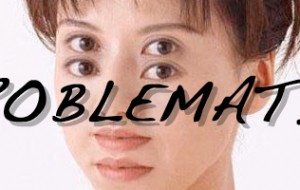
When unpacking sticky situations, one should not expect to discover anything less sticky. With appropriately viscous expectations, I (artist and guest blog alum, Lindsay Lawson) present Art21’s newest column, Problematic, aimed at diffusing, rather than shedding light on subjects that are particularly tricky, paradoxical, and well… problematic. The column borrows its name from friend and artist, Guthrie Lonergan, who suggested “Problematic” as an exhibition title, playing on its buzzword status that has become all too ubiquitous, peppering the rhetoric of art discourses. But everything is problematic if you look hard enough; you just have to will it so.

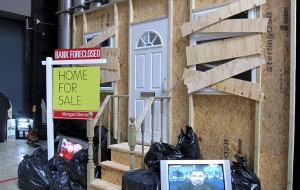
"Tate Modern: Tomorrow Is Another Day (After the Economic Crisis)" installation produced by Not An Alternative for the Tate Modern’s 10th anniversary show “No Soul for Sale: A Festival of Independents.” The work implicated corporate sponsor, Morgan Stanley, for its role in the economic crisis. The piece was accompanied by an essay situating the work art historically as in intervention on participatory art, while simultaneously linking it to other local campaigns targeting Tate sponsorship. May 14-16, 2010 Photo by Not An Alternative.
I encountered the art group Not An Alternative for the first time about a month ago in Corona, Queens, where Tania Bruguera (featured last month in 5 Questions) had assembled a panel on “useful art.” What immediately impressed me was the group’s ability to articulate its ongoing project, which aims both to create new spaces for cultural production and to question the ways that various participatory structures (social media, election processes, relational aesthetics) exclude certain subjects and amplify social and economic inequalities by means of participation.
Through their highly engaged work, work that functions somewhere between political activism, social service, and institutional critique, Not An Alternative confront the limits of what political theorist Jodi Dean has called, after a variety of critical theoretical debates, “communicative capitalism.” In a time of communicative capitalism, our political and social participation is increasingly exploited by the use of new media. Not An Alternative foregrounds this fact, presenting ways of navigating a relatively new digital landscape in which values once cherished by the militant left and avant-garde alike–participation, reflexivity, interactivity–have become corporate watchwords for how neoliberalism manages consent in a networked age.
Networked for some, but obviously not for all. Not An Alternative’s work is also crucial in the ways that it foregrounds exclusion, offering ways to visualize the limits of participation in a society in which obviously one’s ability to participate is largely determined by social and economic privilege. As Not An Alternative said during their presentation in Corona, referring to their collaboration with a homeless advocacy group in the Bronx (discussed below), they recognize the important of “desubjectifying” themselves, where to draw attention to their efforts may work against the causes of the community groups with whom they choose to work.
Open Enrollment | In Poor Taste,* Lunch with Jani Leinonen
I was waiting in line to buy a movie ticket when I heard the news: Jani Leinonen had been incarcerated. Conversations with my Finnish friends in the previous weeks had been gripped with anxiety over the fate of a kidnapped Ronald McDonald figurine from a McDonald’s restaurant in Helsinki. A series of YouTube videos chronicled the antics of the activist group, the Food Liberation Army: beginning with the abduction of a Ronald McDonald statue on January 31, the delivery of eight demands to the McDonald’s corporation to divulge unsavory secrets of their food production processes (see video below), an invitation proffered to McDonald’s employees to speak out, and lastly the grim execution of Ronald McDonald on Friday, February 11, 2011.
Nearly two weeks following Ronald’s guillotine-style beheading, Leinonen agreed to recount his recent stay in the big house with me. I had imagined that the artist Jani Leinonen would match the bombastic hype of the events reported in the recent media flurry. Parallels were drawn–I hoped with hyperbole–between the Food Liberation Army and terrorist groups such as al-Qaeda. I prepared myself to face a brash and dangerous character. Truthfully, I was afraid—I don’t make it a habit of lunching with potential terrorists.
My fears were allayed within minutes. It was immediately apparent that the artist and the affable person across the table in a red woven hat with white snowflakes overlap in name only. As we talked, Leinonen picked at a smudge of white paint on his right hand, a gesture that removed the last vestiges of the artist from the conversation. Though the artist might dabble in petty theft and vandalism, Jani, the ordinary person, enjoys snowboarding and strawberry milkshakes. My erroneous preconceptions of Leinonen disintegrated as he explained a belief in the artist’s responsibility to mediate social and civil injustices.
A contemporary artist such as Leinonen is a cultivated spokesperson; the artist is merely a mouthpiece for the cause or agenda that fuels the work. In graduate school in the United States, it cynically occurred to me that self-promotion can sometimes be an indispensable stratagem for success; cleverly, it can be dissolved into the conceptual thrust of one’s artistic output. In Finland, however, those who willingly bask in the limelight are often reproached for immodesty. Far from an exception to the rule, international coverage of Leinonen’s mock terrorism landed him in jail.