Athletes & Artists: Riyas Komu’s “Mark Him”

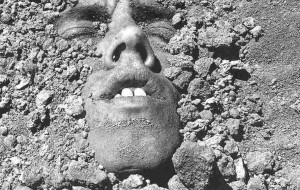
Riyas Komu, "Syed Nabi" from the "Mark Him" series, 2007. Courtesy Komu Studio.
Flash Points contributor and University of Riverside professor Jennifer Doyle is currently spending 2 weeks in India, traveling with the Indian artist Riyas Komu. Following is the first in a series of dispatches from Doyle on the road. — Ed.
Since he produced Mark Him (2007), a series of portraits of Indian National Team soccer players, Riyas Komu has been haunted by the sport.
“Mark him” is something one shouts to a defender: it means to track your opponent’s movements, to limit them. To mark is to anticipate where your player wants to go and contain him. An expert defender will study his opponent as he advances and deduce if he wants to take the ball down the outside, or if he dares to cut through the center. He’ll know his opponent’s preferences (which foot is stronger or more accurate) and if his ego can be engaged (if challenged, will he give the ball to a teammate, or will engage the defender directly). Marking yields a kind of intimacy. It can be surprising, too – a smart attacker knows well what you are doing, and can seduce you right our of your boots — taking you on a trip whose itinerary is of his design, not yours.
I came here to India on the force of this imperative: Mark Him. Somehow my interest in Komu’s work demanded not simply that I get to know the artist, but that I get to know the player who haunts him.
We look at the men in Komu’s portraits from the distinct perspective of heroic propaganda. We look up at them; their eyes are directed forward. We are lifted with their gaze according to a monumental logic. Mark Him is reparative, offering a visual attention to a class of athletes who are largely invisible to the cricket-mad Indian mass media. The team is currently ranked 135th by FIFA, and enjoys little glory even as it represents this large and diverse country (players hail from all over India, speak four different languages, and come from distinctly different cultures). Soccer here is a minor sport, edged out of the newspapers by the glitz and glam of cricket and by the television spectacle of England’s top league (the “Premiership”). To even India’s fans, the sport as played here seems slow and boring. The level is just not what it should be.
Scenes from a Globalized Art World
I’d like to start my guest blogging with Art21 by bringing up a series of questions surrounding globalization and artistic representation. My primary research interest is in the art market and the forces that shape it. With a background in cultural studies, I tend to approach the market through multiple lenses—analyzing it through its cultural, economic, and social contexts and impacts. In the next few weeks, I hope to present some interesting talking points surrounding this very issue, explore how arts communities are built, and feature artists working in exciting, new ways.
Not only can art expose the norms and hierarchies of the existing social order, but it can give us the conceptual means to invent another, making what had once seemed utterly impossible entirely realistic.
— Michael Hardt and Antonio Negri, Artforum, October 2009.
Last week, the San Francisco Art Institute hosted a panel discussion titled, “Global Art in the Downturn.” Panelists included Hou Hanru and Carolyn Christov-Bakargiev. My first question upon coming across the announcement was, what is the definition of “global art”? This is exactly the question that was first addressed by moderator, Dominic Willsdon of SFMOMA. The agreed-upon definition during the panel discussion was that “global art” included the genres and forms of art that are more popular across the globe, and that it is work presented in biennials, art fairs, and internationally-known institutions, and publications.
There are no set terms or definitions or categories for the levels at which artwork is produced, but what became clear to me in my two years of researching art world ecosystems for my master’s thesis is that artists make conscious decisions about how they want their work to be seen and by whom. At the same time, their agency is limited or co-opted by other art world players, such as curators and dealers who control access to major institutions and exhibitions.
There is no doubt that globalization, or the more nuanced French term mondialisation, has affected the art world as a whole—from the expansion of new markets, to the ability for artists to more easily travel, explore, and present a wider range of ideas, or to the proliferation of biennials and art fairs. How, then, does defining “global art” as the work endorsed by the international art community affect how non-endorsed works or artists are read within a globalized art scene?
Unconventional Residencies

Hideous Beast, "Mini Movie Fest hosted during their InCUBATE residency," 2008. Courtesy Charlie Roderick.
Last November, the National Endowment for the Arts established a new funding category explicitly for artist communities. The NEA defines an artist community as “an organization, whether focused on a single discipline or multidisciplinary, whose sole mission is to provide artist residencies.” This unprecedented recognition of the importance residencies play in the contemporary art ecology also serves as a way for the NEA to support the activities of individual artists without the political liability of direct grants to them. The recent dust-up over an NEA conference call encouraging artists to support certain domestic policy agendas is only the most recent example of how the agency continues to be a political flashpoint.
Residencies are an important step in one path to professionalization taken by artists today. Many artists’ CVs have subheadings devoted to residencies they’ve been on, in addition to documenting their education, exhibitions they’ve shown in, and collections to which their work belongs. Residencies serve artists from every discipline, who benefit from them in a variety of ways. They provide devoted studio space and time to complete work and allow artists to operate in new contexts. They serve as postgraduate institutions where artists can continue working out ideas in a social setting. They offer facilities that an artist might not normally have access to and potential collaborators they might not ever have met. Some residencies are invite-only, and others have competitive application processes. This diversity of organizational models is what allows residencies to serve so many artists — the precise reason that funding them makes sense for the National Endowment for the Arts.
But in addition to the residency organizations currently eligible for funding by the NEA, those that run as non-profit 501(c)(3)’s, there exists a great number of unconventional residencies operating under independent organizational models and at radically different scales. They don’t have traditional boards and tend not to be eligible for public funding. Sometimes they operate out of a spare bedroom at the home of the artist or administrator in charge. Others are nomadic, and never work out of a fixed place. Some are hosted in a string of places that open and close as spaces become available. All of them nurture especially strong connections between the artist on the residency and person or persons who administrate it. With administrative duties minimized, the administrators of these residencies take especially active roles in shaping the artist’s work. What they may lack in artist’s facilities, they compensate for with an intense investment in the artist’s residency experience.
For the past two years, I’ve co-run just such a residency as a member of The Institute for Community Understanding Between Art and the Everyday (InCUBATE). In that time, we’ve hosted fourteen residents (including four collectives) out of a storefront in Chicago. InCUBATE is a research group dedicated to exploring and documenting experimental approaches to arts administration and arts funding. In addition to running the residency, we produce and participate in exhibitions, organize public programs, and co-manage the storefront with three other organizations. We accept applications from people working in any discipline to come stay in a bedroom at our storefront from one to three months and work with us on their projects. These projects are generally interdisciplinary, and produce some sort of resource available for public use. The InCUBATE residency is an opportunity for us, as young arts administrators, to both test out ideas and to collaborate with a wide variety of people whose work we’re interested in.
My own personal investment in unconventional residencies led me to the Alliance of Artists Communities in Providence, Rhode Island. I spent six weeks there this past summer researching other groups and spaces operating residencies at scales and with values similar to InCUBATE’s. Over the course of the next two weeks, I’ll be conducting interviews with some of these residencies and posting them here. I hope to show that they make up an important informal system for a host of people working in modes outside or parallel to traditional art infrastructures.
Summer Travelogue

Front door in Kerameikos
Upon arriving in Athens, several curious and helpful people gave me every warning to stay far away from the Kerameikos and Metaxourgeio neighborhoods, which was exactly where I was headed, for ReMap KM 2. Settled by new immigrants from Egypt, Iran, Afghanistan, and Lebanon, and dubbed Little Bangladesh, these neighborhoods are defined by poverty, drugs, petty crime, and prostitution.
Just as I was about to head into the first gallery, Nice & Fit from Berlin, a teenager came barreling around the corner, ran out into the intersection, and was gone without a trace. Six of Athens’s finest gave chase for a couple blocks before giving up the pursuit. Perhaps the bad reputation is sadly deserved. But there was a tremendously festive spirit that night. Hundreds of brave art appreciators were following maps, strolling between abandoned buildings where the 21 international galleries and 16 independent projects had set up squats. It felt like we visitors had set up a block party on derelict pedestrian streets after the residents had agreed to disappear for the night.
Many of us ended our tours at Breeder Gallery’s elegant new space at the end of the nearly empty Iasonos Street. Co-owner George Vamvakidis explained to me that these seedy blocks were once part of Athens’s most affluent neighborhood, the grand homes creating a romantic passageway. As the city expanded, younger residents moved to further out suburbs, their parents died, and the crumbling facades were left to decay. I asked George if it had been a good idea to relocate his gallery to oblivion. He said he liked the action the street gets—all types of action—and that the foot traffic increased as the city grew darker each night. As it turns out, the vast majority of the seemingly abandoned-looking buildings were far from empty. Rather, they had been adapted into brothels, woven into the massive web of Greece’s legal sex trade.
Early the next morning, when I returned to the area to take a few photos in the light, I found myself walking behind the only other person who was out and about. He was dressed smartly, with a polo shirt tucked into his jeans and I assumed him to be a fellow tourist, perhaps a gallery-hopping collector, as we were both fumbling maps while walking. Suddenly he stopped, looked left, looked right, steadied himself, and then bolted through the front door of one of the brothels. I was left alone in the middle of the walkway completely surprised.
Perhaps it isn’t so shocking, the intertwining of ad-hoc galleries amongst prostitutes. Certainly, artists have long investigated the links between the two ancient professions. Marlene Dumas famously wrote, “lf a Prostitute is a person / who makes it a profession/ to gratify the lust of various persons / for economical reasons or gain, / where emotional involvement may / or may not be present— / Then it seems not so far removed / from my definition of an artist.” And six years ago, Andrea Fraser debuted her video, Untitled. She had sex with an unnamed collector who had paid her $20,000, then displayed the bird’s-eye-view footage in galleries around the world. (The $20,000 apparently did not cover the full girlfriend experience. They commenced with intercourse, engaged in a bit of talk, and then exited to opposite sides of the frame.)
With great pleasure, artistic provocateurs have explored every angle of the sex trade, but my recent European vacation made me wonder about the exploitative nature of the art viewer. See, in full confession, not long after I saw the john in Athens, I engaged in my own degrading activity — only mine took place at the entrance gate of an art museum in Venice.
The Studio at Colton: A Look Back and Ahead

If you had to point to one institution that best illustrated the progress of the arts community in post-Katrina New Orleans—not to mention the progress of the city in general—you wouldn’t have to look any further than the Colton Middle School on St. Claude Avenue.
Named for an evidently well-regarded member of the New Orleans Board of Education in the early years of the 20th century, the Charles J. Colton School opened in 1929 and operated for more than seventy-five years as a middle school serving a community which included the Bywater, Faubourg Marigny, Tremé, and Lower Ninth Ward neighborhoods. Although the school was one of a handful to reopen shortly after Hurricane Katrina in 2005, a dispersed population and resulting drop in attendance led to its closing after the 2007-08 school year.
Shortly after its closing as a middle school, the city’s Recovery School District leased the building to the Creative Alliance of New Orleans (CANO), a non-profit arts-focused economic development organization spearheaded by “cultural entrepreneurs” Jeanne Nathan and Robert Tannen. The couple organized the Studio at Colton partly as a response to concerns voiced by artist Paul Chan, who noted while visiting New Orleans for his landmark production of Waiting for Godot during Fall 2007 that there was not enough affordable studio space in the city.

In short order, and with a shoestring budget supplemented by donated janitorial services and volunteer work, CANO transformed the vacant 100,000 square foot building into exhibition, rehearsal, and studio space for more than 100 artists and arts organizations including painters, photographers, theater and dance companies, costume designers, sculptors, landscape architects and video production outfits. In return for use of the facilities, many resident artists and groups at Colton conducted free or low-cost classes and workshops for New Orleans student groups and adults. (More than 60 such classes and workshops were offered during the spring of this year.)

Rechristened the Studio at Colton, the building received a high profile boost when it was selected as one of the venues in last year’s Prospect.1 biennial exhibition. Art:21 Season 3 artist Cai Guo-Qiang’s Black Fireworks piece (above) was installed to magnificent effect in the Colton’s main auditorium, and Prospect.1 artists José Damasceno (below, left) and Tatsuo Miyajima (below, right) created room-scale installations in former classrooms elsewhere in the building.


Flash Points: Art+Economics, Looking Back & Moving Forward

Srdjan Loncar, "Value" (2008), as exhibited at the Old U.S. Mint during Prospect.1 New Orleans
Money is on everyone’s mind but particularly for those in the art world, which faces one of the most difficult economic climates in ages. The last few months on this blog we’ve posted about art and economics, looking at them from various angles and reflecting on a topic to which there is never a conclusion. Here are some highlights from this newly concluded Flash Points topic, “What is the Value of Art?”
Beth Allen kicked off the discussion:
Buried within questions about the economics of art are assumptions, and often judgments, about its value that beg to be examined: How is the value of an artist’s intellectual versus physical labor calculated? Are collectible works valued differently than ephemeral projects?
Ben Street highlighted parallels between the world of money and art:
[they]…may not be equivalent, but they are remarkably alike. As Swiss artist Daniel Spoerri put it, “in exchanging art for money, we exchange one abstraction for another.”
Thomas Micchelli offered his own insights:
Money may be a shared commodity but it fractures perception; not only is it the most unreliable historical indicator of aesthetic value, but when art is rendered into a trophy and displayed as such, its role as a piece of communal experience, owned by all, is diminished.
Lila Kanner pointed out that the artist’s role is crucial in our understanding of art economics and that “currency in art has a beautiful double meaning – it’s about cultural relevance as well as economics.”

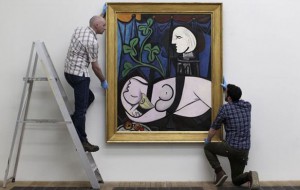
Jackson Pollock's "No.5, 1948" (1948) is, according to Wikipedia, the
most expensive painting in history.
Then there were the tales of financial woe, from the impact that the economic downturn has had on museums (more) to artists looking to be fairly compensated for their work in museums.
Some bloggers looked at artists who thrive in the capitalist system, others sought out alternative economies, including one Chicago-based research institute (InCUBATE) that critically examines models for arts funding, and the Exhibition & Free Store in New York, which sought to “demonstrate the value of free art, free imagination, free form, and free rewards.”
The role of the arts administrator was raised by Tracy Candido, who reminded us, “I am an arts administrator, which is arguably the second invisible position in line behind the artist” and Richard McCoy wrote about the question of value from an art conservator’s point of view.
Julia Steinmetz took a different approach to the question of art’s value and cast her net into the body of Adrian Piper’s work to suggest that “art’s value is its capacity to direct our attention to a particular object, image, sound, environment, or situation.”
Among the key posts of the last few months, there were numerous interviews that focused on economics in different ways, including:
- a video chat with Jackie Battenfield, whose first book The Artist’s Guide: How to Make a Living Doing What You Love is a practical reference book that she wished she had when she began her own art career;
- a Q&A with David A. Ross, former director of the Whitney and SFMOMA, who offers his opinion on art’s economic future;
- Arnold Lehman, director of the Brooklyn Museum, spoke about the financial strain on major institutions;
- Dublin-based artist Seoidín O’Sullivan, explained her interest in helping communities feel empowered and take “ownership and responsibility in and for their localities”;
- Bjøernstjerne Christiansen of SUPERFLEX, who addressed the Danish trio’s critique of (doomed) economic systems; and
- and New York $treet Artist$ Enjoy Banking, who plastered the city with fanciful economic messages like “Enjoy Stimulus Package.”
Finally, we looked at the state of federal arts funding by the numbers and then spoke to the House Arts Caucus co-chairs about the state of federal funds for the arts.
For future reading and some hot topics in the news related to Art+Economics, try these:
- LA Times art critic Christopher Knight explores the merry-go-round of museums that deaccession art to buy more art and then change their minds about what they should be buying;
- Felix Salmon, writing for The Atlantic, thinks that if the federal government is serious about stimulating the economy, it should give out some money to its poorest citizens, artists, since “Arts spending is fantastic at creating employment: for every $30,000 or so spent on the arts, one more person gets a job, compared with about $1 million if you’re building a road or hospital”;
- the US House increased arts and humanities funding, including an additional 9.7% or $15 million increase from this year’s budget for the National Endowment for the Arts (NEA);
- New York gallerist and blogger Ed Winkleman has written a brand new book How to Start and Run a Commercial Art Gallery–it goes on sale tomorrow (Tues., July 14)–which promises to be a comprehensive guide for those eager to start their own gallery; and
- a Boston-based artist Geoff Hargadon has created, CASH FOR YOUR WARHOL website, for those who want to dispose of their Warhols quickly. He explained to Artinfo that he has received mixed reactions: “I have received a lot of calls, most of them hang-ups (curiosity?), but a few have probably been real. I haven’t returned the calls yet cause I don’t know what to say to them quite yet. Would I buy a Warhol from them? Sure, but I haven’t figured out the pricing thing.”
Arts Stimulus Funding & the Art Economy Part 2: Talking to the House Arts Caucus Co-Chairs

Rep. Louise Slaughter speaks about the economic and employment impact of the arts and music industry on March 26, 2009 (via the Education and Labor Committee's YouTube channel).
A few months ago, I went to the Bronx for a studio visit with an accomplished artist, John Fekner, whose personal brand of street graphics helped define a tumultuous era in New York’s cultural life in the late 1970s and early 80s. He explained to me something that people of my generation may not remember, namely that in the early 1980s federal funds for the arts quickly dried up and countless arts programs went into crisis and eventually closed their doors. It was a difficult time, he said, and the decline in federal funding seemed to continue until the mid-1990s, when federal arts funding became a lightning rod issue as the ICA’s exhibition of Robert Mapplethorpe photography became the poster child for an art establishment that reputedly didn’t represent the values of middle-class Americans. The resulting controversy made the federal agency that allocates federal arts money, the National Endowment of the Arts (NEA), a target for national disdain.
If the late 1990s were the nadir of federal arts funding in America (funding hit an all-time low of $97.6 million in 2000) since the turn of this century, the numbers have started to creep up. This year, the NEA received $155 million in funding, with an additional $50 million as part of President Obama’s stimulus plan.
But these small victories are not easy ones for the arts community. Fortunately, the arts sector has two champions in Congress who co-chair the House Arts Caucus, Rep. Louise Slaughter (D-NY) and Rep. Todd Russell Platts (R-PA), both of whom I spoke to separately via phone about the state of federal arts funding today.
A longtime art advocate and a powerful voice in Congress, Rep. Slaughter of Western New York mentioned that while President Ronald Reagan “zeroed out arts funding,” it was also the period when the House Arts Caucus was established. “The Mapplethorpe controversy was a major problem in the 1990s and in 1994, we had people who were being elected to Congress to kill the NEA,” she explains. “They thought it was decadent and didn’t fit their pattern of decency.”
After the turmoil and culture wars of the 1990s, things changed after the 1999 elections. According to Rep. Slaughter: “[Arts funding] did better under President Bush and now with President Obama, we have a more sympathetic ear.”
Arts Stimulus Funding & the Art Economy Part 1: By the Numbers

President Obama, with Vice President Joseph R. Biden Jr., signing the $787 billion stimulus bill at the Denver Museum of Nature and Science in February. (via NYTimes.com, photo by Ruth Fremson/The New York Times)
Talking about federal arts funding in America can be very confusing because of the many facts and figures. So, in an effort to understand the current and historic levels of federal funds that artists of all types have enjoyed, and to better understand the economic impact of the arts in America, I have compiled the following data from online sources for Part 1 of this two-part series. Part 2 is an interview with both Congressional Arts Caucus Co-Chairs, Rep. Louise Slaughter (D-NY) and Rep. Todd Russell Platts (R-PA) about federal funding for the arts, and will post on Thursday.
STIMULUS ARTS FUNDING TODAY
Current funding for the National Endowment of the Arts (NEA): $155 million
2009 Stimulus Bill
American Recovery and Reinvestment Act of 2009 (aka 2009 Stimulus Bill): $787 billion
Arts portion of the Stimulus Bill: $50 million (0.006%)
- 40% for state & regional arts organizations
- 60% to arts projects competing for NEA grants
Other arts-related funding in the Stimulus Bill:
- $150 million for infrastructure repairs at the Smithsonian
What the Arts Does For America Economically (via Americans for the Arts)
- There are approximately 100,000 nonprofit arts organizations in America, which spend $63.1 billion annually.
- There are more full-time jobs (incl. accountants, designers, plumbers, union workers & engineers) supported by the nonprofit arts organizations than are in accounting, public safety officers, even lawyers and just slightly fewer than elementary school teachers.
- America’s nonprofit arts & culture industry generates $166.2 billion economic activity annually, including 5.7 million jobs, generating $29.6 billion in government revenue, of which $12.6 billion is federal revenue.
The value of didactic art and the gift economy—from object ownership to object affiliation

Anti-copyright graphic on Latin-American Solidarity, by the Beehive Collective (http://www.beehivecollective.org)
There is quite a tradition around visualizing information that reaches beyond the more familiar pie charts and quantifications used in science and commerce, dealing with the communication of complex thought and circumstance. Here’s a small sampling: Pioneer Otto Neurath developed a pictorial language to aid education. Both Alfred Barr and Fluxus founder George Maciunas mapped their art worlds. Graphic designer Edward Tufte coined the term “cognitive art.” Artist Mark Lombardi was an early proponent in the arts; of a younger generation, Ashley Hunt crosses between art and activism, and the Beehive Collective explicitly produces non-art, activist works. Socially conscious graphic designers populate and run a number of firms worldwide, for example Piece Studio in Baltimore, creating edgy products like the Good Sheet.
Be it termed art or design, created independently, on spec, or for a client, what is produced is intended to make a cognitive impact by mediating complexity. That intent can be termed didactic, and as such it is much maligned in visual arts discourse, at its worst as boring indoctrination that neglects formal concerns and fails to transcend issues of the day. Looking at the works linked above, it should be clear that those criticisms don’t need to apply. I would love to reclaim the didactic for the arts, as part of their range. Didactic refers to the art of teaching. In conservative terms, teaching may be framed as authoritative instruction, perpetuating canons and control, but progressive concepts of education center on a give-and-take that supports critical thinking—the capability to evaluate provocations and propositions in context.
Why the resistance, then? Isn’t the art world largely progressive? Should provocative, didactic work not be supported, particularly now? Cognitive linguist George Lakoff holds that US liberals tend to fund down by aiding those who can’t help themselves and conservatives fund up in support of preferred ideological infrastructures. That leaves liberal US intellectuals and artists in a bit of a pickle. While they certainly can help themselves, their capacity to help create a more just and equitable society does not receive the extra support it could.

The opening screen for “The Story of Stuff,” sponsored by Tides Foundation and Funders Workgroup for Sustainable Production and Consumption (http://www.storyofstuff.com)
A project that was able to gain some support, The Story of Stuff, seems to be a success. This is work that wants to be given away, distributed freely. We have the technology, a large and growing audience has access to it, but how can we arrive at schemes to fund the creation of this work? We need improved models of state support, new collective and entrepreneurial models and appropriate forms of sponsorship. Mr. Landesman might want to consider creating a visual think tank—maybe starting with a funding category for cognitive arts. Collective and entrepreneurial models are under discussion around the world. As I am writing this, an Artist Run Credit League is getting ready to launch in Chicago.
Interview with Jackie Battenfield
As our Flash Points topic of Art and Economics comes to a close, I sat down and spoke with Jackie Battenfield, whose first book The Artist’s Guide: How to Make a Living Doing What You Love was just published.
Jackie has supported herself from art sales for over twenty years and currently teaches career development at Creative Capital and Columbia University, helping artists flourish and sustain their creative practice while focusing on the professional skills needed to face the challenges and frustrations that all encounter in their careers. The Artist’s Guide presents valuable tactics that Jackie first learned head-on nearly 25 years ago as the founder of Brooklyn’s Rotunda Gallery, and taught for 15 years as the facilitator to the Bronx Museum of the Arts’ AIM (Artist in the Marketplace) program. The guide offers many lessons that most artists (including myself) never even heard of in an arts program—from writing a proper artist statement, to planning budgets, to time management and exhibition negotiation.
Jackie will attend a reception and signing for The Artist’s Guide on Wednesday (July 1) at the Bronx Museum of the Arts, from 5:30-7:30pm. Click here for more information.