Letter from London: War(hol)! What is he good for?

While the prospect of yet another Andy Warhol exhibition will be met by most gallery-goers with an indifferent shrug, Other Voices, Other Rooms, the new show at the Hayward Gallery, attempts to illuminate “lesser-known” aspects of the artist’s output–namely his forays into television, music production, filmmaking, album sleeve design and photography. The poster outside the gallery inventories the exhibition’s entire contents—well over 300 objects in total—in blaring neon caps. I defy anyone to read the legend for 33 Photobooth Photographs without feeling their will to live shrivel away.
Maybe it’s too cynical to extrapolate from the show’s paucity of well-known material an inability to secure significant loans (there are only five paintings). After all, the show trumpets its stone-turning analysis of the minutiae of the artist’s works on all of its advertising (“Think You Know Him? Think Again” teases the strapline on the posters, underneath a not-very-intriguing Polaroid self-portrait with a rubber skull) and claims to “shed new light” on an artist whose works seem to bounce between museums on a permanent basis. But the show itself–three large rooms whose curatorial conceits breathlessly make up for some very mediocre work (a star-spangled enclosure houses over forty individual TV screens showing his mind-numbing cable TV shows made between 1979 and 1987)–misses more than it hits, and is a reminder that greater exposure doesn’t necessarily mean greater understanding.
There are few artists with a stronger and more tenacious hold on the public imagination than Andy Warhol, but the more you see him (in mugs, t-shirts, mousemats, tattoos, interior design, greetings cards and, of course, Hollywood), the less you actually know him. His ubiquity has allowed myths to grow like mold on the surfaces of his paintings: Andy the camp Pied Piper, facetious and nasal, ready with an acid put-down; the user of losers. The everything-counts free-for-all of the exhibition implies a Midas touch that Warhol palpably didn’t possess. Any exhibition that features both a series of electric chair screenprints and a videoed performance of Duran Duran in their cocksure heyday can’t help but feel lopsided. The juxtaposition serves merely to limn the shape of Warhol’s visionary talents: at its best, his art is one of a finessed poise, leavened by a post-Surrealist acceptance of the happy accident–what Dave Hickey calls “exactly wrong.” The worst Warhols are a lapse in concentration, a falling-back on the haunches of his own myth; the best let things happen in an extremely concentrated, extremely controlled way.
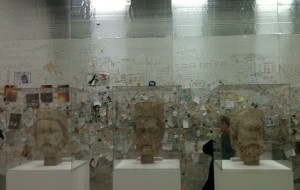
Like Francis Bacon (whose retrospective happens to coincide at Tate Britain), Warhol’s public statements are a kind of pantomime narcissism some distance away from his real self. In both shows, biographical minutiae are given pride of place. By far the most popular room in the Bacon show is the display of minor ephemera–letters, scribblings, drawings, art books and photographs–that act like the preserved shinbones of saints in Catholic churches. In the Warhol show, the crowds around the glassed-in Time Capsule (scatterings of invites, letters and snapshots) were three people deep. Yet for all the media-friendliness of both artists, and their willingness to pad out articles with a juicy bit of misanthropy, they share a sensibility that is at once disinterested and profoundly moral. In their art, modern horror is framed in fields of affectless color, serialized and blanched of emotional meaning. And for both, the artist is a smokescreen for the art, a reflection in the glass of a screen or a painting.
Letter from London: God Save McQueen!

British artist Steve McQueen’s current feature film, Hunger, has received pretty much universally positive reviews. Tracing the last six weeks of the life of Bobby Sands, the IRA hunger striker imprisoned in the Maze prison near Belfast in 1981, Hunger is a film that has sent journalists clamoring for synonyms for “harrowing” and “bleak.” The first notable thing about the publicity for the film is that his name isn’t suffixed by “not that Steve McQueen” on the posters dotted around the London Underground (he’s high profile enough not to need that). The second is that it forms part of what might be considered the wearing-down of barriers between mainstream cinema and video art.
The relationship between artists and the cinematic mainstream is one–until recently–with a relatively unsteady history. Cindy Sherman’s 1997 Office Killer was a campy extrapolation of the artist’s work in the 90s, all high-key color and shlocky gore. Larry Clark’s films, on the other hand (Kids, Bully, Ken Park) operate in symbiotic relationship with his photography, exploring similar territory of teenage sexuality and territorial awareness. They are defiantly outside the conventional Hollywood aesthetic, despite having undoubted influence on it. John Waters has similarly flickered between broad and narrow audiences, even featuring Cindy Sherman as herself in his joyous Pecker from 1998.
Video art itself has taken on an increasingly high-gloss approach over its short history. Bill Viola’s somewhat portentous video installations have harnessed the slick special effects of Spielbergian fantasy to hugely popular effect. And Rodney Graham’s brilliant deadpan films, like 1997’s Vexation Island, replay Hollywood cliché in its own cinematic vernacular, fusing Beckett and the historical epic in a hilarious and mesmerizing fashion.
Arguably, without Julian Schnabel’s unprecedented rise into mainstream cinematic culture with 2007’s The Diving Bell and the Butterfly, McQueen’s Hunger would have had difficulty finding a similar foothold. Schnabel’s widely acclaimed films have lent some retroactive luster to his critically frowned-upon smashed-plate paintings of the 1980s (Basquiat and Before Night Falls gathered critical steam before last year’s four Oscar nominations for Diving Bell).
The commercial and critical success McQueen’s film seems to be garnering could have positive impact on his work too. Although an accomplished and widely-acclaimed artist in his own right (he was the 1999 winner of the Turner Prize and will represent Britain in the Venice Biennale next year), McQueen’s ongoing attempt to have his For Queen and Country project–postage stamps depicting British servicemen and women killed in Iraq–put into circulation by the Royal Mail has so far been turned down. The project, which has already gone on display in Manchester and London and is now heading to Edinburgh, is on par with his stark and unflinching vision in Hunger. Both are assertions of the need for political engagement in public discourse, and are explorations into relatively uncharted artistic territory; both cinema and art could gain from Hunger’s success.
Letter from London: The Turbine Hall

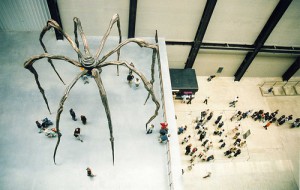
Tate Modern’s Turbine Hall commissions have set a certain standard for scale in art making at a time when many artists have retreated from the big, brash statement towards the self-effacing, the handmade, the infra-mince. The hall itself is the former home of the electricity generators, and it’s as soaring and belittling as the nave of a Gothic cathedral. Linking as it does all of the floors of the galleries, it functions both as prologue and nervous system for the entire permanent collection. You see it everywhere. Kids skid down its vast concrete tongue on wheeled sneakers, people take pictures of their babies wriggling on the floor, old couples sneak in sandwiches and hide behind the columns. As locus for what Tate Modern means for art, the Turbine Hall says it all: open, casual, self-consciously relaxed. The Turbine Hall commissions set the scene and provide a definition of contemporary art for the thousands of visitors that leans somewhat on the post-Sensation notion that art should be big, performative, demonstrative. It’s that reliance on overwhelming scale, gross-out nastiness, and audience participation that draws the crowds.
It’s instructive to compare this space with MoMA’s atrium. Both serve as nave-equivalents that spin off into quieter areas of contemplation, but it’s notable that MoMA’s pristine atrium sets a hushed and somewhat churchy tone that carries through in the installation of works (canonical and chronological), while the Turbine Hall suggests an irreverence and friendliness that is picked up in the whimsical installations of art and dayglo plastic chairs in the café. Both approaches have their faults: at MoMA, the tasteful neatness of Taniguchi’s galleries chastises messiness like a prissy primary school teacher (Philip Guston looks like an example to the class of what not to do, children); at Tate Modern, cleanliness and tidiness looks mean-spirited and non-participatory–Donald Judd’s brass box is smeared with fingerprints, the square guy who won’t dance at the party.
By its nature, the Turbine Hall demands the showboat, but the most effective of its commissions have been ones that challenge rather than comply with its bullish vastness. Bruce Nauman’s installation in 2004, Raw Materials, consisted of a number of speakers set along the walls of the space, which played snippets of sound from his back catalogue, a brilliant play on language’s ability to both unite and divide. Juan Muñoz’s Double Bind set false floors into the hall to mine areas of theatricality and illusionism with unsettling effect. What distinguishes these works is that the space provided a frame for a continuation of themes within the artists’ work as a whole. The setting serves both artists’ concerns with the slipperiness of language and the theatricality of art. Other artists haven’t fared as well, their works either compromised by the space (Rachel Whiteread’s Embankment, stacks of cast cardboard boxes that lacked the emotional punch a smaller space would have provided) or flawed by choosing to square up to its epic scale.
The current occupant, Dominique Gonzalez-Foerster’s TH.2058, is a good example of the latter. Gigantic replicas of well-known works of public sculpture–by Louise Bourgeois, Alexander Calder, Henry Moore, Nauman, Maurizio Cattelan and Claes Oldenburg–squat over the end of the hall, whose floor is occupied by rows of blue and yellow metal bunk beds with works of apocalyptic fiction scattered on them (Sebald, Ballard, Huxley). Gonzalez-Foerster’s narrative (patiently explained in the wall labels) is that, fifty years into the future, endless rain will cause public sculptures to grow and become Godzilla-like monsters that will need to be contained inside. This is a conceit the artist explored in reduced scale in her Sculpture Munster project last year, but here it looks as though the space has won again. The apocalyptic narrative looks less convincing in the context of global economic meltdown, and the works feels like a weak art in-joke, a flailing attempt to draw attention. Paired with the outstanding show of late Rothko paintings the installation looks like artistic endgame: a self-regarding gambit for cheap laughs versus a hard-won exploration of things beyond experience. It felt like an indictment, a real challenge.
Letter from London: The Contemporary Portrait

It might seem a bit old-fashioned to bemoan the demise of the portrait tradition in contemporary art, but looking at a new show of Renaissance portraits, and having read a short article on Marlene Dumas describing her as “the anti-portraitist,” I’ve been thinking about how, and if, the portrait tendency persists in art now. The National Gallery exhibition, Renaissance Faces, is a survey of portraits and their functions, from Van Eyck’s Arnolfini Portrait, with its evocation of a specific time and place (”Van Eyck Was Here” is scrawled in florid cursive on the back wall of the painting’s room, above the artist’s reflection in a convex mirror) to Raphael’s Pope Julius II, brooding on his political misfortunes, one hand gripping his throne as though fearful of losing it.
What connects these portraits is their ability to reconstitute physical presence through the stuff of paint. Portraiture is less a genre than a function of art itself. Pliny’s legendary origin of painting–the tracing on a cave wall of the projected silhouette of the departing soldier by her weeping lover–is tied into the notion that art can stand in for a physical absence. Both the physical and the visual–the temporal as well as spatial–presence is implied in the meticulousness of the painted portrait, a meticulousness bound up in the shortness of life expectancy in the Renaissance and the function of portraits as diplomatic tokens. What came persistently to mind while looking at the show was Dave Hickey’s passage in Air Guitar about Scott Burton. Hickey attempts to recall his late friend’s presence through images, and comes to this fascinating conclusion:
“I could have…looked at a photograph, of course, but photographs are nailed in the moment of their making, and when the subject is dead, this distance from the present only reminds you of that. I would have preferred an image that reminded me, persuasively, physically, that Scott had once been alive…That’s what painting used to do – what only painting can do – and does no longer, and this seemed a pity, since regardless of fashions in image-making, we continue to die at an alarming rate.”
A portrait is the visualization of presence, not of likeness, and while the rather conservative likeness tradition continues apace, and while there are artists (like Elizabeth Peyton, Dumas, and Luc Tuymans) who engage with the tradition to a certain extent, they present the image as image, not as a conceptualization of presence and absence. Lucian Freud’s muscular impasto portraits perpetuate the tradition of the great 17th-century portraitists (Velazquez, Rubens, and Rembrandt), but are locked into a groove of representation that is resolutely ahistorical.
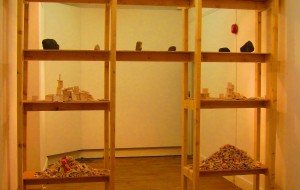
Perhaps the closest contemporary art has got to the fundamentals of portraiture is in the work of Felix Gonzalez-Torres. His 1991 Portrait of Ross in LA is, ostensibly, a pile of brightly wrapped candies piled in the corner of the gallery, to which viewers can help themselves. Replenished daily by the gallery, the candy stack weighs 175lbs, the weight at full health of Gonzalez-Torres’ deceased lover, Ross. What this work has in common with the tradition of the painted portrait is in its realization of the intertwining of the physical and visual that characterizes our experiences of other people. It’s a condition of the persistence of an idea (a sort of post-Warhol slippage between subject and form) that this function has been sidelined in contemporary art practice. It’s what sends a shot up your spine when you see Van Eyck reflected in the mirror, or consider that the painter “was here,” exactly where you stand as you read it, or feel the sweetness in your mouth long after you’ve left the gallery.
Letter from London: Serra and Irwin

Amid the noise and anxiety of the art fairs (read my review of Scope here), two significant exhibitions by major US artists have opened simultaneously in London: Richard Serra at Gagosian and Robert Irwin at White Cube. The two artists share a number of similarities: California-born (Irwin in 1928, Serra in 1939), emerging from and expanding upon the principles of minimalist sculpture, and experiential in approach (and therefore practically unreproducible in photographs; Irwin famously banned photos of his work for a large part of his career). Each artist has attracted some outstanding writers to their defense: Kirk Varnedoe in Pictures of Nothing embarks on an extended consideration of Serra’s steel ellipses; Lawrence Weschler’s book Seeing is Forgetting the Name of the Thing One Sees traces Irwin’s career to compelling and hugely influential effect. Both shows feel like reminders—to those browbeaten by the last-days-of-Rome extravagance of the art fair crowd—of why contemporary art matters.
Serra’s Gagosian show (for which the floor of the gallery had to be reinforced) consists of four vast steel sculptures: two russet Cor-Ten ellipses, a flat steel ‘wall,’ mottled with rust, and a huge steel ‘maze’ that fills the gallery like a beached whale. The ‘maze’ (entitled Open Ended) sends the viewer through alternately widening and narrowing passages, the walls bulging and contracting like the lungs of a dinosaur. In Serra’s work, viewers are forced into a looping movement that is reminiscent of the artist’s earliest performance works that grew out of Jackson Pollock’s performative abstraction. Yet Serra’s sculptures don’t require any prior knowledge of the artist’s work, or of any artist’s work; the experience itself, a sort of industrial sublime, is accessible and even generous. Standing under a sheet of steel that bulges above your head like a tidal wave, you feel the smallness and the frailty of your own body in a way that thrusts you back to childhood experiences of cliff edges, rollercoasters, and thunderstorms. It’s a primal experience that lights up the dark parts of your memory. I find it amazing that Serra hasn’t yet been, to my knowledge, invited to display work in Tate Modern’s Turbine Hall. Of all artists, his sheets of weathered metal would sit well in its stark factory interior.
Irwin’s show at White Cube is, incredibly, the 80-year-old artist’s first solo exhibition in the UK. Upstairs, two square black lacquered panels on opposite walls of the gallery are separated by numerous ceiling-high sheets of scrim in wooden frames. On each layer, the shape of the square is repeated, so that a kind of rectangular black tunnel appears, suspended in the middle of the space. Walking between the layers, you feel weightless, buoyant; other visitors slip in and out of your vision, so that your eyes and brain get knocked out of sync. It’s like Kazimir Malevich’s Black Square turned three-dimensional, as insubstantial as fog and equally as disorienting. Downstairs, three adjacent walls of the gallery are filled floor-to-ceiling with arrangements of pairs of white fluorescent tubes, set in various combinations of right angles (again apparently an extrapolation of early Modernist utopian art, here recalling El Lissitzky). The piece gives light a physical presence, energizing the space between the walls. Here, as in all of Irwin’s best-known works, the pieces are correctives to indiscriminate looking; the one thing you’re considering is your perception of the piece, not the piece itself.
What both Serra and Irwin manage to do in these shows is to connect our senses of perception inextricably. Contemporary culture’s overabundance of visual data creates a disconnection between looking and thinking–and between looking and seeing. I left both shows feeling enlivened and enlightened, faith restored.
Letter From London: A Contemporary Timeline

At a recent trip to Tate Modern I spent some time looking closely at something I’d regularly passed by without really thinking about it. On two floors of the museum, by the entrances to the four galleries of permanent holdings, there is a timeline of twentieth-century art, written in the cursive script reminiscent of Tate’s chosen font (a round-headed sans serif of implicit, somewhat patronizing accessibility). The timeline, designed by Sara Fanelli as part of their UBS-sponsored 2006 rehang, underscores Tate Modern’s (highly successful) public profile as a fun day out with a bit of weird art thrown in. The timeline intersperses the names of art movements in wonky caps with the names of artists associated with them, clustered around like moths. The thinking is that the public will respond favorably to the cutesily handmade (its ubiquity in branding is remarkable), which can make the apparently unpalatable (the history of conceptual photography, or a faceless global conglomerate) seem sweet and likeable. This notion is carried through in Tate’s identity in wall texts and advertising.
What’s interesting, though, is the notion of creating a Barr-style timeline for the history of postmodern/contemporary art, something that contemporary art historians might balk at because of its Darwinian association of art as a series of improvements on the past. This remains entrenched in survey courses in western art history, which sees the high Renaissance as a lofty peak, with pre- and post-Renaissance art as the slopes leading up and down.
Teaching contemporary art as art history, then, presents certain problems: how do we go about constructing a history of the recent past? Are we in danger of being token in our selection of artists outside of the conventional framework of western art? Clearly the Tate Modern-style approach is too overly redolent of established histories of art (it may be appropriate for more obviously developmental periods, though, such as Archaic, Classical and Hellenistic sculpture). But as educators, what method can we use to make sense of art of, say, the last 50 years for the benefit of students? In general, I tend to lean toward the unapologetically idiosyncratic. This charming “timeline” by James Elkins from Stories of Art is a good example of a defiantly non-linear “history of art” that might make more sense for art of the recent past.
I’d love to hear how other educators might consider approaching this idea. Who’s in and who’s out - and why?
Letter From London: Bacon Movies

The current (brilliant) retrospective of Francis Bacon at Tate Britain ends with a montage of filmed interviews the artist gave, largely with David Sylvester as part of his extended sequence of interviews with the artist, which drew me back to thinking about artists on film in the pre-Art:21 days. Bacon’s televisual presence gives, I think, a greater understanding of his work as self-reflexive and theatrical in a way that isn’t often discussed in the extensive writing about the artist. Extracts from a 1985 interview with Bacon reveal him to be acutely aware of his own (to him negligible) stature as an artist, and he sits in the soon-to-be-defunct Colony Room in Soho looking and sounding every inch the disdainful nihilist/hedonist of popular legend, in his boho scarf and geography-teacher jacket. What’s unusual about Bacon in these films is his slightly camp self-awareness. In print his many aphorisms look viciously misanthropic; on film, there’s something avuncular, even cuddly, about his resting-actor hamminess and pantomime pessimism. A famous quote of Bacon’s often used to illustrate his supposed gruesomeness (“I’ve always hoped in a sense to be able to paint the mouth like Monet painted a sunset”) is somewhat sheepishly amended (in a compelling early Sylvester interview in 1966) with “I’d like to paint a smile too, but I can’t quite get it right.”
By contrast, Bacon’s near-contemporary (and kindred spirit, in a way) Willem de Kooning, comes off as somewhat awkward, uneasy in front of the camera, describing himself as a “country dumpling” in Hans Namuth’s 1964 film. Namuth’s 1951 film of Jackson Pollock remains instructive, not as intended (to demystify or perhaps justify to the viewing public the artist’s ‘dripping’ technique), but as epitaph to a division between public and private personas. Pollock stomps around, frowning, both aware of the camera and apparently fearful of how he’ll be seen, like an actor concentrating on remembering his lines but terrified he’ll mess them up.
Andy Warhol’s appearances on television can be seen (as they are in the current retrospective of his work at the Hayward Gallery) as part of his body of work as a whole. Answering a sequence of questions in a 1964 interview, his responses remain as curt and affectless (and likewise studiedly so–he gives a little smirk at one point) as his paintings, sculptures, films and photographs. In looking at these films in sequence, there’s a sense of a relationship between art and its audience undergoing a subtle shift, a sort of coming of age, not to be rewound.
Letter From London: Protest Too Much

Whichever candidate succeeds this November, there will be a discernible effect in art. The last eight years have seen a resurgence of politically motivated art comparable to that produced during and after the Vietnam War. Characterizing the nature of art made now is, of course, a quixotic and thankless task. Contemporary art is far too multifarious and globally produced, experienced, and consumed to be bracketed into an “ism.” However, an art born of outrage revitalizing art’s shock tactics has emerged within the last few years, and may be seeing its twilight in the run up to a new administration.
Political outrage can blast the subtlety out of artmaking, and not all attempts to articulate it have been successful. Too often, real events throw artists’ discontent into stark relief. Thomas Hirschhorn’s Superficial Engagement at Barbara Gladstone in 2005, nail-studded, gnarly, and startling, looked mute and minor in relation to the Abu Ghraib revelations. A new show of work by veteran minimalist and performance artist Robert Morris at Spruth Magers in London has a pre-emptively archaic look to it: all inverted American flags, big black eagles, and screaming skulls in relief: theatrical, even camp in its outrage.
However, some works have addressed contemporary history with a lucidity and thoughtfulness that has asserted the importance of art as a forum for non-mainstream discussion. Mark Wallinger’s State Britain installation at Tate Britain was a rare example of a poised and poetic response to the curtailing of civil liberties that have taken place during the Iraq war, and is one of a number of more oblique responses to contemporary events that drag the discussion into the realm of art without compromising their efficacy as works of art (Alfredo Jaar’s and An-My Lê’s works operate on similar levels). And Maypole (Take No Prisoners) (2007), by fellow Protest artist Nancy Spero, might be this generation’s Guernica: a howl of pain and anger distilled into a direct visual language that feeds into a historical continuum of the human cost of war—the visual articulation of horrified disbelief. Graphically simple paintings on paper of human heads–screeching, wailing, vomiting–radiate suspended from blood-red threads around a maypole, conflating historical circularity (the pole itself recalls the grotesque folk ritual dramatised in The Wicker Man), the theatrics of warfare, and raw human emotion.
The example of Spero is, in fact, instructive; the best political art has always been able to be comprehended in mass-media contexts. It’s significant that Goya’s Third of May and Gericault’s Raft of the Medusa–both produced on the cusp of the mass-distribution period that produced Guernica, a painting that replicates the striations of newsprint–retain their visual currency in political cartoons. Conversely, successful photographic icons of wartime have a pictorial quality that links them to the heritage of painted protest. Staged propaganda photographs from the American Civil War and photographs of atrocities from Abu Ghraib share a compositional quality that taps into a subconscious compositional sympathy (Art21 guest blogger Emily Liebert has written succinctly and fascinatingly on the role of photography in wartime here).
The revival of protest in painting has re-engaged the connection between painted mark and emotional intensity muffled by the generation of post-Richter distanced photorealists. Increasing mistrust of mainstream media coverage and the euphemistic language of contemporary conflict may turn out to be art’s gain; we may return to it as the basic language of human understanding and communication. Whether or not that continues to be the case will, in part, depend upon what takes place in six weeks’ time.
Letter from London: Art During Wartime

All the talk around the potential sale of two of the most important paintings in British collections (Titian’s Diana and Actaeon and Diana and Callisto) has generated more interest than usual in the public value of works of art, or the distinction, at least, between value and worth. That this debate is happening against the backdrop of crumbling financial institutions on the one hand and astronomical flashing of cash on the other makes the discussion all the more important now, underscoring the need for patient re-evaluation of art and its importance to the wider world.
With that in mind, a smaller Titian painting in the National Gallery, Noli me Tangere, has been drawing me back more and more in recent months. Titian was about 19 when he painted this; it’s small enough to be intended for private worship, and to be drowned out in proximity to larger and more celebrated Titians in its room (like this one). Against a backdrop of tumbling hills, farm buildings, scattered sheep and a rich melancholy Venetian sunset, Mary Magdalene reaches towards the recently-resurrected Christ. She’s just realized who he is and what’s happened, and tries to touch him; he bends away (his bent body, like an open parenthesis, imitated by the bend of the tree above), to demonstrate the need to focus on the spiritual rather than earthly, the soul and not the body. What seems to happen is that shape–a curve leaning away from a vertical, like a sprung bow–echoes across the shapes of the painting, like a chorus.
As a meditation on the nature of mortality, the painting is exemplary and that poignancy opened up its second life, during World War II, when the Blitz was ravaging the city (there are still ragged craters—bomb damage—on the sides of Tate Britain and the Victoria and Albert Museum). The National Gallery’s emergency plan was to ship its paintings to the Welsh countryside (contingency plans like this had been actioned by all the major institutions: the Parthenon Frieze spent most of the forties in the dank gloom of a disused tunnel in Aldwych tube station), where they sat in slate mines, gradually brought back one by one to the gallery. The first to return was Noli me Tangere, due to vociferous pressure from the public documented in newspapers of the time. A letter written to the London Times in January 1942 explained, “Because London’s face is scarred and bruised these days, we need more than ever to see beautiful things.”
So for the first month–with the exception of a small display of contemporary paintings–Noli me Tangere was the only painting in the National Gallery. For Londoners under constant threat of extinction from above, this small High Renaissance painting, produced as a display of virtuosity and ingenuity by a young artist on the make in the aristocratic circles of early 16th century Venice, contained an idea of transcendence that collapsed historical time and lived again at that moment. It might be worth reminding ourselves, especially now, that that’s what art is supposed to do.
Letter from London: Hirst Among Equals

Art gets into the national news in the UK in four ways. One: a publically funded institution decides to purchase something of apparent worthlessness (a ‘pile of bricks,’ a can of poo) with taxpayers’ money. Two: privately owned works of art on public display are put up for sale and the public is asked to help ‘save’ them through a national appeal. Three: the international auction price for a work of art reaches unprecedentedly astronomical heights. And now there’s a fourth: an artist decides to sidestep the gallery system altogether and sell new works directly at an auction house, leaving the dealers by the wayside.
Damien Hirst’s sale (titled ‘Beautiful Inside My Head Forever,’ like an exhibition), which takes place at Sotheby’s in London on Monday and Tuesday evening, is either the death-knell for the gallery system or a predictably unorthodox approach from an artist whose work is so unrepresentative of most contemporary art that it demands its own particular form of critical language. Hirst’s supporters reach for the Old Testament when defending his work, which is appropriate for an artist whose work makes apparently unironic reference to biblical parable (imagine discussing Tomma Abts or Kara Walker or even Matthew Barney in a similar way and you can see the point). The Golden Calf, the centerpiece of his Sotheby’s display, is practically an illustration of Aaron’s sacrilegious statue cast from the molten jewelery of the Israelites. Hirst’s work is more or less what it sounds like: a whole calf pickled in formaldehyde with golden hooves, horns, and a gold disc lodged in its forehead in a gold-plated vitrine atop a Carrara marble plinth. If that sounds like a prop from a Queen backstage party in the late 70s, it’s appropriate: ever since his diamond-studded skull (For The Love of God) and its accompanying security frenzy, Hirst has embraced the grandiloquent pretensions of his loyal supporters, the oligarchs and hedge-funders who are the only people not squeezed out of the bidding by his extraordinary price-tags (the relative paucity of significant Hirsts in public collections is testament to that). The appeal is obvious: you get what you pay for. Gold and diamonds equal expensive, death and mortality equal important themes, big art equals good art. Hirst’s prices have a perverse logic that would appeal to the dulled wits of the 19th century French salon who held that paintings of classical heroism and tragedy must be more important than still-lifes because they’re, like, big pictures about big stuff.
Hirst is still the (British) public’s go-to guy for the definition of modern art: a bit shocking, a bit gruesome, easy to describe in a few words (‘shark in a tank’ – try doing that with Martin Puryear), high-concept and high-gloss. For good or bad, he makes art of our time: iconic works that withstand the buffetings of international communication, able to retain their power across all information streams. Hirst’s art lives in the head as much as in the gallery, and for art to do that, at this moment in history, is an achievement in itself. And while his inverse snobbery is absurd and ill-founded (selling works at prices inaccessible to any museum’s acquisitions budget isn’t exactly sticking it to the man, however radical the implications of the sale), it’s true that Hirst is a genuinely popular and (in the best possible way) populist artist whose works are comprehensible to a far wider public than that of most of his contemporaries. Don’t get what the shark is about? Read the title: The Physical Impossibility of Death in the Mind of Someone Living. (This is not Untitled Number 243). The hope is that Hirst will become a gateway drug for viewers hankering after something more reflective and substantial (Paul Thek, Sol LeWitt, Joseph Beuys, or any number of other artists to whom Hirst owes a substantial debt). The fear is that most of his best work (and there is more than a handful) will be invisible to the public and turn into a series of one-liners from a bygone past, signifiers of mad wealth without a life beyond the funny pages.